
If you are building an off-grid cabin, converting a van into a tiny home, or trying to slash your terrifyingly high summer electric bill, there is only one HVAC system you should be looking at: The Ductless Mini Split.
Traditional central air conditioners and cheap window units use "single-stage" compressors. They have two modes: 100% ON or completely OFF. This results in massive electrical surges that destroy solar inverters and portable generators.
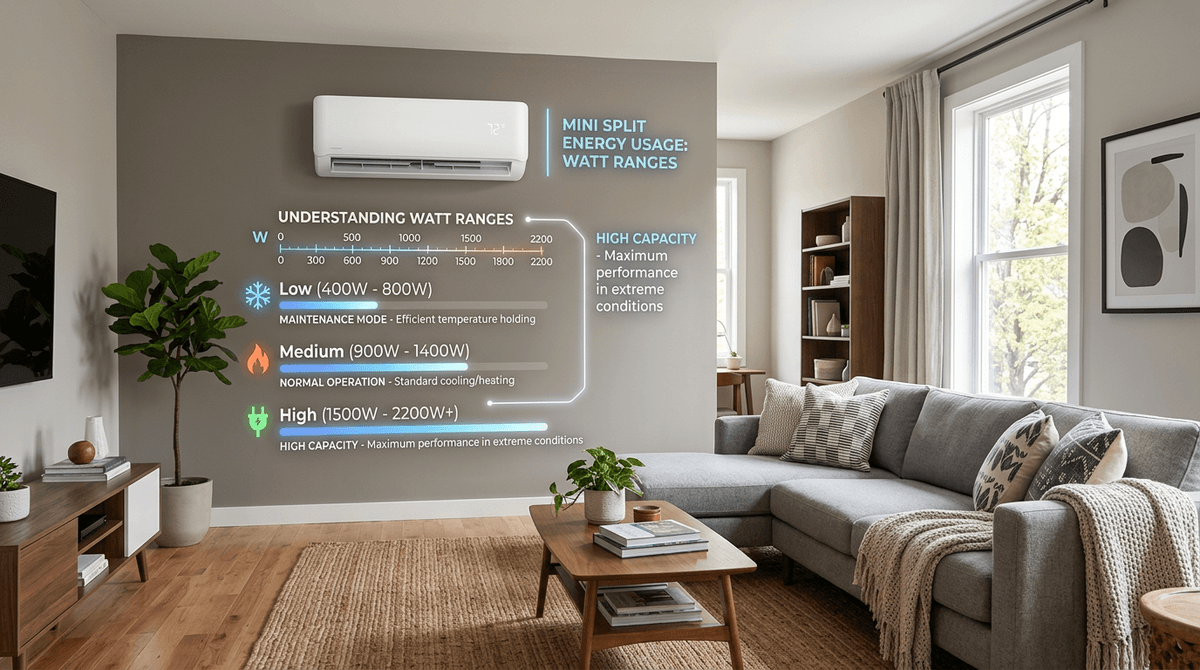
A Mini Split operates differently. It uses a variable-speed inverter compressor. Instead of blasting on and off, it ramps up slowly and runs continuously at low speeds to perfectly maintain the room temperature. This technology completely eliminates the startup surge and uses 30% to 50% less electricity than a traditional AC.
In this comprehensive guide, we will break down the exact wattage of Mini Splits by BTU size, explain why they are the holy grail of off-grid solar, and detail exactly what size generator you need to run them.
To model your specific mini split alongside your other household loads, use our free WattSizing Off-Grid Calculator.
The Quick Answer: Mini Split Power Draw
Mini Splits are incredibly efficient, but their exact power draw depends heavily on their BTU capacity and the outside temperature.
- Average Running Watts: Once the room reaches the target temperature, a standard 12,000 BTU (1-Ton) mini split will idle down and draw a mere 300 to 600 continuous watts to maintain the climate.
- Maximum Watts: If you turn the unit on when the room is 90°F, the compressor will ramp up to maximum speed to cool the room quickly, drawing 1,200 to 1,500 watts for the first hour.
- Starting (Surge) Watts: Because of the inverter technology, mini splits have virtually zero startup surge. The maximum running wattage is usually the highest wattage you will ever see.
Mini Split Wattage by BTU Size
Mini splits are sized by BTUs (British Thermal Units). They provide both Air Conditioning in the summer and Heat Pump heating in the winter.
Here is a realistic look at what different sizes of Mini Splits pull from your electrical panel:
| Mini Split Size (BTUs) | Minimum "Idle" Watts | Maximum Cooling Watts | Maximum Heating Watts | Voltage Required |
|---|---|---|---|---|
| 9,000 BTU (3/4 Ton) | 200 - 300 W | 700 - 900 W | 800 - 1,000 W | 120V or 240V |
| 12,000 BTU (1 Ton) | 300 - 400 W | 1,000 - 1,300 W | 1,200 - 1,500 W | 120V or 240V |
| 18,000 BTU (1.5 Ton) | 400 - 600 W | 1,400 - 1,800 W | 1,600 - 2,000 W | 240V |
| 24,000 BTU (2 Ton) | 600 - 800 W | 1,800 - 2,500 W | 2,200 - 3,000 W | 240V |
| 36,000 BTU (3 Ton) | 900 - 1,200 W | 2,800 - 3,800 W | 3,200 - 4,500 W | 240V |
Note: Heating mode almost always consumes slightly more maximum wattage than cooling mode. If you are sizing a generator for winter use, use the Maximum Heating Watts column.
Off-Grid Solar: The Holy Grail of Heating and Cooling
In the off-grid community, mini splits are universally praised. Before mini splits, running Air Conditioning on solar panels required a massive $20,000 battery bank and a 12,000-watt inverter capable of surviving the violent LRA (Locked Rotor Amps) surge of a central AC.
Because a 12,000 BTU mini split has no surge and idles at 400W, you can run it on a significantly smaller and cheaper solar setup.
Calculating Daily Watt-Hours (Wh):
Formula: (Average Running Watts × Hours Run) ÷ 1,000 = Daily kWh
Let's assume you run a 12,000 BTU Mini Split 24 hours a day in the summer. Because it idles down once the room is cool, its average continuous draw is roughly 400W.
400W × 24 Hours = 9,600 Wh (9.6 kWh) per day.
Sizing the Battery Bank
To safely provide 9.6 kWh of energy, you would need two 48V 100Ah Server-Rack Lithium batteries (which hold roughly 10 kWh of total energy).
Sizing the Solar Inverter
Because there is no surge, your inverter sizing is incredibly simple. If you have a 120V 12,000 BTU unit that maxes out at 1,300W, a basic 2,000W Pure Sine Wave Inverter will run it flawlessly.
What Size Generator Do I Need for a Mini Split?
Sizing a generator for a mini split is refreshingly easy compared to traditional air conditioners. You do not need to calculate massive 3x multipliers for starting surges. You simply need a generator that can handle the "Maximum Cooling/Heating Watts" plus whatever other appliances you want to run.
The Voltage Catch (120V vs 240V)
While the wattage is low, the voltage is critical.
- Most 9,000 and 12,000 BTU units are available in standard 120V models. These can be plugged into almost any portable inverter generator.
- Almost all 18,000 to 36,000 BTU units require 240V split-phase power. You must buy a heavy-duty 240V generator, even if the wattage is technically low enough for a smaller unit.
Generator Sizing Guidelines
- For a 120V 12k BTU Unit + Fridge: A small 2,500W to 3,500W Inverter Generator is the perfect size. It handles the 1,300W max draw of the mini split and leaves plenty of room for your refrigerator compressor to cycle.
- For a 240V 24k BTU Unit + Essentials: You need a 4,500W to 6,000W 240V Generator.
Worked Generator Example
You have a 12,000 BTU 120V Mini Split in your living room and you lose power.
- Mini Split (Max Draw: 1,300W / Surge: None)
- Refrigerator (Running: 200W / Surge: 1,200W)
- Starlink Internet & Lights (150W)
The Math:
Assume the fridge compressor surges while the Mini Split is running at maximum speed.
1,300W (Mini Split Max) + 1,200W (Fridge Surge) + 150W (Internet) = 2,650W Peak Load.
Add a 20% safety margin: 2,650W × 1.2 = 3,180W.
Recommendation: A 3,500W portable generator will safely power this setup all day long on just a few gallons of gas.
4 Tips to Maximize Mini Split Efficiency
- Never Turn It Off: This sounds counterintuitive, but the most efficient way to use a mini split is to set the thermostat to 72°F and leave it there 24/7. Let the inverter compressor idle at 300W. If you turn it off when you leave for work, the walls and furniture will heat up. When you get home, the unit will have to run at maximum speed (1,500W) for 3 hours to pull the heat out of the walls, wasting massive amounts of energy.
- Clean the Indoor Filters Bi-Weekly: Mini splits move a massive amount of air. The thin mesh filters inside the wall unit get clogged with dust rapidly. A clogged filter reduces airflow, forcing the compressor to ramp up its speed to compensate. Wash them in the sink every two weeks.
- Buy a High SEER Rating: SEER (Seasonal Energy Efficiency Ratio) is the holy grail metric. A cheap 17 SEER mini split will use significantly more electricity than a premium 24 SEER or 38 SEER unit from Mitsubishi or Pioneer. If you are off-grid, pay the extra money upfront for the highest SEER rating possible to save thousands on battery costs.
- Use "Dry" Mode in Humid Climates: If you live in Florida or Texas, the heat isn't the problem; the humidity is. By switching the mini split to "Dry Mode," it acts as a hyper-efficient dehumidifier. Dry air feels significantly cooler than humid air, allowing you to set the thermostat to 75°F instead of 70°F, saving immense amounts of electricity.
Frequently Asked Questions
Can I run a 12,000 BTU mini split on a 2,000W generator?
Yes, absolutely. Because a 12,000 BTU 120V unit maxes out around 1,300W and has no startup surge, a high-quality 2,000W inverter generator (like a Honda EU2200i) will run it flawlessly. Just be aware that you cannot run a microwave at the same time.
Do mini splits work for heating in the winter?
Yes! Mini splits are Heat Pumps. They can reverse their refrigerant flow to pull heat from the freezing outside air and pump it into your home. Modern "Hyper-Heat" models can provide 100% of their rated heating capacity even when the outside temperature is -15°F (-26°C).
Why doesn't my mini split turn on immediately?
If you change the mode from cooling to heating, or turn the unit on for the first time, it will often sit idle for 3 to 5 minutes before the compressor kicks on. This is a built-in safety delay to allow the refrigerant pressures to equalize, preventing compressor damage.
Conclusion
The Ductless Mini Split is arguably the most important HVAC invention of the last 30 years. By utilizing variable-speed inverter technology, it completely bypasses the massive electrical surges that plague traditional air conditioners. Whether you are sizing a portable generator for hurricane season or building a massive off-grid solar array, the mini split is the clear winner for home climate control.
Want to accurately size a generator or solar system for your mini split? Use our free Off-Grid & Backup Load Calculator to enter your exact BTU rating, add your refrigerator and lights, and get a precise sizing recommendation instantly.


