
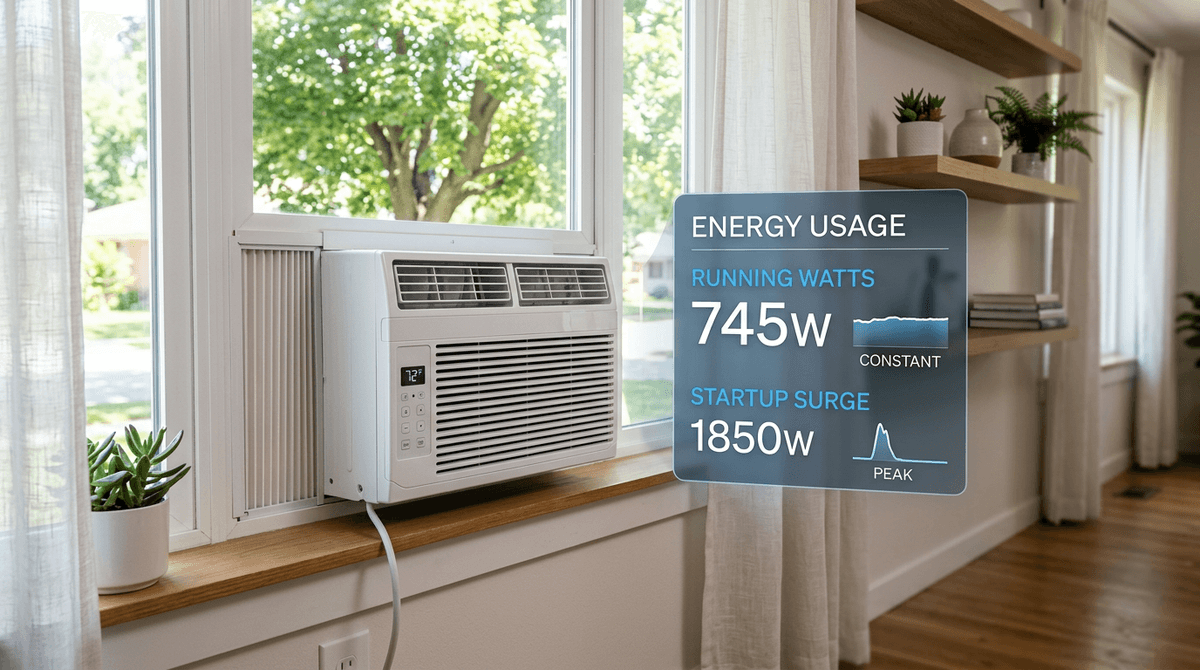
In RV use, startup surge and limited circuits matter more than nameplate running watts.
For full system planning, use the WattSizing Calculator.
Quick Answer
A window AC in RV setups usually draws 700-1,400 W running and may surge above 2,000 W at compressor start.
Detailed Explanation
RV electrical systems have tight limits on branch circuits and inverter output. Even efficient units can trip protection if startup current overlaps with microwave or water-heater loads.
See What Size Generator for RV Air Conditioner and How to Read Generator Specs Running vs Peak.
Watt Table
| RV Cooling Setup | Running Watts | Daily kWh |
|---|---|---|
| Compact RV unit | 650 - 900 W | 3 - 5.5 |
| Mid-size RV unit | 900 - 1,200 W | 4.5 - 7 |
| Hot-weather use | 1,100 - 1,400 W | 6 - 9 |
Calculation Example
1,050 W x 5.5 h/day = 5.78 kWh/day.
Tips
- Stagger high-draw appliances to avoid overlap.
- Use a soft-start module for smoother starts.
- Improve RV insulation and seal slide-outs.
- Pre-cool on shore power before battery mode.
FAQs
Will a 30A hookup run window AC reliably?
Usually yes for one AC plus light loads.
Why does AC trip inverter at startup?
Compressor surge exceeds short-term inverter peak.
Is rooftop AC always better than window AC in RV?
Not always; efficiency and fit vary by rig.
CTA
Match RV cooling load to shore, generator, and battery in the WattSizing Calculator.


