
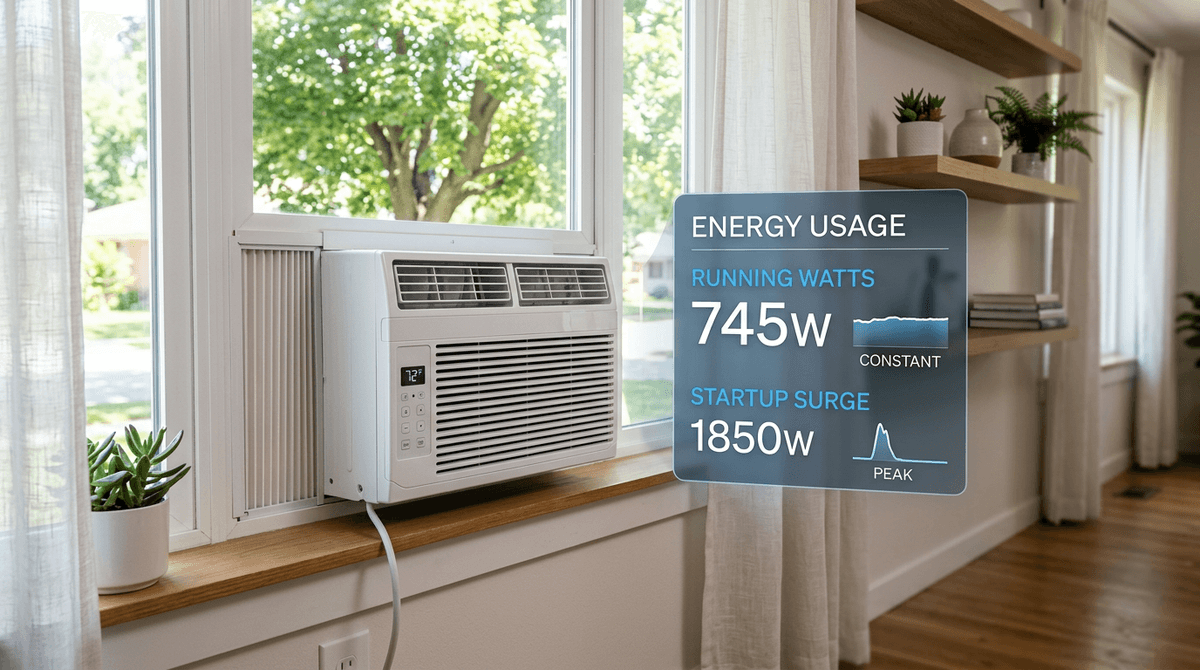
Summer operation is usually the highest-use case: most window AC units run about 700 to 1,600 watts with longer compressor cycles in afternoon heat.
For full system planning, use the WattSizing Calculator.
Quick Answer
In summer, most window AC units run around 700 to 1,600 W and often consume 6 to 14 kWh/day depending on room size, sun exposure, and thermostat setting.
Detailed Explanation
In summer, indoor-outdoor temperature difference is large, so compressors stay on longer. Units installed on west-facing windows usually draw similar instantaneous watts, but they run more hours and produce higher daily kWh.
You can compare baseline watt behavior in How Many Watts Does a Window Air Conditioner Use and estimate daily energy from How to Calculate Daily Energy Use.
Watt Table
| Window AC Size | Typical Running Watts | Typical Summer Use (kWh/day) |
|---|---|---|
| 5,000 BTU | 500 - 700 W | 4 - 7 |
| 8,000 BTU | 700 - 1,000 W | 6 - 9 |
| 10,000 BTU | 900 - 1,250 W | 7 - 11 |
| 12,000 BTU | 1,050 - 1,450 W | 8 - 13 |
| 15,000 BTU | 1,300 - 1,600 W | 10 - 14 |
Calculation Example
A 10,000 BTU unit averaging 1,050 W for 9 summer hours/day:
kWh/day = (1,050 x 9) / 1000 = 9.45 kWh/day
Tips
- Pre-cool before peak afternoon heat where possible.
- Shade the window side of the home to reduce heat gain.
- Keep filters clean so airflow stays high.
- Raise setpoint by 1-2C to cut compressor runtime.
FAQs
Why does summer kWh rise faster than expected?
Because runtime increases more than nameplate watts change.
Do inverter window AC models save energy in summer?
Usually yes, especially during long steady cooling periods.
Should I size backup for running watts only?
No. Include startup/surge margin for compressor starts.
CTA
Want exact summer sizing for your room and tariff? Use the WattSizing Calculator to model load, battery runtime, and inverter capacity.


