
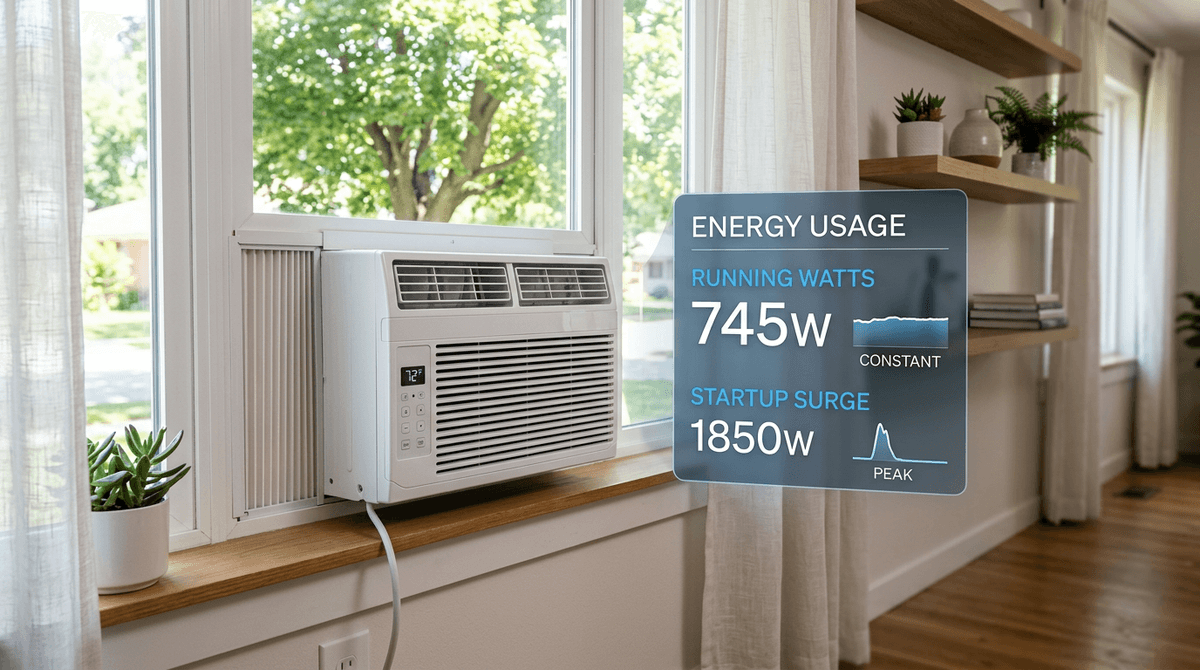
Winter usually means lower cooling demand, so daily energy is mostly driven by short daytime runs rather than all-day compressor cycling.
For full system planning, use the WattSizing Calculator.
Quick Answer
A window AC in winter still draws roughly 500 to 1,500 W when running, but many households only use 1 to 5 kWh/day because runtime drops sharply.
Detailed Explanation
In cool months, thermostat setpoints are reached quickly and compressor off-time grows. Instantaneous watt draw remains similar, but daily energy falls because duty cycle is lower.
For reference ranges, review How Many Watts Does a Window Air Conditioner Use Per Day and compare with How Many Watts Does a Portable Air Conditioner Use.
Watt Table
| Window AC Size | Typical Running Watts | Typical Winter Use (kWh/day) |
|---|---|---|
| 5,000 BTU | 450 - 650 W | 1 - 3 |
| 8,000 BTU | 650 - 900 W | 1.5 - 3.5 |
| 10,000 BTU | 850 - 1,150 W | 2 - 4 |
| 12,000 BTU | 1,000 - 1,350 W | 2.5 - 4.5 |
| 15,000 BTU | 1,200 - 1,600 W | 3 - 5 |
Calculation Example
If a 12,000 BTU unit averages 1,100 W for 2.5 hours/day:
kWh/day = (1,100 x 2.5) / 1000 = 2.75 kWh/day
Tips
- Turn unit off fully during cold nights if not needed.
- Seal air leaks around the mounting frame.
- Use fan-only mode before switching to compressor cooling.
- Clean filters to avoid short cycling.
FAQs
Why are winter watt readings similar but bills lower?
Because compressor runtime is much shorter.
Is it safe to run every window AC in very cold weather?
Not always; check manufacturer operating temperature limits.
Does humidity still matter in winter?
Yes, indoor moisture can still increase perceived warmth and comfort settings.
CTA
Need month-by-month cooling estimates? Use the WattSizing Calculator to model seasonal kWh and backup requirements.


