
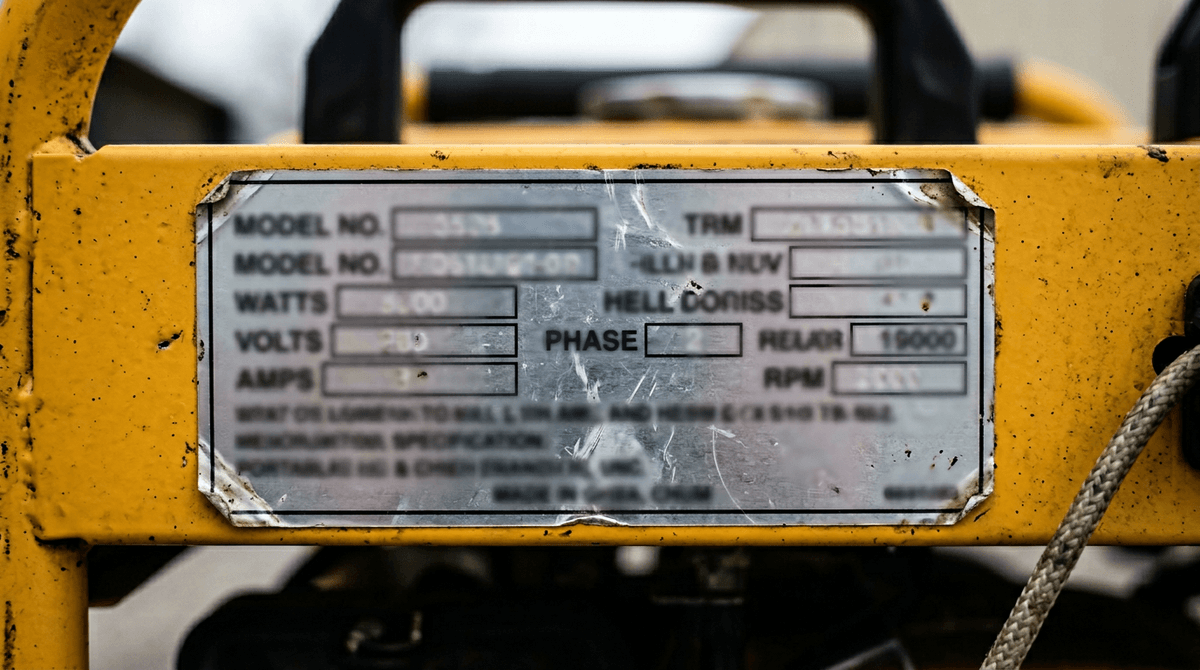
Generator labels look simple, but many purchasing mistakes happen because people treat peak watts as if they were continuous output. The short version: running watts are sustainable, peak watts are temporary.
Size accurately with the WattSizing Calculator.
Quick Answer
- Running watts = continuous power the generator can deliver safely.
- Peak watts (surge/starting watts) = short burst available for motor startup.
- For planning, keep normal use below running watts and verify startup events fit within peak watts.
What Each Spec Means in Practice
| Generator Spec | What It Means | How to Use It |
|---|---|---|
| Running Watts (Rated) | Continuous power output | Main number for daily operation |
| Peak / Starting Watts | Short duration surge headroom | Check motor/compressor startups |
| Voltage & Amps | Output limits per circuit | Match your transfer setup safely |
| THD (if listed) | Waveform cleanliness | Lower THD is better for electronics |
| Fuel runtime @ load | Time per tank at a test load | Estimate refueling schedule |
Example Label Interpretation
Suppose a unit is labeled:
- Running: 3,000W
- Peak: 3,600W
Interpretation:
- You should treat 3,000W as your practical max continuous target.
- The extra 600W is mainly for brief startup spikes.
- If your running load sits near 3,000W all day, the unit has little room for unpredictable surges.
Appliance Matching Example
Your planned loads:
- Refrigerator: 180W run / 1200W start
- Sump pump: 800W run / 2200W start
- Lights + network: 200W
Possible moments:
- Base running with fridge already on:
180 + 200 = 380W - Sump starts during base:
2200 + 200 + 180 = 2580W(within 3,600W peak) - Pump running steady:
800 + 200 + 180 = 1180W(within 3,000W running)
This setup fits, but if you add a microwave (1200W), peak overlap risk rises fast.
Common Reading Mistakes
- Buying by peak number alone.
- Ignoring surge of pumps/compressors.
- Assuming extension-cord setup equals panel-backed circuit behavior.
- Missing altitude/temperature derating in the manual.
For appliance-level power checks, see How Many Watts Does a Sump Pump Use and How Many Watts Does a Refrigerator Use.
Rule-of-Thumb Sizing Table
| Use Case | Recommended Approach |
|---|---|
| Electronics + lights only | Keep continuous load ≤ 60% to 70% of running watts |
| Mixed household loads | Keep continuous load ≤ 70% to 80% of running watts |
| Frequent motor startups | Prioritize peak headroom and sequence big loads |
| Sensitive office electronics | Prefer inverter generator with low THD |
FAQs
Is peak watt the same as surge watt?
Yes, in most generator listings those terms are used interchangeably.
How long can a generator hold peak watts?
Usually seconds, not minutes. Check the manufacturer documentation for exact limits.
Should I run a generator at 100% of running watts continuously?
It is possible, but not ideal for longevity, heat management, and fuel efficiency.
Does inverter vs conventional generator change these definitions?
Definitions stay similar, but inverter models usually provide cleaner output and better part-load behavior.
CTA
Want a safer sizing target than label guessing? Use the WattSizing Calculator to map running load, startup surges, and usable headroom for your real outage plan.


