
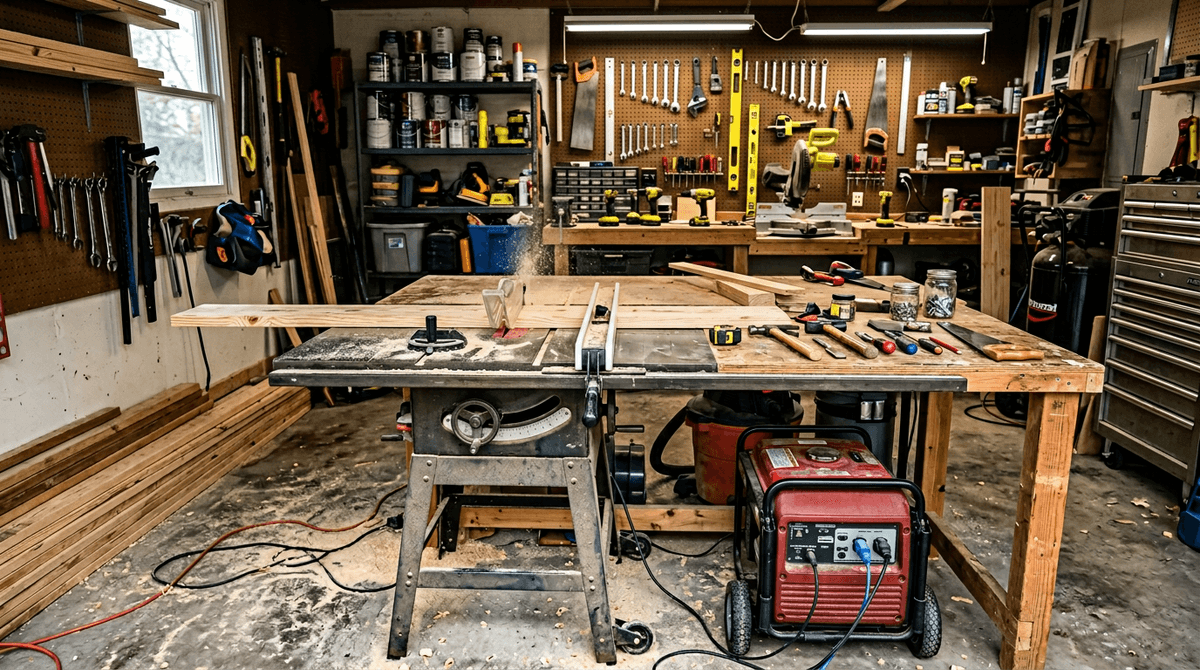
Answer-first classes: a one-tool-at-a-time hobby bench with lights often fits about 3,500–5,500 running watts; a table saw + dust collector + compressor rhythm typically lands in about 7,500–12,000 W classes; two large motor tools that might start close together can push toward 12,000–18,000 W depending on labels.
Motor surge behavior is the same idea as in How Many Watts Does a Vacuum Cleaner Use—short peaks above running watts. Read Generator Running Watts vs Starting Watts Explained and How to Calculate Surge Watts for Motor Loads, then map loads in the WattSizing Calculator.
Scope
This page is for portable or standby generators feeding corded shop tools. Hardwired 240 V shop subpanels need an electrician; sizing logic below is still illustrative until you read motor nameplates and test under load.
Generator class ranges by shop profile
| Shop profile | Typical generator class (running watts) | What drives the size |
|---|---|---|
| Hand tools + LED lights + battery charger | 2,500–4,000 W | Low surge; margin for a single small motor |
| Table saw OR miter saw + air filter + lights | 5,500–8,500 W | One dominant motor surge |
| Table saw + dust collector + compressor (staggered) | 8,500–12,000 W | Stacked running watts + worst-case start |
| Frequent simultaneous starts / large shop vac | 12,000–18,000 W | Overlapping surge events |
Stacked loads (illustrative watt table)
| Tool / load | Illustrative running W | Illustrative starting W |
|---|---|---|
| 10" table saw | 1,400–1,900 | 2,800–3,800 |
| 20–30 gal air compressor | 1,200–1,800 | 2,400–3,600 |
| Dust collector (1–2 HP class) | 800–1,400 | 1,600–2,800 |
| Shop vac (compare to upright vacuums) | 900–1,400 | 1,600–2,600 |
| Overhead lights + chargers | 150–400 | small bump |
Add your largest surge gap to concurrent running loads, then apply 15–25% margin.
Worked example (illustrative)
Assumed: table saw 1,800 / 3,600 W; dust collector 1,100 / 2,200 W; lights and chargers 400 W running.
- Steady work: saw + dust + lights = 1,800 + 1,100 + 400 = 3,300 W running.
- If the saw starts while dust and lights are already on, a simplified peak model uses 3,600 + 1,100 + 400 = 5,100 W.
- With 20% margin: 5,100 × 1.2 ≈ 6,120 W—a ~7,000–8,500 W class unit is a common next step for reliable headroom.
If the compressor can kick while the saw is running, recompute the peak; overlapping surges are where “big enough on paper” fails.
Safety: feeds, CO, cords, bonding
- Never backfeed a house panel without a listed transfer device or interlock installed to code.
- CO: operate outdoors, downwind of doors/windows—see NFPA portable generator safety.
- Cords: use heavy-gauge, short runs for high-current tools; voltage drop causes nuisance trips and brownouts.
- Grounding: follow the generator manual; RV/shop setups still need correct bonding rules for the scenario.
U.S. Department of Energy: Portable generators.
FAQs
I only run one motor tool at a time—can I undersize?
You can plan for sequenced use, but leave margin for accidental overlap (compressor unloading, dust collector auto-on). Undersizing saves purchase price but costs time when breakers or overloads trip mid-cut.
Are inverter generators worth it in a wood shop?
They are often quieter and pleasant for electronics, but surge watts still rule for big saws. Compare the unit’s starting capability to your worst tool—not the eco-mode marketing number alone.
Why does my 50 ft extension cord make the saw bog down?
Voltage drop on long, undersized cords raises current and can prevent clean motor starts. Shorter runs and heavier gauge fix more “mystery trips” than a bigger generator alone.
Sources
- U.S. Department of Energy: Portable Generators
- U.S. Energy Information Administration: Electricity Explained
- Generac: Generator Sizing Guide
CTA
Translate nameplates into a staged shop plan with the WattSizing Calculator.


