
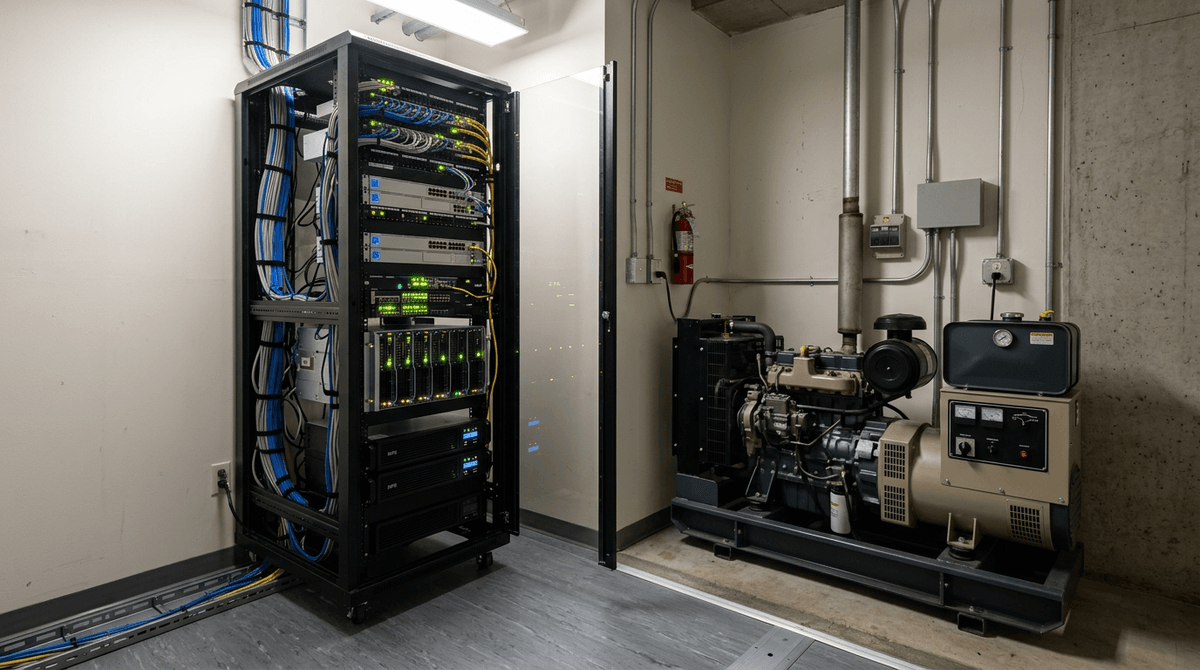
Server and network loads are mostly electronic, not compressor-driven, but generator sizing still fails when people use PSU labels instead of measured draw, forget PoE budgets, or ignore cooling and UPS recharge after an outage. Baseline references: How Many Watts Does a Desktop Computer Use (roughly 60–400 W typical tower bands by workload) and How Many Watts Does a Router Use (~5–20 W for many standalone routers, higher with mesh/modem/PoE).
Build a defensible list in the WattSizing Calculator.
Straight answer
A network-only mini rack (modem, firewall, switch, NVR) often lands in a 1,800–3,000 W generator class once you add transient headroom and future growth. A homelab with one or two servers plus cooling commonly plans 3,500–6,000 W inverter generators; small business + room cooling frequently moves into 6,000–10,000+ W territory.
Exact numbers depend on measured watts, not catalog fantasies.
Stack the load in the right order
- Measured IT load under worst realistic business or lab use (not idle).
- Network overhead: uplink gear, APs, and PoE delivered power—see router/switch context in How Many Watts Does a Router Use.
- Cooling: rack fans, room fans, or CRAC/mini-split segments on the same backup plan.
- UPS charging after an event (can dominate for minutes to hours).
- 20–30% sustained margin so the generator is not riding redline during summer heat or after battery drain.
Illustrative rack profiles (hypothetical watts)
| Rack profile | Typical continuous direction | Why the band is wide |
|---|---|---|
| Mini rack (modem, router, NVR, small switch) | ~250–700 W run / ~600–1,500 W short peaks | PoE cameras and disk spin-up |
| Homelab (1–2 servers + network + UPS recharge allowance) | ~900–2,000 W run / ~2,000–3,800 W peaks | Charger inrush + cooling step changes |
| SMB rack + office/room cooling | ~2,000–4,000 W run / ~4,000–7,000 W peaks | Compressor or fan ramp depending on HVAC type |
| Dense PoE + stronger cooling | ~3,500–6,000 W run / ~6,500–10,000 W peaks | Stacked PoE + thermal headroom |
Align individual device estimates with the watt tables in How Many Watts Does a Desktop Computer Use and How Many Watts Does a Router Use before you buy hardware.
Worked example (illustrative)
Loads:
-
Two 1U servers (measured peak business load): 1,000 W
-
Firewall + core + access + ONT: 320 W
-
PoE APs + cameras (budgeted): 260 W
-
Rack/room cooling fans: 500 W
-
UPS recharge planning allowance: 700 W
-
Continuous sum:
1,000 + 320 + 260 + 500 + 700 = 2,780 W -
With 25% margin:
2,780 × 1.25 = 3,475 W -
Add short transient cushion for cooling/charger steps: plan roughly +1,000 W of available surge capability on the unit you select.
Illustrative pick: ~5,000 W inverter generator class (or larger if you expect more servers or PoE growth).
Reliability habits that cost nothing
- Staged UPS charging so the rack does not demand full recharge the same minute the generator comes online.
- Separate branches for IT vs heavy motor loads where practical.
- Monthly test at realistic load—not a single strip lamp on the output.
Safe installation and power quality
- Poor grounding and bonding can damage IT gear; follow qualified electrical work for transfer equipment and neutral bonding rules for your jurisdiction. Ready.gov power outages covers baseline home backup safety expectations.
- Inverter generators are often preferred for voltage/frequency stability for switching power supplies; compare your vendor’s THD specs against what your UPS and servers tolerate.
- Keep fuel and exhaust strictly outside living spaces; NFPA generator guidance reinforces outdoor placement.
FAQs
Should I add up server PSU watt ratings to size the generator?
No—PSU ratings are capacity, not draw. Use measured or vendor-documented maximum AC input under your workload, then add cooling and PoE.
Where do “starting watts” come from if there is no big motor?
From UPS chargers, cooling step changes, disk arrays spinning, and PoE inrush when many devices boot together—plan peak simultaneous behavior, not steady-state only.
Do I need 240 V for a rack generator?
If any critical load is 240 V only, yes. Many homelabs stay 120 V-dominant; confirm your PDU and UPS input requirements before you buy.
How does PoE change the math?
PoE turns network ports into heat and DC conversion losses at the switch. Budget delivered PoE power + overhead; How Many Watts Does a Router Use explains why small network stacks can still surprise you when mesh nodes and modems stack up.
Is a portable generator acceptable for a business rack?
Sometimes for short outages, but runtime, noise, fuel handling, and SLA expectations often push serious shops toward standby units—this article sizes portable-class planning only.
What if I only need the rack, not the whole building?
You can downsize the generator if nothing else is on the backup path—but you must still include cooling and internet path power (ONT/modem) in the same budget.
Sources
- Ready.gov: Power outages — household backup safety framing
- NFPA: Generators — installation and operation hazards
CTA
Map IT watts, cooling, and recharge in one pass. Use the WattSizing Calculator before you spec the generator class.


