
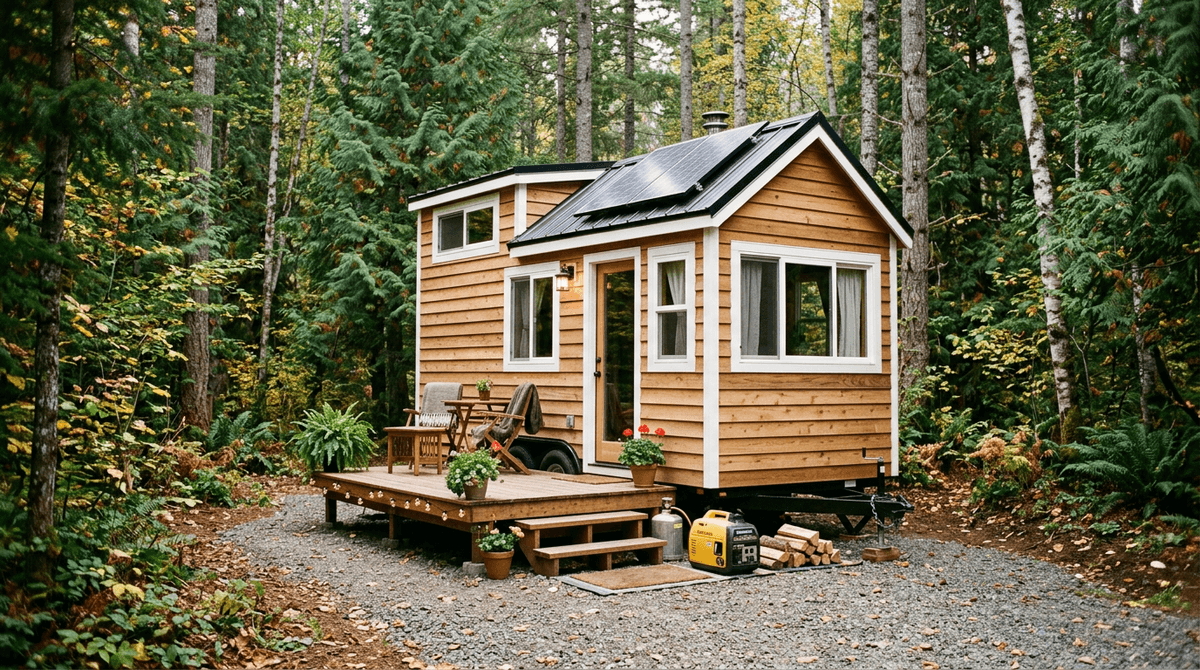
Answer-first: essentials-only builds often land near 2,000–3,500 W classes; comfort + mini-split cooling commonly points to 4,000–7,500 W; well pump or high-heat cooking overlap can push 7,500–12,000 W depending on labels and sequencing.
Treat a tiny house as a small breaker panel: size for simultaneous running watts plus the worst motor start while other loads are already on. See How Many Watts Does a Mini Split Use and How Many Watts Does a Refrigerator Use; add pumps from How Many Watts Does a Well Pump Use where relevant. Stack everything in the WattSizing Calculator.
What changes the class
- Compressor HVAC (mini split) vs resistive heat (space heater, hot plate) is a different sizing problem.
- Well pumps add 240 V and high LRA concerns.
- Battery-inverter hybrids often pair with a smaller generator—but the generator must still cover peak surge if it runs the same bus.
Generator class ranges (typical profiles)
| Tiny-house profile | Typical class (running watts) | Dominant sizing notes |
|---|---|---|
| Fridge + lights + internet + phone chargers | 2,000–3,500 W | Fridge compressor restart vs other loads |
| Above + 9k–12k BTU mini split (see watt table) | 4,000–7,500 W | HVAC surge + fridge overlap |
| Pump + modest cooling + kitchen | 7,500–10,500 W | Pump start often sets the peak |
| All-electric cooking with HVAC + water heat | 9,000–15,000+ W | Continuous kW stacks fast |
Mini-split bands from our guide: 9,000 BTU about 450–800 W run / 900–1,500 W start; 12,000 BTU about 600–1,100 W run / 1,200–2,000 W start—illustrative only.
Stacked loads (illustrative table)
| Concurrent load | Illustrative running W | Illustrative surge note |
|---|---|---|
| Refrigerator | 120–220 | 600–1,400 start |
| Mini split (12k BTU class) | 600–1,100 | 1,200–2,000 start |
| LED lights + router + laptop | 80–250 | small |
| Microwave (1 kW resistive) | ~1,000 | mostly continuous while heating |
| Well pump (¾ HP class) | 900–1,500 | 1,800–3,200 start |
Worked example (illustrative)
Assumed: 12k BTU mini split 900 W run / 2,000 W start; fridge 160 W run / 1,200 W start; misc. 220 W.
- If the compressor starts while fridge and misc. are already on: 2,000 + 160 + 220 = 2,380 W peak in a simplified model.
- Add 20% margin: 2,380 × 1.2 ≈ 2,856 W—a ~4,000–5,500 W class generator is a common real-world bracket before adding kitchen heat or pumps.
Recompute before buying; tiny houses vary wildly.
Safety: interlocks, CO, cords, bonding
- Transfer switch or interlock when connecting to house wiring; tiny-house panels still need a legal isolation path from utility.
- CO: place generators outdoors with clear airflow—NFPA portable generator safety.
- Cords: use heavy outdoor-rated cords; undervoltage from thin cords trips motor controls.
- Grounding/bonding: follow generator and local code; do not assume RV and residential rules are identical.
U.S. Department of Energy: Portable generators.
FAQs
I heat with propane and cook with induction—does that shrink the generator?
Often yes, because you remove large continuous electric heat loads—but induction can still spike during overlap with HVAC starts. Model worst-case minutes, not average days.
Is a “hybrid” with batteries a reason to buy a smaller generator?
Batteries can cover short peaks if the inverter is sized correctly, but the generator must still meet any sustained load you expect it to carry alone. Read your inverter/charger manual alongside the WattSizing Calculator.
My tiny house only has a 30 A inlet—does that cap generator size?
Connector and wire limit safe current; watts must fit V × A at your service voltage. An electrician should verify connector rating, neutral, and grounding for your inlet type.
Sources
- U.S. Department of Energy: Portable Generators
- U.S. Energy Information Administration: Electricity Explained
- Generac: Generator Sizing Guide
CTA
Map concurrent tiny-house loads and surge events in the WattSizing Calculator.


