
Choosing between LiFePO4 (lithium iron phosphate) and lead-acid for your off-grid solar bank affects capacity, lifespan, weight, and total cost. This comparison helps you decide.
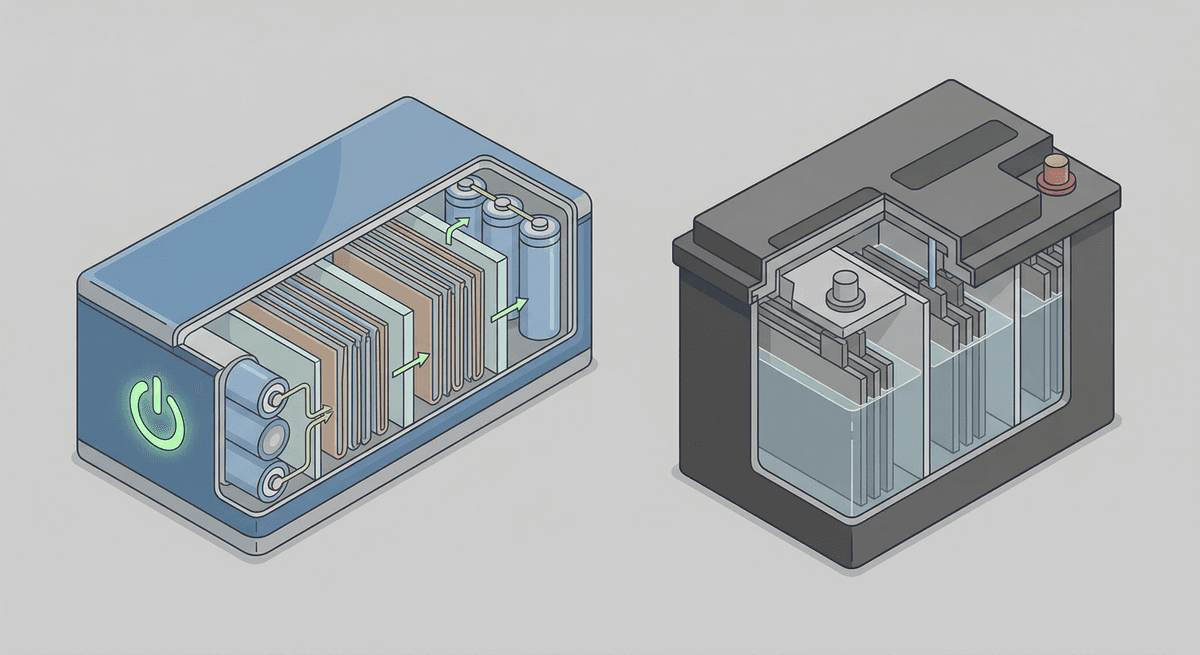
Usable Capacity and Depth of Discharge
- LiFePO4: You can safely use 80–90% of the rated capacity (depth of discharge). A 100 Ah LiFePO4 gives you ~80–90 Ah usable.
- Lead-acid: You should only use about 50% to extend life. A 100 Ah lead-acid gives you ~50 Ah usable.
So for the same usable energy, you need roughly twice the lead-acid capacity (and often twice the physical batteries) compared to LiFePO4. That affects how many batteries you need and depth of discharge in sizing.
Cycle Life
- LiFePO4: Often 3,000–6,000+ cycles (daily charge/discharge for many years).
- Lead-acid: Often 300–1,200 cycles. In daily use, lead-acid may need replacing every few years; LiFePO4 can last a decade or more.
Over 10 years, you might buy lead-acid 2–3 times and LiFePO4 once. That makes LiFePO4’s higher upfront cost easier to justify for long-term off-grid.
Weight and Space
LiFePO4 is much lighter per kWh than lead-acid. For RVs, boats, and cabins, that can be the deciding factor. See off-grid solar for RVs and solar for boats.
Cost: Upfront vs Total Cost of Ownership
- Lead-acid: Lower price per kWh new, but you use only half the capacity and replace sooner. Total cost over 10 years often exceeds LiFePO4.
- LiFePO4: Higher upfront, but more usable capacity per unit and longer life. Usually better value over the life of the system for most off-grid users.
When Each Makes Sense
- LiFePO4: Most new off-grid and mobile (RV, boat) systems; anyone who wants long life, less weight, and more usable capacity.
- Lead-acid: Very tight budget and short-term use; existing systems already built around lead-acid; some backup-only applications.
For new builds, LiFePO4 is the default choice for solar. If you’re also curious about newer options, see LiFePO4 vs sodium-ion. Use the WattSizing calculator to size your bank for either chemistry.


