
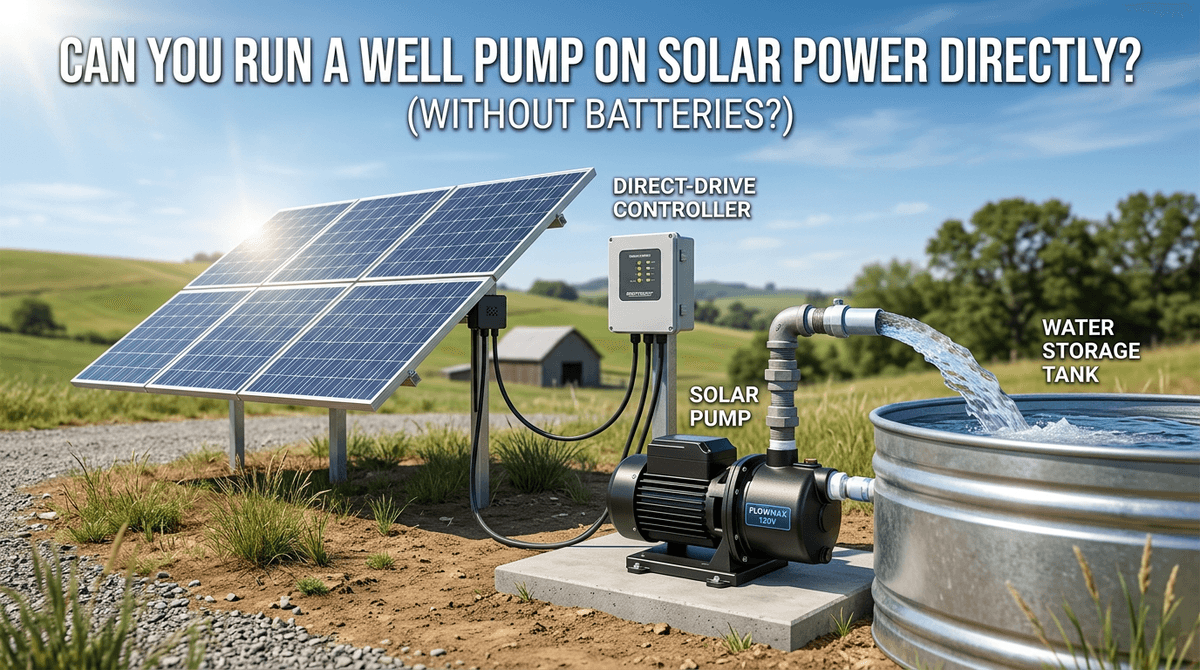
When designing an off-grid homestead, securing a reliable water supply is just as critical as generating electricity. For most rural properties, this means pumping water from a deep well.
Traditionally, off-grid well pumps require massive, expensive battery banks and heavy-duty inverters to handle the massive surge of power required to start the pump's motor. But what if you could eliminate the batteries entirely?
Can you run a well pump on solar power directly without batteries?
The answer is a resounding yes. In fact, running a well pump directly off solar panels—known as a "direct-drive" solar water pumping system—is one of the most efficient, cost-effective, and reliable ways to get water off-grid.
In this guide, we will explain exactly how direct-drive solar pumps work, why you should store water instead of electricity, and how to size a system for your property. If you need help sizing the rest of your off-grid electrical system, be sure to use our Off-Grid Solar Calculator.
How Direct-Drive Solar Well Pumps Work
A standard residential well pump runs on 240V Alternating Current (AC). To power it with solar, you need panels (which produce DC power), a massive battery bank to store that power, and a large inverter to convert the DC to AC and handle the pump's startup surge.
A direct-drive solar well pump operates on an entirely different principle.
These pumps are specifically designed with highly efficient brushless DC (BLDC) motors. Because they run on Direct Current, they can be wired directly to your solar panels. There is no inverter, and more importantly, there are no batteries.
The Role of the Linear Current Booster (Pump Controller)
While you can wire a DC pump directly to a solar panel, it won't work very well early in the morning or late in the afternoon. Solar panels produce a high voltage but very little current (Amps) in low-light conditions. A motor needs current to start turning.
To solve this, direct-drive systems use a specialized device called a Pump Controller or Linear Current Booster (LCB).
The controller sits between the solar panels and the pump. It acts like an automatic transmission for electricity. In low-light conditions, it takes the high voltage from the panels and steps it down, simultaneously boosting the current (Amps). This allows the pump to start turning and pumping water even when the sun is barely over the horizon or hidden behind light clouds.
As the sun gets higher and the panels produce more power, the controller adjusts, allowing the pump to spin faster and pump more water.
The Golden Rule: Store Water, Not Electricity
The obvious drawback of a direct-drive system is that it only pumps water when the sun is shining. If you turn on your kitchen faucet at midnight, the pump cannot turn on.
So, how do you get water at night? You store water, not electricity.
Batteries are expensive, heavy, require maintenance, and typically need replacing every 5 to 10 years. A plastic water storage tank (cistern) is relatively cheap, requires zero maintenance, and can last for decades.
The Gravity-Fed Cistern System
The most common and reliable off-grid water setup works like this:
- The Solar Pump: During the day, the solar panels power the well pump, which pushes water up out of the ground.
- The Storage Tank: The water is pumped into a large storage tank (cistern) located at a high elevation on your property (e.g., on a hill behind your house or on a tall water tower).
- The Float Switch: A simple mechanical float switch inside the tank tells the pump controller to shut off when the tank is full, preventing overflows.
- Gravity Delivery: When you open a faucet in your house—day or night—gravity pulls the water down from the tank, providing natural water pressure.
If you don't have a hill to provide gravity pressure, you can use a small, highly efficient 12V or 24V DC booster pump (powered by a small house battery) to pressurize the water from a ground-level tank into your home's plumbing.
Advantages of Direct-Drive Solar Pumps
Why choose a direct-drive system over a traditional AC pump with batteries?
1. Massively Reduced Costs
A traditional off-grid AC well pump system requires a large inverter (often $1,500+) and a massive battery bank capable of handling a 3,000W to 5,000W startup surge (often $3,000+). A direct-drive DC pump eliminates both of these components, saving you thousands of dollars upfront.
2. Extreme Reliability
Batteries and inverters are the most common points of failure in any off-grid system. By removing them, you drastically increase the reliability of your water supply. Direct-drive DC pumps have very few moving parts and can operate for 15-20 years with zero maintenance.
3. "Soft Start" Technology
Traditional AC pumps slam on at full speed, causing a massive electrical surge and physical torque on the pipes and wiring down the well. DC solar pumps feature a "soft start." As the sun rises, the pump slowly begins to spin, gradually increasing speed. This eliminates electrical surges and greatly extends the physical lifespan of the pump mechanism.
4. Better Yield from Low-Producing Wells
If your well has a slow recovery rate (e.g., it only produces 1 or 2 gallons per minute), a powerful AC pump will quickly pump the well dry, requiring complex sensors to shut it off and wait for the well to refill. A solar pump pumps slowly and steadily throughout the day, perfectly matching the natural recovery rate of slow wells.
How to Size a Direct-Drive Solar Pump System
Sizing a solar well pump requires knowing three critical pieces of information:
1. Total Dynamic Head (TDH)
This is the total vertical distance the water needs to be pushed, plus the friction loss in the pipes.
- Static Water Level: The distance from the ground surface down to the water level in your well.
- Drawdown: How far the water level drops while pumping.
- Elevation: The vertical distance from the top of the well to your storage tank.
- Friction Loss: Resistance caused by the water moving through the pipe (usually calculated as a percentage of the total pipe length).
Example: If your water level is 100 feet deep, and your storage tank is on a hill 50 feet above the well, your TDH is roughly 150 feet (plus a few feet for friction).
2. Daily Water Requirement
How much water do you actually need per day?
- Average US Home: Uses about 60-80 gallons per person, per day.
- Off-Grid Home: Typically uses much less, around 30-50 gallons per person, per day.
- Livestock: A cow needs roughly 15 gallons per day; a sheep needs 2 gallons.
- Irrigation: Varies wildly based on garden size and climate.
3. Peak Sun Hours
How many hours of usable sunlight does your location receive per day? (Usually between 4 and 6 hours in the US).
The Calculation
Once you know these three numbers, you can consult a pump manufacturer's "Pump Curve" chart.
For example, if you need 500 gallons per day, and you have 5 peak sun hours, you need a pump capable of delivering 100 gallons per hour (or 1.6 gallons per minute) at your specific Total Dynamic Head.
You then match the pump to the required solar panel wattage specified by the manufacturer (usually between 200W and 800W of solar panels).
Popular Direct-Drive Pump Brands
If you are looking to install a direct-drive system, here are the industry leaders:
- Grundfos (SQFlex Series): The gold standard in solar pumping. Incredibly reliable, can run on AC or DC power, and features built-in dry-run protection. They are expensive but worth it for critical home water supplies.
- Lorentz: A premium German brand offering highly advanced controllers and massive pumping capabilities for agriculture and large homesteads.
- RPS (Rural Power Systems): A very popular, mid-tier option that offers complete, easy-to-install DIY kits specifically designed for off-grid homesteaders and ranchers.
- Dankoff (SunCentric / SolarForce): Excellent for surface pumping (from a pond or creek) or shallow wells.
Frequently Asked Questions (FAQ)
Can I run my existing AC well pump on solar without batteries?
No. Standard AC well pumps require a massive surge of current to start (often 3 to 5 times their running wattage). Solar panels cannot provide this sudden surge of current. You must have an inverter and a battery bank to start an AC pump, or you must replace the pump with a DC solar pump.
What happens if it's cloudy for a week?
This is why sizing your storage tank is critical. You should size your cistern to hold at least 3 to 5 days' worth of your daily water requirement. If you use 100 gallons a day, install a 500-gallon tank. During cloudy weather, the solar pump will still pump some water, just at a much slower rate.
Do direct-drive pumps work in the winter?
Yes, solar panels actually operate more efficiently in cold temperatures. As long as the panels are clear of snow and the sun is shining, the pump will run. However, because the days are shorter in winter, your total daily water volume will be lower than in the summer. Ensure your pipes and storage tanks are buried below the frost line or properly insulated to prevent freezing.
Can I use a generator as a backup for a solar pump?
Yes. Many high-end solar pump controllers (like the Grundfos CU200) have an AC input. If your storage tank runs dry during a long winter storm, you can plug a portable gas generator directly into the controller to run the pump and fill the tank.
Conclusion
Running a well pump directly on solar power without batteries is not only possible—it is often the smartest, most reliable way to design an off-grid water system.
By utilizing a high-efficiency DC pump, a smart pump controller, and a large water storage tank, you can eliminate the need for expensive, maintenance-heavy battery banks and inverters. The golden rule of off-grid water is simple: Store water, not electricity.
Whether you are watering livestock, irrigating a garden, or supplying a full-time off-grid home, a direct-drive solar pump provides a robust, set-it-and-forget-it solution that will provide free water for decades.
If you are currently designing your off-grid homestead and need to calculate the solar requirements for the rest of your appliances, head over to our Off-Grid Solar Calculator to get started!


