
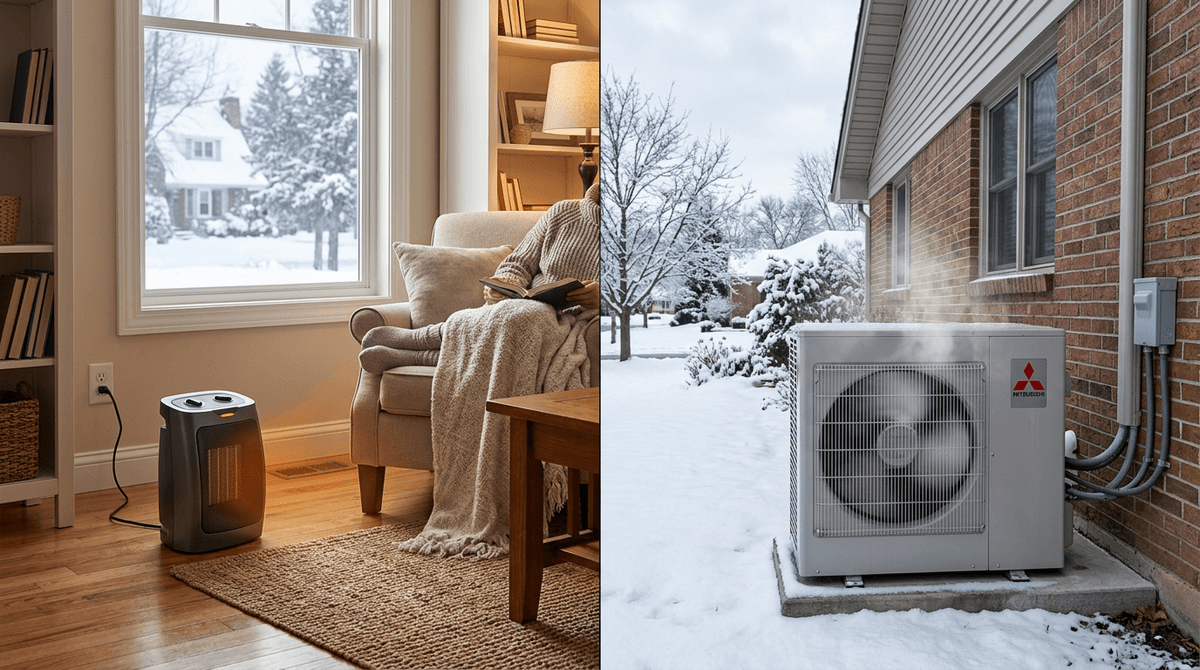
Both can keep you warm, but they use electricity very differently. A space heater is usually a fixed high-watt resistive load, while a heat pump can deliver more heat per watt by moving heat instead of creating it directly.
If you are deciding what to run at home or during backup power, this guide gives practical watt and cost comparisons you can use quickly. For exact sizing with your own usage pattern, use the WattSizing Calculator.
Quick Comparison
| Topic | Space Heater | Heat Pump |
|---|---|---|
| Typical running watts | 750 - 1,500 W (per unit) | 500 - 3,500 W (system, varies by size/conditions) |
| Efficiency concept | Resistive heat (about 1 unit heat per unit electricity) | Moves heat (often 2-4x effective heating output per unit electricity) |
| Startup behavior | Usually little surge beyond running watts | Compressor startup/modulation may vary |
| Best use case | Heating one room for short periods | Heating larger areas or whole-home use |
| Backup-power friendliness | Hard on small batteries/inverters if run long | Better heat-per-kWh, but central systems can still be large loads |
Detailed Power Consumption Breakdown
Space Heater
Most portable units run at one or two fixed levels, often around 750 W and 1,500 W. The draw is straightforward: when heating is on, power is close to nameplate.
For baseline device ranges, see How Many Watts Does a Space Heater Use.
Heat Pump
Heat pump draw changes with outdoor temperature, thermostat settings, and equipment type. Variable-speed systems can run for long periods at lower watts, while auxiliary electric heat can sharply increase total draw.
For baseline system ranges, see How Many Watts Does a Heat Pump Use.
Side-by-Side Table (Watts, kWh, Cost)
Assume electricity rate of $0.16/kWh.
| Scenario | Estimated Average Power | Duration | Energy (kWh) | Estimated Cost |
|---|---|---|---|---|
| Space heater on high (single room) | 1.5 kW | 4 hours | 6.0 kWh | $0.96 |
| Space heater cycling (about 70% duty) | 1.05 kW | 6 hours | 6.3 kWh | $1.01 |
| Mini split heating one zone (moderate weather) | 0.9 kW | 6 hours | 5.4 kWh | $0.86 |
| Central heat pump (cold evening, no strip heat) | 2.2 kW | 4 hours | 8.8 kWh | $1.41 |
| Central heat pump with frequent auxiliary heat | 5.0 kW | 3 hours | 15.0 kWh | $2.40 |
Worked Scenarios
1) One Bedroom, Evening Use
- Option A: 1,500 W space heater for 3 hours with about 80% heating duty.
- Average power about 1,200 W.
- Energy = (1.2 x 3) = 3.6 kWh.
- Cost = 3.6 x $0.16 = $0.58.
If your mini split can hold the same room around 600-900 W average in mild conditions, total cost can be lower for similar comfort.
2) Whole-Home Winter Night
-
Option A: Multiple space heaters (for example two units at 1,500 W each): total 3,000 W if both actively heating.
-
Over 5 hours at 70% duty: average 2,100 W -> 10.5 kWh -> $1.68.
-
Option B: Central heat pump averaging 2,400 W over same window:
-
Energy = 2.4 x 5 = 12 kWh -> $1.92.
In colder weather, if the central system triggers auxiliary strips often, cost can exceed space-heater-only room heating. In milder weather, heat pumps often win on delivered heat per kWh.
Practical Decision Guide
- Choose a space heater when you need quick spot heating in one room for limited hours.
- Choose a heat pump for regular multi-room or whole-home comfort and generally better seasonal efficiency.
- If you already own a heat pump, reducing auxiliary strip-heat runtime often has a bigger bill impact than small thermostat tweaks.
- For backup systems, compare sustained watt draw against inverter and battery limits before relying on either option.
Related reads:
FAQs
Is a heat pump always cheaper to run than a space heater?
Not always in every hour. For one small room and short use, a single space heater can be competitive. Over a season and larger heated area, heat pumps are often more efficient.
Why do heat pump costs jump on very cold days?
System efficiency can drop in colder air, and some systems add electric auxiliary heat, which is high watt like built-in space heaters.
Are space heaters bad for backup batteries?
They are challenging because they are sustained high-watt loads. Runtime can drain batteries quickly unless your storage is sized for it.
Should I replace all space-heater use with a heat pump?
Not necessarily. Many households use a hybrid approach: heat pump as primary, space heater for occasional room-level comfort.
CTA
Ready to compare your exact costs and backup needs? Use the WattSizing Calculator to model appliance watts, runtime, battery storage, and inverter sizing with your own assumptions.


