
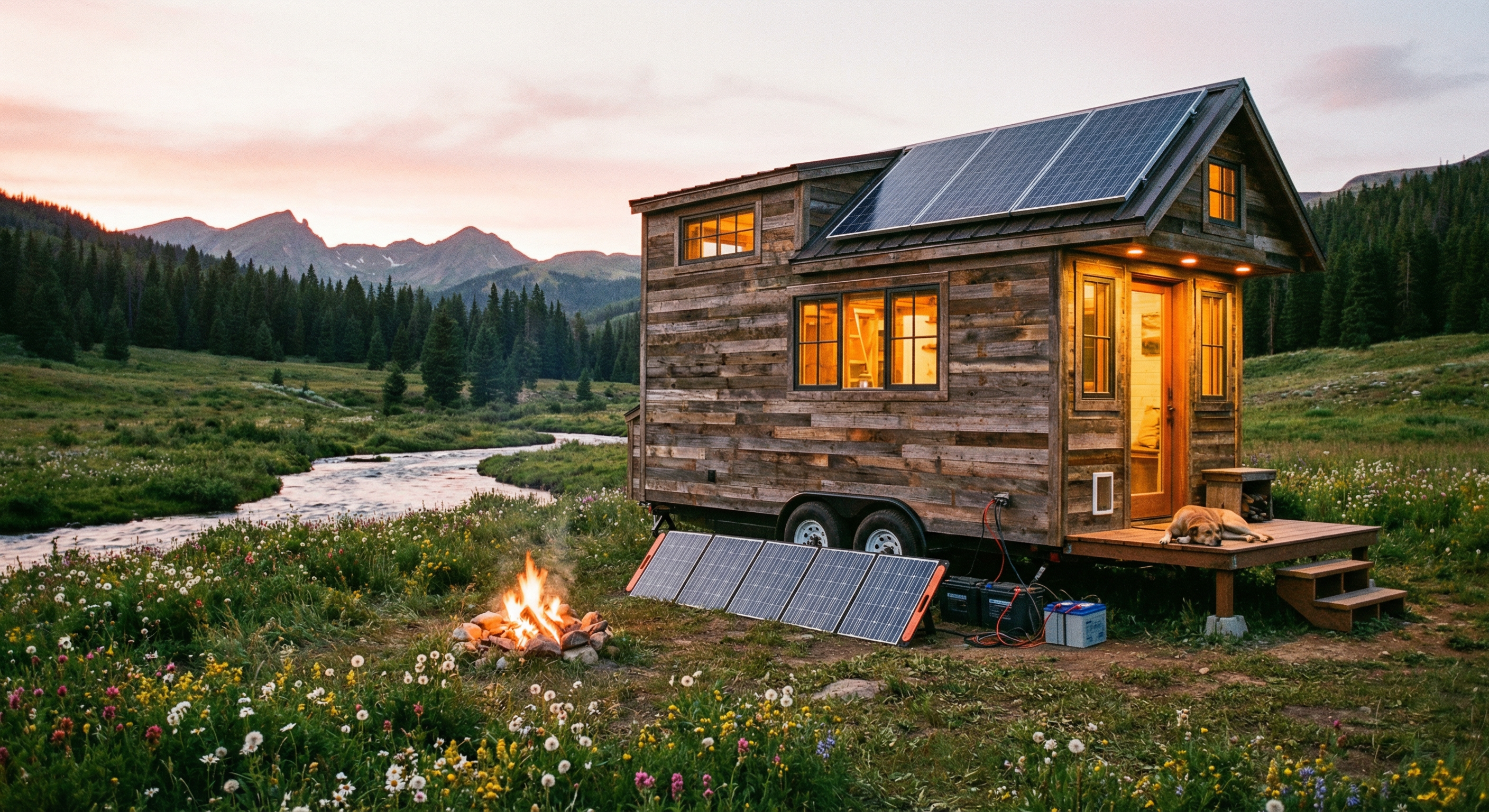
Tiny houses and solar power are a match made in heaven. The philosophy of minimalism and reducing one's footprint aligns perfectly with generating your own clean energy. However, tiny houses present unique challenges: limited roof space for panels and limited interior space for batteries and equipment.
Sizing a system for a tiny house requires precision. Over-size, and you waste precious space and money. Under-size, and you'll be sitting in the dark. This guide will walk you through the specific considerations for powering a tiny home.
Step 1: The Audit (Tiny House Edition)
In a standard home, you might have 20 lightbulbs. In a tiny house, you might have 4. However, you likely still have high-draw appliances like a fridge, laptop, or induction cooktop.
Create a spreadsheet with columns for: Appliance, Watts, Hours/Day, and Total Wh/Day.
Common Tiny House Loads (Estimates)
- Mini-Split A/C & Heat: 500W - 1000W (running). This is usually the biggest power hog.
- 12V Fridge: 40W - 60W (average draw).
- Induction Cooktop: 1500W - 1800W (high surge, short duration).
- Laptop: 60W.
- LED Lights: 5W each.
- Water Pump: 100W (intermittent).
- Composting Toilet Fan: 2W (runs 24/7).
Pro Tip: If you plan to cook with electricity (induction) or heat water with electricity, your solar system needs to be significantly larger. Using propane for cooking and water heating can drastically reduce your solar requirements and save roof space.
Step 2: The Space Constraint (Roof Tetris)
This is the biggest bottleneck for tiny homes. A typical tiny house on wheels (THOW) is 8.5 feet wide and 20-30 feet long. However, skylights, vents, and lofts reduce usable solar space.
- Measure your available roof area. Be precise.
- Check panel dimensions. A standard 400W residential panel is roughly 68" x 44".
- Play Tetris. Draw your roof and see how many panels fit.
Example: If you have a 24ft tiny house, you might fit 4-6 large residential panels. 6 panels x 400W = 2400W Max Array.
If your energy audit says you need 4000W of solar, you have a problem. You may need:
- Ground mounts: Place extra panels on the ground near the tiny house. See DIY Solar Mounting Systems: Roof vs Ground Mount.
- Solar Awning: Panels that fold out or extend from the side.
- High-Efficiency Panels: Invest in the highest efficiency panels available (like 23-24% efficiency) to maximize watts per square foot.
Step 3: Sizing the Battery Bank
Since you can't easily add more roof space later, your battery bank becomes your buffer.
For tiny houses, Lithium (LiFePO4) is the only logical choice.
- Weight: Towing a tiny house with 500lbs of lead-acid batteries is dangerous and kills fuel economy.
- Space: Lithium batteries are compact. You can often fit a 5kWh server rack battery under a couch or in a utility closet.
Sizing Rule of Thumb: Aim for 3 days of autonomy. If your daily use is 2000Wh (2kWh): 2kWh x 3 days = 6kWh battery bank.
A single 48V 100Ah server rack battery provides ~5kWh. Two of them would give you ample buffer (10kWh).
Step 4: Voltage - 12V, 24V, or 48V?
- 12V: Good for very small setups (van life style) with < 500W of solar.
- 24V: A good middle ground for smaller tiny houses.
- 48V: Recommended for most tiny houses.
- Allows for thinner wiring (saving money and easier to route in thin walls).
- More efficient for inverters > 2000W.
- Standard for server rack batteries.
Step 5: The Inverter/Charger
You likely want a Hybrid Inverter/Charger. This combines the solar charge controller, inverter, and grid charger into one box.
- Space Saving: One box on the wall instead of three.
- Shore Power: When you park at an RV park or a friend's house, you can plug in to charge your batteries and run loads.
Recommendation: A 3000W 48V Hybrid Inverter is a standard "sweet spot" for tiny homes. It can run a microwave or induction cooktop comfortably.
Real-World Example: The "Weekend Warrior" Tiny
- Usage: Weekend trips, lights, phone charging, 12V fridge. No A/C.
- Daily Load: ~800Wh.
- Solar: 2 x 400W panels (800W total).
- Battery: 1 x 12V 200Ah LiFePO4 (~2.5kWh).
- Inverter: 1200W Pure Sine Wave.
Real-World Example: The "Full-Timer" Tiny
- Usage: Full-time living, remote work (laptops), mini-split A/C, induction cooking.
- Daily Load: ~4000Wh (4kWh).
- Solar: 6 x 400W panels (2400W total).
- Battery: 2 x 48V 100Ah Server Rack Batteries (10kWh total).
- Inverter: 5000W 48V Hybrid Inverter.
Conclusion
Sizing for a tiny house is a balancing act between your power desires and your physical space limitations. Always prioritize efficiency—insulation, propane for heat, and LED lights—to make your limited solar harvest go further.
Thinking about cooling? Read our specific guide on Running an Air Conditioner on Solar Power.


