
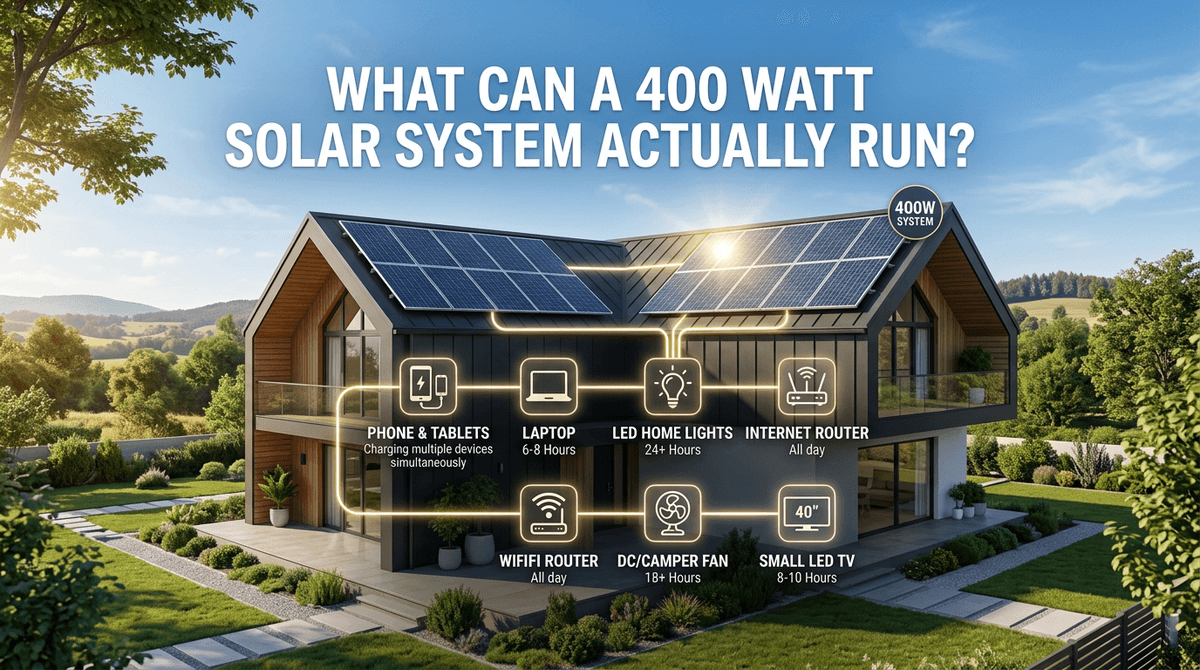
When venturing into the world of off-grid solar power, one of the most common starting points is the 400-watt solar system. It hits a sweet spot: it’s affordable, relatively compact, and powerful enough to make a meaningful difference in your energy independence. But a critical question remains: What can a 400-watt solar system actually run?
In this comprehensive guide, we will break down the real-world capabilities of a 400W solar setup. We’ll explore the math behind solar production, list specific appliances you can power, discuss the essential role of batteries, and help you determine if 400 watts is enough for your specific needs. If you're ready to size your own system, don't forget to check out our solar calculator to get precise recommendations based on your unique energy profile.
Understanding the Math: How Much Power Does 400 Watts Produce?
Before we can list the appliances a 400W system can run, we need to understand how much energy it actually generates. The term "400 watts" refers to the system's peak power output under ideal laboratory conditions (known as Standard Test Conditions or STC).
In the real world, you rarely get exactly 400 watts of continuous power. Factors like the angle of the sun, cloud cover, temperature, and shading all impact performance.
The Concept of Peak Sun Hours
To calculate daily energy production, solar engineers use a metric called Peak Sun Hours (PSH). This is not the total hours the sun is up, but rather the equivalent number of hours the sun shines at an intensity of 1,000 watts per square meter.
- Average US Location: Receives about 4 to 5 peak sun hours per day.
- Winter/Cloudy Regions: Might only receive 2 to 3 peak sun hours.
- Sunny Regions (e.g., Arizona): Can receive 6 or more peak sun hours.
Calculating Daily Energy Production
Let's do the math for an average location receiving 5 peak sun hours:
400 Watts × 5 Peak Sun Hours = 2,000 Watt-hours (Wh) or 2 Kilowatt-hours (kWh) per day.
However, solar systems are not 100% efficient. You lose energy through wiring resistance, charge controller conversion, and inverter inefficiencies. A safe assumption is an overall system efficiency of about 80%.
Real-World Daily Production: 2,000 Wh × 0.80 (Efficiency Factor) = 1,600 Watt-hours (1.6 kWh) per day.
So, a 400W solar system will reliably provide about 1,600 Wh of usable energy per day in average conditions.
What Can 1,600 Watt-Hours Run?
Now that we have our daily energy budget (1,600 Wh), let's look at what this translates to in terms of real-world appliances.
To determine if an appliance can run, you need to know its wattage and how long you plan to use it. The formula is: Appliance Wattage × Hours of Use = Total Watt-hours (Wh) Consumed.
Small Electronics and Devices
A 400W system is more than capable of keeping all your personal electronics charged indefinitely.
| Appliance | Average Wattage | Daily Usage | Total Wh Consumed |
|---|---|---|---|
| Smartphone Charger | 10W | 2 hours | 20 Wh |
| Laptop Computer | 50W | 4 hours | 200 Wh |
| Tablet | 15W | 2 hours | 30 Wh |
| LED Camp Lights | 10W | 5 hours | 50 Wh |
| Portable Bluetooth Speaker | 15W | 3 hours | 45 Wh |
| Total | 345 Wh |
As you can see, charging basic electronics barely makes a dent in your 1,600 Wh daily budget.
Kitchen and Cooking Appliances
This is where energy consumption starts to climb. Heating elements draw a massive amount of power.
| Appliance | Average Wattage | Daily Usage | Total Wh Consumed |
|---|---|---|---|
| 12V Portable Fridge (e.g., Dometic) | 40W (cycles on/off) | 24 hours | ~400 Wh |
| Small Coffee Maker | 800W | 15 minutes (0.25 hrs) | 200 Wh |
| Microwave | 1000W | 10 minutes (0.16 hrs) | 160 Wh |
| Instant Pot / Slow Cooker | 1000W | 30 minutes (0.5 hrs) | 500 Wh |
| Total | 1,260 Wh |
A 400W system can easily run a highly efficient 12V refrigerator 24/7, while still leaving enough power to brew a pot of coffee and heat up lunch in the microwave.
Entertainment and Comfort
If you're outfitting an RV or a small off-grid cabin, you'll likely want some creature comforts.
| Appliance | Average Wattage | Daily Usage | Total Wh Consumed |
|---|---|---|---|
| 32-inch LED TV | 40W | 3 hours | 120 Wh |
| Starlink Satellite Dish | 50W | 8 hours | 400 Wh |
| CPAP Machine (no humidifier) | 30W | 8 hours | 240 Wh |
| Roof Vent Fan (e.g., MaxxFan) | 20W | 10 hours | 200 Wh |
| Total | 960 Wh |
What a 400W System CANNOT Run
It is equally important to understand the limitations of a 400W system. High-draw appliances that run for extended periods will quickly drain your batteries and exceed your daily solar production.
- Air Conditioners: Even a small 5,000 BTU window AC unit draws about 500W continuously. Running it for just 4 hours would consume 2,000 Wh, exceeding your entire daily solar budget.
- Electric Space Heaters: Drawing 1,500W, a space heater would drain a typical battery bank in less than an hour.
- Electric Water Heaters: These require massive amounts of energy. Propane is a much better alternative for off-grid water heating.
- Large Residential Refrigerators: While a 400W system might run a small, highly efficient apartment fridge, standard residential fridges consume too much power over a 24-hour period.
The Crucial Role of the Battery Bank
Solar panels only generate power when the sun is shining. To run appliances at night or during cloudy days, you must store that energy in a battery bank. A 400W solar array is useless without a properly sized battery bank.
Sizing Your Battery Bank for 400 Watts
A common rule of thumb in solar design is to have enough battery capacity to store at least one to two days' worth of solar production.
Since our 400W system produces roughly 1,600 Wh per day, we want a battery bank that can store at least that much usable energy.
Lead-Acid vs. Lithium Iron Phosphate (LiFePO4)
- Lead-Acid (AGM/Gel): You should only discharge lead-acid batteries to 50% of their total capacity to avoid damaging them. Therefore, to get 1,600 Wh of usable energy, you need a 3,200 Wh battery bank. At 12 volts, this equates to roughly 260 Amp-hours (Ah) of total capacity.
- Lithium (LiFePO4): Lithium batteries can be safely discharged to 80-100% of their capacity. To get 1,600 Wh of usable energy, you only need about a 1,600 Wh to 2,000 Wh battery bank. At 12 volts, this equates to roughly 150 to 200 Amp-hours (Ah).
For a 400W system, a 200Ah 12V Lithium battery is the perfect pairing. It provides 2,400 Wh of total storage, giving you a comfortable buffer for cloudy days.
The Inverter: Converting DC to AC
Your solar panels and batteries operate on Direct Current (DC) power. Most household appliances (microwaves, TVs, laptop chargers) require Alternating Current (AC) power. To bridge this gap, you need an inverter.
When selecting an inverter for a 400W system, you need to look at the peak wattage of the appliances you want to run simultaneously, not just your daily energy budget.
For example, if you want to run a 1,000W microwave, you need an inverter rated for at least 1,500W to handle the surge when the microwave starts. A 1,500W or 2,000W Pure Sine Wave Inverter is typically recommended for a system of this size.
Example 400W System Setups
To make this concrete, let's look at three common scenarios where a 400W solar system shines.
Scenario 1: The Weekend Warrior RV
This setup is designed for weekend camping trips where you want basic comforts without running a noisy generator.
- Solar Array: 4 x 100W panels on the RV roof.
- Battery: 1 x 100Ah 12V Lithium Battery (1,280 Wh usable).
- Inverter: 1000W Pure Sine Wave.
- Daily Load:
- LED Lights (4 hours) = 40 Wh
- Water Pump (30 mins) = 30 Wh
- Phone/Tablet Charging = 50 Wh
- Roof Vent Fan (8 hours) = 160 Wh
- Small TV (2 hours) = 80 Wh
- Total Daily Use: 360 Wh
- Verdict: A 400W system absolutely crushes this load. You will have fully charged batteries by noon every day, even in less-than-ideal weather.
Scenario 2: The Full-Time Vanlifer
Vanlifers rely on their solar systems for daily living and working remotely.
- Solar Array: 2 x 200W panels.
- Battery: 2 x 100Ah 12V Lithium Batteries (2,560 Wh usable).
- Inverter: 2000W Pure Sine Wave.
- Daily Load:
- 12V Fridge (24 hours) = 400 Wh
- Laptop (8 hours) = 400 Wh
- Starlink Internet (8 hours) = 400 Wh
- Lights/Phones/Misc = 100 Wh
- Induction Cooktop (15 mins) = 300 Wh
- Total Daily Use: 1,600 Wh
- Verdict: This is a perfectly balanced system. The 400W array will generate just enough power on a sunny day to replace what was used. However, a few cloudy days in a row will require driving the van to charge via the alternator (using a DC-to-DC charger).
Scenario 3: The Off-Grid Cabin Starter Kit
For a small hunting cabin or weekend getaway.
- Solar Array: 1 x 400W residential panel.
- Battery: 2 x 6V Golf Cart Batteries in series (approx. 1,300 Wh usable).
- Inverter: 1500W Pure Sine Wave.
- Daily Load:
- Lights (5 hours) = 50 Wh
- Radio/Music (4 hours) = 40 Wh
- Coffee Maker (10 mins) = 130 Wh
- Charging Power Tools = 200 Wh
- Total Daily Use: 420 Wh
- Verdict: More than enough power for basic weekend cabin needs.
How to Optimize Your 400W System
To get the absolute most out of your 400 watts, follow these best practices:
1. Upgrade to an MPPT Charge Controller
The charge controller sits between your solar panels and your batteries, regulating the voltage. Cheap kits often include PWM (Pulse Width Modulation) controllers, which are inefficient. Upgrading to an MPPT (Maximum Power Point Tracking) controller can increase your solar harvest by up to 30%, especially in cold weather or cloudy conditions.
2. Tilt Your Panels
Flat-mounted panels on an RV roof lose efficiency because they rarely face the sun directly. If possible, use tilting mounts. Tilting your panels toward the winter sun can increase production by 20-40% during the shortest days of the year.
3. Eliminate Phantom Loads
Inverters consume power simply by being turned on, even if nothing is plugged in. This is called a phantom load or idle consumption. A large inverter might draw 10-20 watts continuously, which adds up to 240-480 Wh per day—a huge chunk of your 1,600 Wh budget! Turn off your inverter when you aren't actively using AC appliances.
4. Switch to 12V Appliances
Whenever possible, run appliances directly off the 12V DC battery bank rather than using the AC inverter. 12V TVs, 12V refrigerators, and 12V laptop chargers eliminate the 10-15% energy loss associated with the inverter's DC-to-AC conversion process.
Frequently Asked Questions (FAQ)
Will a 400W solar system run a refrigerator?
Yes, a 400W system can easily run a highly efficient 12V portable refrigerator (like an ARB or Dometic) or a small, energy-star rated apartment fridge. It will struggle to run a full-size residential refrigerator, especially during cloudy weather.
How many batteries do I need for a 400 watt solar system?
For optimal performance, pair a 400W solar array with roughly 200Ah of Lithium (LiFePO4) batteries or 400Ah of Lead-Acid batteries. This provides enough storage to capture a full day of sun and run your appliances through the night.
Can 400 watts run an air conditioner?
No. Even the smallest RV air conditioners draw too much continuous power (500W to 1,500W). A 400W system cannot generate or store enough energy to run an AC unit for more than a few minutes.
Is 400 watts enough for a camper van?
For most vanlifers, 400 watts is the "sweet spot." It provides enough power to run a 12V fridge, charge laptops and phones, run LED lights, and power a roof vent fan indefinitely, provided you get decent sunlight.
How long does it take 400W solar to charge a 100Ah battery?
A 100Ah 12V lithium battery holds 1,280 Watt-hours of energy. In peak sunlight, a 400W array produces roughly 320W of actual charging power. Therefore, it would take approximately 4 hours of direct, peak sunlight to fully charge a depleted 100Ah battery (1280Wh / 320W = 4 hours).
Conclusion
A 400-watt solar system is a powerful and versatile setup for off-grid living, RVing, and vanlife. Generating roughly 1.6 kWh of usable energy per day, it is more than capable of running a 12V refrigerator, keeping all your electronics charged, powering lights and fans, and even running short-burst high-draw appliances like a microwave or coffee maker.
The key to success is understanding your energy budget, sizing your battery bank correctly, and managing your power consumption. By keeping your expectations realistic—skipping the air conditioning and electric heating—a 400W system can provide incredible freedom and energy independence.
Ready to see exactly what size system you need for your specific appliances? Head over to our Off-Grid Solar Calculator to build your custom power profile today!


