
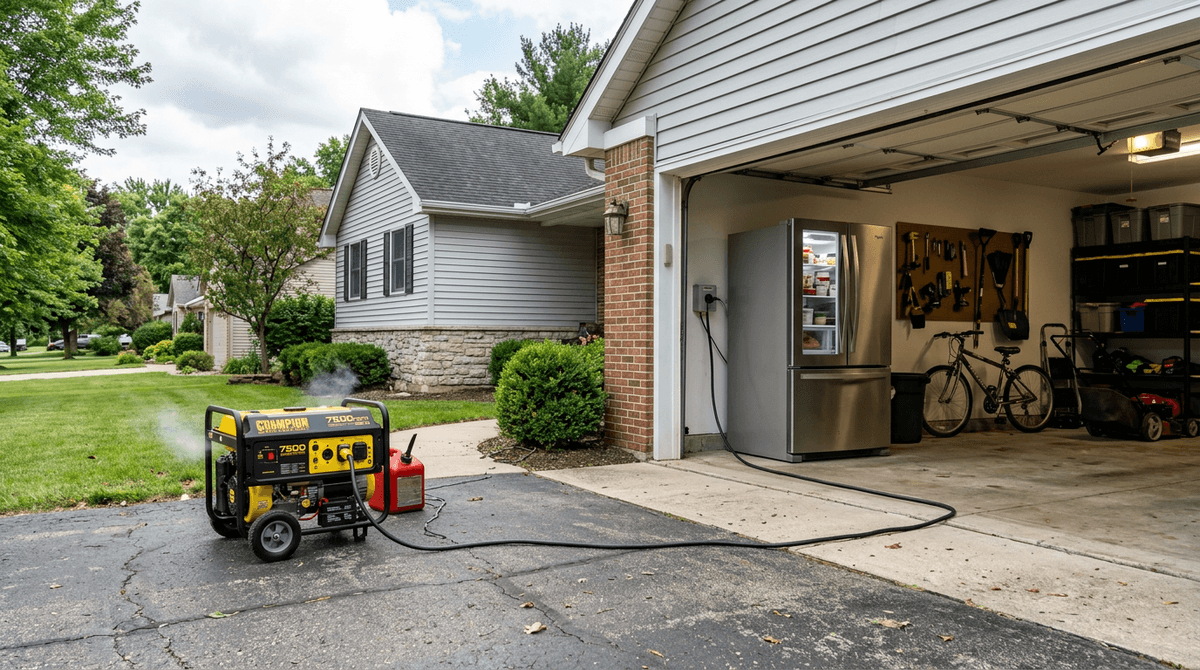
If you are buying a backup generator mainly to keep food from spoiling, refrigerator sizing is the first thing to get right. The key is not just the fridge's running watts, but the short startup surge when the compressor kicks on.
For a full backup plan, use the WattSizing Calculator.
Quick Answer
Most standard home refrigerators are best paired with a 1,800 to 2,500 watt generator when they are the primary load. Compact fridges can run on less, while older or large French-door units often need more startup headroom.
How to Size a Generator for a Refrigerator
Use this simple rule:
- Find refrigerator running watts (often 100 to 300 W for modern units).
- Estimate or measure starting watts (often 3x to 6x running watts).
- Add a 20% safety margin so the generator is not maxed out at startup.
Motors start cleaner when the generator has spare capacity. This reduces nuisance breaker trips and protects both the generator and refrigerator electronics.
For appliance-level estimates, see How Many Watts Does a Refrigerator Use.
Refrigerator Generator Sizing Table
| Refrigerator Type | Typical Running Watts | Typical Starting Watts | Recommended Generator Size |
|---|---|---|---|
| Mini fridge | 60 - 120 W | 300 - 700 W | 1,000 - 1,500 W |
| Top-freezer (16-18 cu ft) | 100 - 180 W | 600 - 1,200 W | 1,500 - 2,000 W |
| Bottom-freezer (20-22 cu ft) | 120 - 220 W | 700 - 1,400 W | 1,800 - 2,200 W |
| French-door (24-28 cu ft) | 150 - 280 W | 900 - 1,800 W | 2,200 - 3,000 W |
| Older large fridge | 200 - 350 W | 1,200 - 2,400 W | 2,800 - 3,500 W |
Worked Sizing Example
You have a 20 cu ft refrigerator with:
- Running watts: 180 W
- Startup watts measured with meter: 1,250 W
Calculation:
- Required startup capacity with 20% margin:
1,250 x 1.2 = 1,500 W - Add 150 W of lights and charger load:
1,500 + 150 = 1,650 W
Practical pick: a 2,000 W inverter generator.
It starts the fridge reliably and gives room for small essentials.
If you want to model multiple circuits, start from How to Calculate Daily Energy Use.
Practical Buying Tips
- Choose an inverter generator for cleaner power and quieter operation.
- Keep generator load around 50% to 80% for better fuel economy.
- Store enough fuel for at least 24 to 48 hours of outage use.
- Test your setup before storm season, not during it.
FAQs
Can a 1,000W generator run a refrigerator?
Sometimes for a mini fridge, rarely for a full-size kitchen refrigerator. Most households need 1,800 W or more for dependable compressor starts.
Do I need to run the fridge 24/7 during an outage?
Not always. Many users cycle power (for example, 1 hour on and 1 to 2 hours off) while keeping doors closed, but food safety rules still apply.
Is a higher watt generator always better?
Not necessarily. Oversizing can increase cost and fuel use at low load. Right-sizing with surge margin is usually the best value.
Should I power anything else with the same generator?
Yes, but add each load's running and startup watts first. If you plan to include pumps or AC, step up in generator size.
CTA
Ready to size your backup setup accurately? Use the WattSizing Calculator to estimate generator, inverter, and battery requirements from your real appliance loads.


