
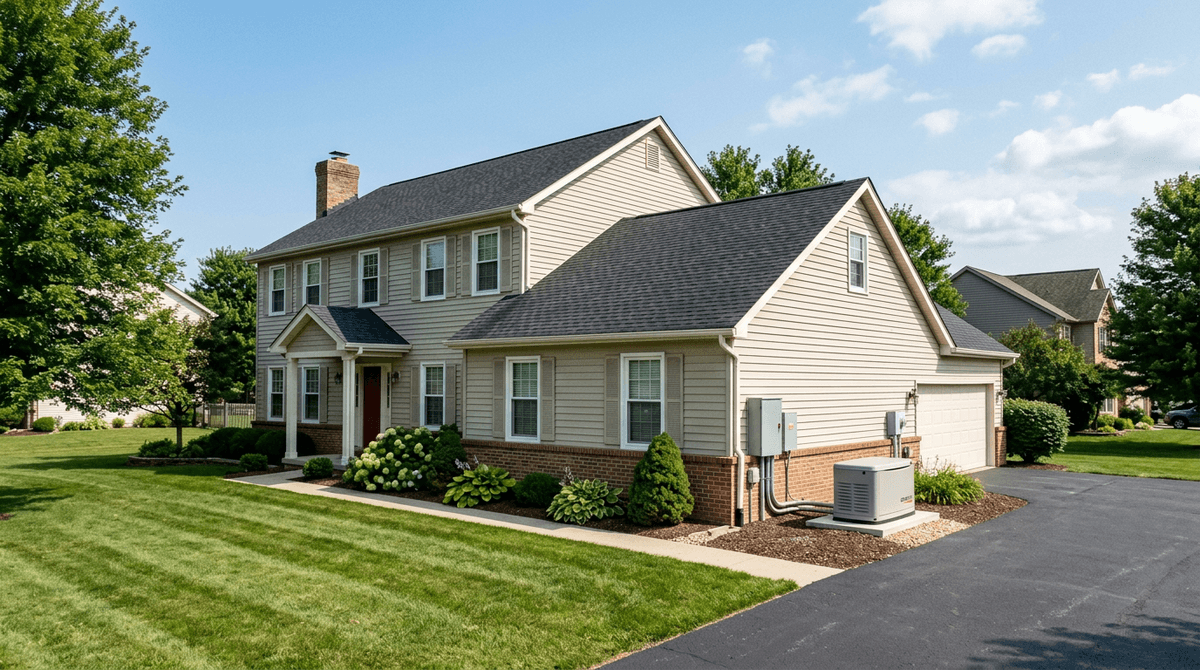
A 2,000 sq ft house commonly needs 7,000 to 12,000 running watts for comfortable essential backup, while near whole-house operation can require 14,000 to 22,000+ watts depending on HVAC and electric heating loads.
For a load-specific answer, use the WattSizing Calculator.
Quick Answer
Square footage alone does not size a generator, but for many 2,000 sq ft homes:
- Essential circuits only: often 7k to 12k watts
- Expanded/near whole-house: often 14k to 22k+ watts
Major HVAC and electric water/space heating loads are what usually push the generator class upward.
Why Square Footage Is Only a Starting Point
Two homes with the same floor area can have very different outage loads:
- One may use gas heat and gas water heating (lower electric demand).
- Another may have electric resistance heat and large AC compressors (higher demand).
Size by actual circuits and appliance labels first, then use home size as a sanity check.
If you are focusing on core circuits first, start with What Size Generator for House Essential Circuits.
2000 Sq Ft Home Sizing Table
| Backup Strategy | Typical Running Watts | Practical Starting Requirement |
|---|---|---|
| Essentials only (fridge, lights, internet, outlets) | 1500 - 3500 W | 2500 - 5500 W |
| Essentials + furnace blower + freezer | 2200 - 4500 W | 3500 - 7000 W |
| Essentials + well/sump pump + kitchen basics | 3000 - 6500 W | 5000 - 10000 W |
| Expanded backup with one AC or heat pump zone | 5000 - 9000 W | 8000 - 14000 W |
| Near whole-house (managed loads) | 9000 - 16000 W | 14000 - 24000 W |
Always verify large motor loads and whether your plan includes 240V appliances.
Calculation Example
Example 2,000 sq ft home outage plan:
- Refrigerator + freezer: 700 W running / 1,900 W start combined
- Furnace blower + controls: 800 W running / 1,500 W start
- Lighting + outlets + internet: 700 W running / 900 W start
- Sump pump: 900 W running / 2,200 W start
- Small kitchen appliance use allowance: 1,000 W running
Step 1: Running total
700 + 800 + 700 + 900 + 1,000 = 4,100 W
Step 2: Largest surge gap
Sump pump gap = 2,200 - 900 = 1,300 W
Step 3: Startup-capable minimum
4,100 + 1,300 = 5,400 W
Step 4: Add 20% margin
5,400 x 1.2 = 6,480 W
Practical selection: 6,500 to 8,000 running watts for this specific load profile.
Selection Tips for 2,000 Sq Ft Homes
- Decide early: essential-only backup or broader comfort backup.
- Keep average operation below generator max for better reliability.
- Use transfer equipment and clear circuit labeling to avoid overload.
- Plan fuel logistics for multi-day outages, not just first-day runtime.
FAQs
Is 10,000 watts enough for a 2,000 sq ft house?
For many essential or moderately expanded backup plans, yes. It may be insufficient for full electric HVAC plus other heavy loads at once.
Can I run central AC and everything else together?
Sometimes, but that often requires a much larger unit or deliberate load management.
Should I choose portable or standby for this house size?
It depends on outage frequency, desired automation, and how many circuits you want active.
CTA
Want a right-sized answer for your exact house instead of a generic estimate? Use the WattSizing Calculator to build your load list and pick the right generator capacity.


