
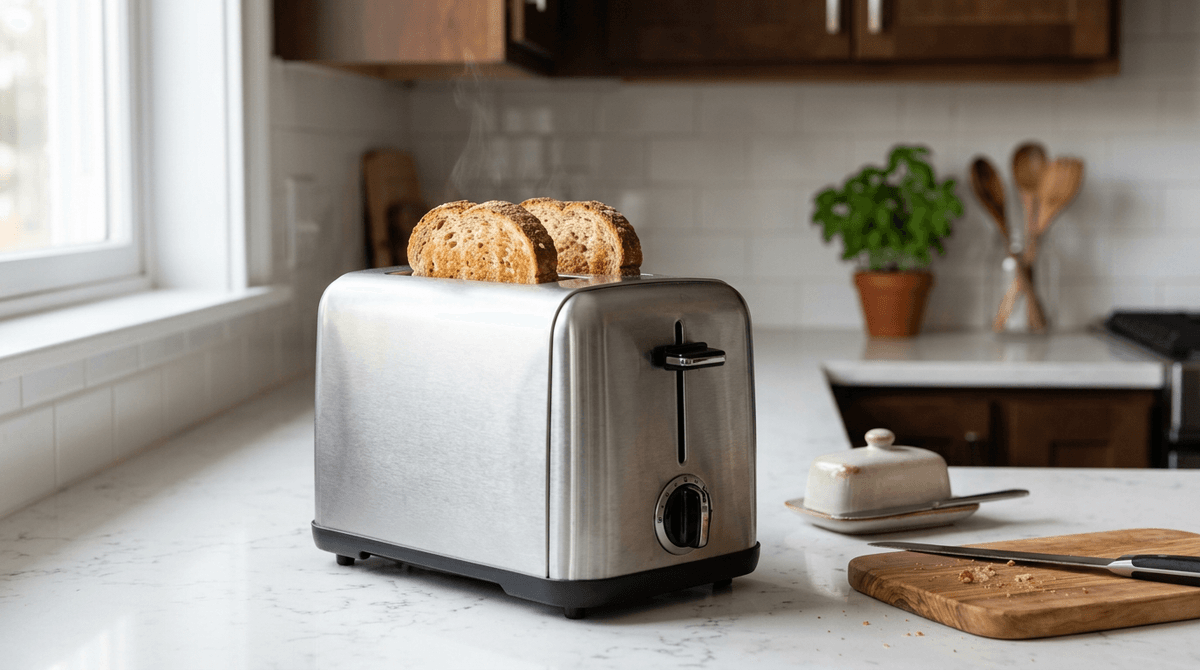
Toasters are straightforward high-watt kitchen loads. They do not have major motor surge, but short high-power bursts can still push a small generator over the limit when other essentials are running.
Plan your complete outage load stack with the WattSizing Calculator.
Quick Answer
For most homes, a 2,000 to 3,500 watt generator is a practical range for toaster use plus core household essentials.
Toaster Generator Sizing Method
- Confirm toaster rating (typically 800 to 1,500 W).
- Add steady outage loads (fridge, lights, internet).
- Account for overlap with other kitchen devices.
- Add a 20% to 25% safety margin.
Because toaster demand is mostly resistive and predictable, success depends on limiting simultaneous kitchen peaks.
Related appliance guides:
Toaster Generator Sizing Table
| Toaster Setup | Typical Running Watts | Typical Peak Watts | Recommended Generator Size |
|---|---|---|---|
| 2-slice toaster only | 800 - 1,200 W | 900 - 1,300 W | 1,500 - 2,200 W |
| 4-slice toaster only | 1,200 - 1,600 W | 1,300 - 1,700 W | 2,000 - 2,800 W |
| Toaster + fridge + lights | 1,400 - 2,100 W | 1,700 - 2,600 W | 2,500 - 3,500 W |
| Toaster with occasional second kitchen load | 2,000 - 3,000 W | 2,500 - 3,800 W | 3,000 - 4,500 W |
Worked Sizing Example
Breakfast outage scenario:
- 4-slice toaster: 1,400 W
- Refrigerator running load: 180 W
- Kitchen lights: 100 W
- Router + modem: 35 W
Calculation:
- Combined running load:
1,400 + 180 + 100 + 35 = 1,715 W - Add 25% margin:
1,715 x 1.25 = 2,144 W
Practical pick: a 2,500 to 3,000 W generator.
This keeps enough overhead for stable operation without frequent overload alarms.
Practical Outage Cooking Tips
- Avoid using toaster and kettle at the same time on small generators.
- Pre-plan a short "high-load window" for breakfast appliances.
- Keep fridge and critical circuits prioritized if capacity gets tight.
- Test your real kitchen load once before storm season.
FAQs
Can I run a toaster on a 2,000W generator?
Yes in many cases, especially for 2-slice units, but check overlap with other appliances to avoid overload.
Does a toaster need extra startup headroom?
Very little compared with motor appliances. Most demand is immediate resistive power.
Can I run toaster and microwave together?
Usually not on smaller generators unless other loads are temporarily reduced.
Is a bigger generator always better for kitchen use?
Only up to a point. Right-sized capacity with a good load plan is usually the most practical and fuel-efficient approach.
CTA
Want a no-guess kitchen backup plan? Use the WattSizing Calculator to model your exact appliance overlap and choose a reliable generator size.


