
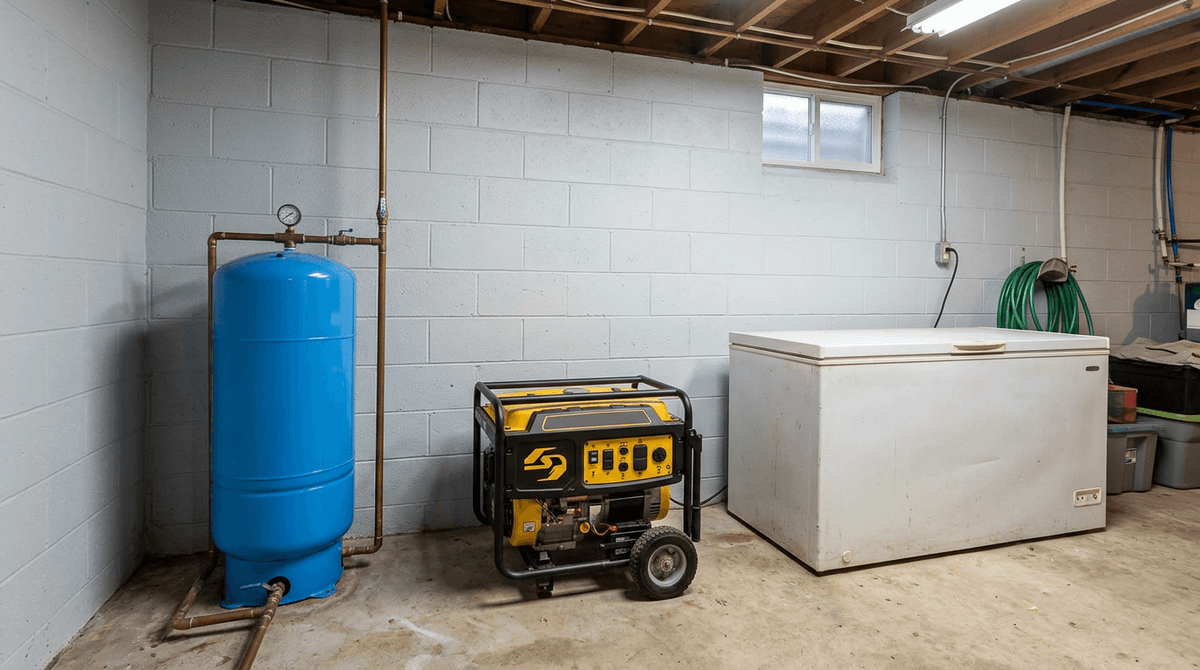
For most homes, a 4,000 to 7,500 watt generator is the practical range for running one well pump and one freezer together, with exact size depending on pump horsepower and startup surge.
For a fast personalized estimate, use the WattSizing Calculator.
Quick Answer
If your well pump is around 1/2 to 3/4 HP and you are also running a chest or upright freezer, a 5,000 to 6,500 running watt generator (with solid surge capacity) is usually the safe target.
If the pump is 1 HP or your freezer and other essentials run at the same time, step up toward 7,000 to 8,500 watts.
How to Size It Correctly
You are sizing two very different loads:
- A well pump can have a strong startup surge.
- A freezer has a compressor surge, but usually lower than the well pump.
The practical method is:
- Add your expected running watts.
- Add the largest expected surge gap (starting watts minus running watts) from whichever motor starts first.
- Add a 15 to 25% buffer so the generator is not pinned at max output.
If you also plan to run a refrigerator, use What Size Generator for House Essential Circuits as a broader framework.
Sizing Table (Well Pump + Freezer)
| Setup | Typical Running Watts | Practical Starting Requirement |
|---|---|---|
| 1/2 HP well pump + chest freezer | 1300 - 2100 W | 3200 - 5200 W |
| 3/4 HP well pump + chest freezer | 1600 - 2500 W | 4000 - 6500 W |
| 1 HP well pump + chest freezer | 2000 - 3200 W | 5000 - 8000 W |
| 1/2 HP well pump + upright freezer | 1400 - 2300 W | 3400 - 5600 W |
| 3/4 HP well pump + upright freezer | 1700 - 2700 W | 4200 - 6800 W |
These are planning ranges. Always confirm your pump nameplate and freezer label.
Calculation Example
Example load:
- 3/4 HP well pump: 1,500 W running, 4,200 W starting
- Upright freezer: 450 W running, 1,100 W starting
- Small lighting + router: 250 W
Step 1: Running total
1,500 + 450 + 250 = 2,200 W
Step 2: Largest surge gap
Well pump surge gap = 4,200 - 1,500 = 2,700 W
Step 3: Minimum startup-capable target
2,200 + 2,700 = 4,900 W
Step 4: Add 20% buffer
4,900 x 1.2 = 5,880 W
Practical choice: a generator in the 6,000 to 7,000 watt class.
Practical Setup Tips
- Use a transfer switch or interlock so startup loads are managed safely.
- Let the well pump finish a heavy cycle before adding optional loads.
- Keep freezer doors closed during outages to reduce compressor run time.
- Test your setup monthly under real load, not just no-load startup.
FAQs
Can I run both on a 3,500 watt generator?
Sometimes with a small 1/2 HP pump and careful load management, but it is often tight on surge and leaves little headroom.
Do inverter generators work for well pumps?
Yes, if they provide enough surge and are 240V when your pump requires it.
Should I use pump starting devices to reduce surge?
Soft-start options can help in some systems, but verify compatibility with your pump motor and controls.
CTA
Want a right-sized backup plan instead of guessing? Use the WattSizing Calculator to size generator, inverter, and battery options from your actual loads.


