
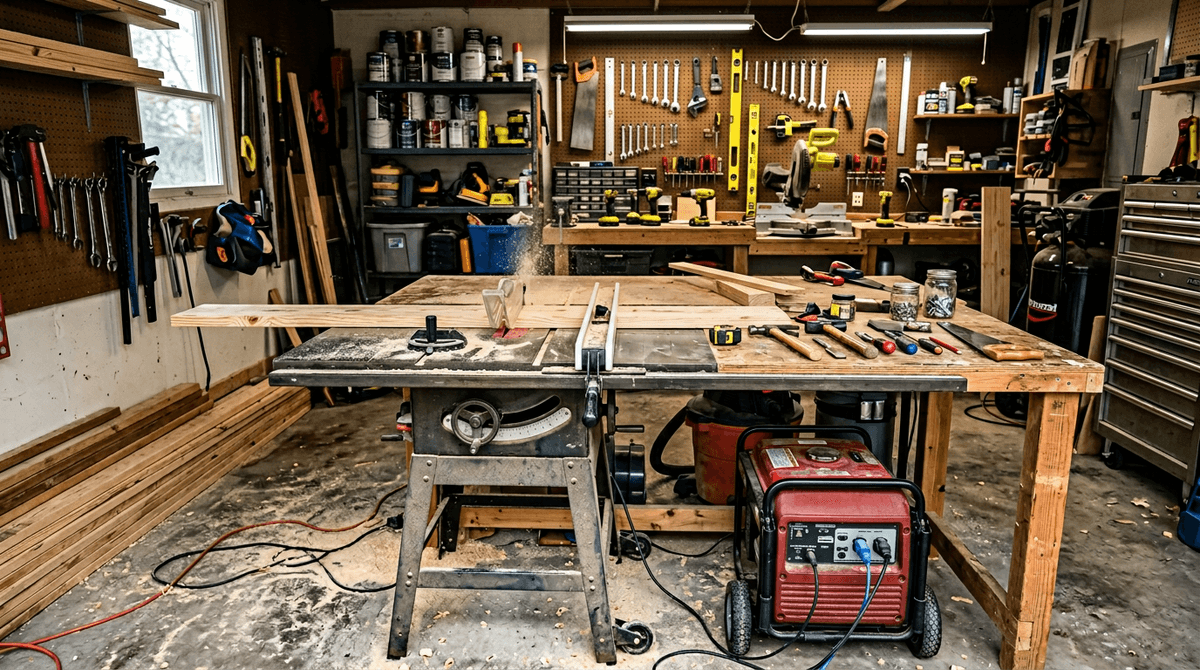
Workshop loads can fool you: many tools have moderate running watts but sharp startup spikes. A generator that looks big enough on paper may still trip if two motor tools start close together.
Build your tool-specific setup with the WattSizing Calculator.
Quick Answer
Most small to medium workshops need a 6,500 to 12,000 watt generator, depending on whether high-surge tools like compressors, table saws, and dust collectors run together.
Sizing Explanation
Use this sequence:
- List all tools that may run at the same time
- Mark motor-driven tools with high startup surge
- Add lighting, battery charging, and ventilation
- Add 20% headroom for real-world operation
Focus on the largest startup event plus your normal running load. That is usually the deciding number.
For related appliance load planning, see How Many Watts Does a Vacuum Cleaner Use and How Many Watts Does a Electric Oven Use.
Workshop Generator Sizing Table
| Workshop Setup | Typical Running Watts | Typical Peak/Starting Watts | Recommended Generator Size |
|---|---|---|---|
| DIY bench tools + lights | 1,200 - 2,500 W | 2,500 - 4,500 W | 4,000 - 6,500 W |
| Table saw + compressor + lights | 2,500 - 4,500 W | 5,000 - 8,500 W | 7,500 - 11,000 W |
| Woodworking shop with dust collection | 3,500 - 6,000 W | 7,000 - 11,000 W | 10,000 - 14,000 W |
| Mixed fabrication shop (intermittent heavy tools) | 4,500 - 8,000 W | 9,000 - 15,000 W | 12,000 - 18,000 W |
Worked Example
Your workshop loads:
- Table saw: 1,800 W run / 3,600 W start
- Air compressor: 1,500 W run / 3,000 W start
- Dust collector: 1,100 W run / 2,200 W start
- Lighting + chargers + fan: 450 W
Calculation with realistic sequencing:
- Normal concurrent run (saw + dust + lights):
1,800 + 1,100 + 450 = 3,350 W - Highest startup moment (saw starts while others run):
3,600 + 1,100 + 450 = 5,150 W - Add 20% working margin:
5,150 x 1.2 = 6,180 W
Practical pick: 7,500 W generator.
If compressor and saw may start near the same time, move up to around 9,000 to 10,000 W.
Practical Tips for Shop Power
- Stagger tool startup to avoid stacked surge events.
- Use dedicated heavy-gauge extension cords for high-draw tools.
- Keep fuel and filters maintained; power quality drops when engines are neglected.
- Test under real work rhythm, not one-tool-at-a-time assumptions.
FAQs
Can I run a table saw and compressor on a 5,000W generator?
Sometimes, but it is often marginal once startup surge is included. Most shops are more reliable with a larger unit.
Is inverter output important for workshop tools?
For motors, less critical than for electronics. For battery chargers and CNC controls, cleaner output is beneficial.
Should I size for every tool at once?
Not always. Size for realistic simultaneous use plus a margin, then enforce startup sequencing.
What about future tool upgrades?
Plan at least 20% extra capacity if you expect larger compressors or added dust collection.
CTA
Want fewer nuisance trips and smoother starts? Use the WattSizing Calculator to model your workshop tools, startup behavior, and safe generator headroom.


