
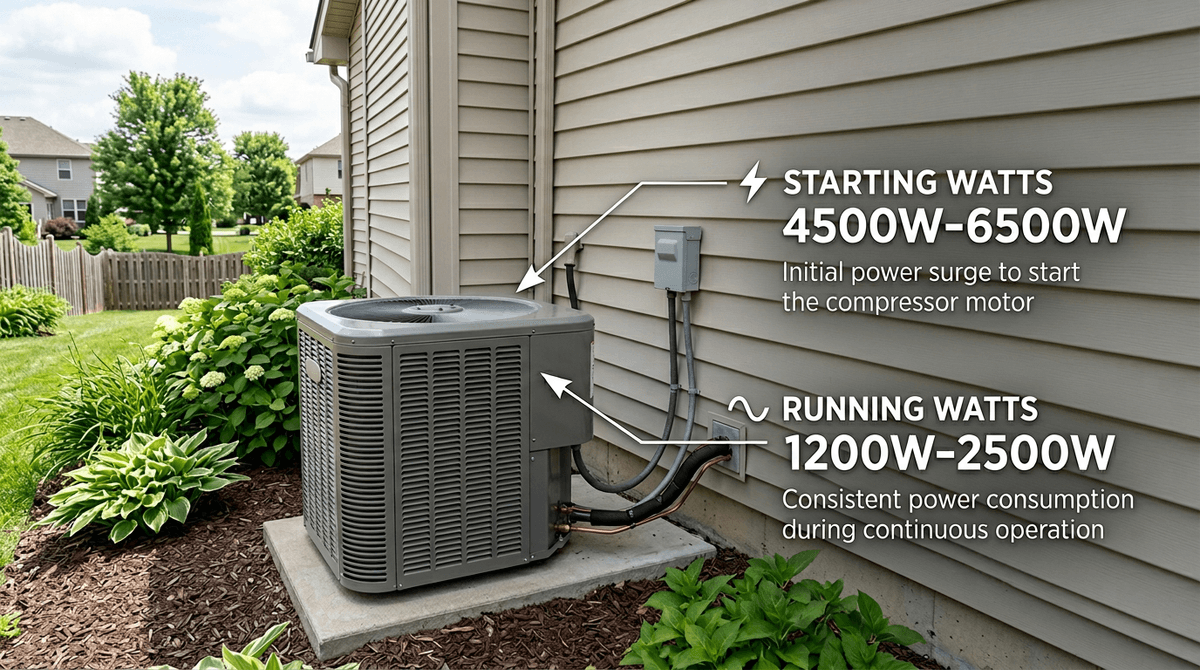
A central air conditioner draws about 1,800 to 7,200+ watts at the wall while cooling, depending on tonnage, equipment age, and whether you count the whole system—outdoor compressor and condenser fan plus indoor blower—not the outdoor nameplate alone. Running watts track SEER, charge, duct losses, and thermostat duty cycle; LRA on the compressor label is the locked-rotor story that can trip portables even when average kWh looks manageable.
Practical bottom line: a 2-ton system often lands 2,200 to 3,200 W running; 3-ton 3,000 to 4,500 W; 4-ton 4,000 to 5,800 W. Ten hours at 3,800 W average is 38 kWh in one hot day—often the largest summer line on the bill. Read your condenser and air-handler labels, then model outdoor plus indoor in the WattSizing Calculator before betting a portable generator on LRA.
Running watts by tonnage (ballpark)
A cooling "ton" is 12,000 BTU/h of capacity—not weight. Installed watts vary with line set length, airflow, and single-stage vs variable-speed design. Treat the table as a conversation starter; your sticker wins.
| Size (ton) | Running W (very rough) | Notes |
|---|---|---|
| 1.5 | 1,800 – 2,800 W | Smaller homes, mild climates |
| 2.0 | 2,200 – 3,200 W | Common residential class |
| 3.0 | 3,000 – 4,500 W | Frequent one-system homes |
| 4.0 | 4,000 – 5,800 W | Often 240 V outdoor section |
| 5.0 | 5,200 – 7,200 W | High run W; LRA is not gentle |
Variable-speed outdoor sections with a matched indoor unit can soften both peak draw and real-world kWh versus old single-stage equipment at the same nominal tonnage.
Where the watts go: compressor, outdoor fan, indoor blower
Most kWh is the compressor; the outdoor condenser fan and indoor blower add steady watts every minute the system is in call. A blower left on "fan 24/7" is a separate habit from cooling cycles.
For modest comfort watts without spinning the compressor, a ceiling fan plus a slightly higher thermostat setpoint often beats running the condenser harder. Ducted central is a system story—do not model the outdoor box in isolation.
RLA, LRA, and reading the condenser label
Outdoor nameplates use amp ratings that mean different things:
- RLA (rated load amps): running current for the compressor in normal conditions—rough W is RLA × supply voltage (many outdoor sections on ~240 V split; read your tag).
- LRA (locked rotor amps): a stressed inrush/locked-rotor value for backup sizing and licensed soft-start discussions—field results vary; marketing "percent off LRA" is a reason to test, not a promise.
- FLA on the outdoor fan: add to the outdoor run picture. The indoor blower is often a separate overcurrent device and label—include it in system watts.
A safely measured clamp reading in active cooling plus blower context beats any blog table for your house. See running vs starting watts when stacking AC start with a refrigerator on the same backup leg.
What most guides skip
Outdoor nameplate alone is an incomplete model. Real bills and generator lists need compressor, condenser fan, and air-handler blower together. Sizing backup on outdoor RLA without the indoor unit understates run watts and misstates comfort.
LRA is not your daily amp draw—but it sizes portables. A 7,500 W portable might start a small tonnage on favorable LRA with nothing else surging; a 4-ton single-stage with stacked loads often will not. Get a licensed opinion before betting outage comfort on brochure math.
Thermostat fantasy: colder does not mean faster on single-stage. Dropping setpoint 10 °F below target does not "rush" cooling—it extends run time and kWh. Shade, envelope, and filter maintenance move bills more than heroic setpoints.
Duct leak in a hot attic wastes kWh before the unit is "bad." Sealed ducts and a clean filter (often 30 to 60 days for 1-inch pleated in real dust) reduce run time. Poor airflow can extend cycles or risk freeze-up behavior.
Ducted central vs ductless is an installed kWh question. Window AC vs mini split comparisons depend on zoning, part-load behavior, and install quality—not headline tonnage alone.
Worked example: kWh on a hot summer day
Use kWh = watts × hours ÷ 1,000 when average draw is reasonably stable over the cooling window.
Example: whole-system average 3,800 W for 10 hours of active cooling on a hot day:
3,800 × 10 ÷ 1,000 = 38 kWh
At $0.16/kWh, that day costs about $6.08. A mild week in a tight, shaded home can be far lower; poor insulation plus extreme heat and solar gain pushes the curve the other way. For dollar math, see electricity bill from kWh. U.S. retail context: EIA electricity explained.
Daily kWh is roughly running W × hours in call, with cycling smoothing the average—submeter or utility interval data beats guessing when stakes are high.
Generators, soft start, and stacking the rest of the house
LRA sets part of the "can the backup source start it?" story. Concurrent refrigerator, water heater, and dryer circuits on the same transfer panel eat headroom fast—model concurrent peaks, not best-case isolation.
A listed soft-start or compressor ramp product is designed and commissioned by qualified trades; treat field tests as mandatory before relying on a marginal portable. Operate generators outdoors with listed transfer gear—no backfeed. U.S. DOE portable generator safety is the sensible anchor.
For room-scale alternatives during outage, portable air conditioner loads differ in surge shape and zoning—but central ducted comfort is a different commitment entirely.
Checklist: measure your central AC before backup planning
- Photograph outdoor condenser labels: RLA, LRA, FLA, voltage.
- Find the indoor air-handler or furnace blower label—separate from outdoor.
- If safe and qualified, clamp active cooling for a run-cycle average—not one guess at idle.
- Note thermostat habits, filter condition, and obvious duct issues in hot spaces.
- Add outdoor plus indoor rows in the WattSizing Calculator with fridge and other transfer-panel loads.
FAQs
How many watts does a central air conditioner use?
Running watts depend on tonnage and system design. Very rough bands: 1.5 ton 1,800–2,800 W; 2 ton 2,200–3,200 W; 3 ton 3,000–4,500 W; 4 ton 4,000–5,800 W; 5 ton 5,200–7,200 W. Include indoor blower watts for honest totals.
Is "3 tons" the same as a fixed running wattage?
No. Tons are cooling capacity; watts are electrical input at your SEER and field conditions. The blower and fan motors are part of the system story.
Why is LRA so much higher than RLA on the tag?
LRA is a stressed inrush/locked-rotor ceiling for the compressor, not a continuous day-long draw. It still matters for backup and ramp devices because starting is when breakers and generators stall or trip.
Do I include the indoor air handler in central AC watts?
Yes for real bills and real backup. The system does not cool with an outdoor box alone—air moves through ducts via the blower.
Can a 7,500 W portable start central AC?
Sometimes on small tonnage with favorable LRA and nothing else surging; often not for larger tonnage without a field strategy. See running vs starting watts and get a licensed opinion before you bet comfort on it.
Does high SEER always fix a high summer bill?
No if the envelope and gains are bad. A modest SEER in a tight home can beat a trophy rating on a leaky one in kWh per degree terms.
Is daily kWh just running W times hours the AC is on?
Roughly, with cycling smoothing the average—submeter or utility interval data beats guessing when stakes are high.
When is ducted central still competitive on kWh with mini splits?
When ducts are sealed, charge is right, and the blower is not fighting the coils—compare installed kWh, not headline W from a chart.
Next step: Enter outdoor plus indoor measured watts and concurrent transfer-panel loads in the WattSizing Calculator before sizing a portable generator or planning outage cooling.


