
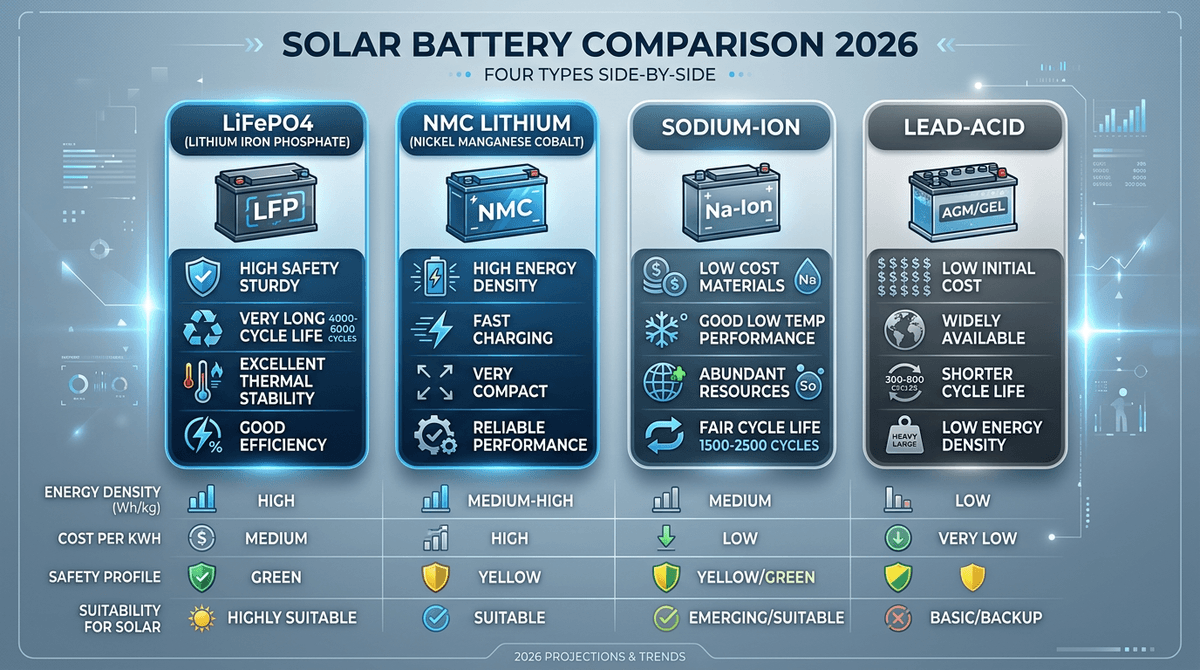
For solar energy storage in 2026, Lithium Iron Phosphate (LiFePO4) remains the best overall battery chemistry for off-grid and home backup due to its exceptional safety, 6,000+ cycle lifespan, and high usable capacity. NMC (Nickel-Manganese-Cobalt) is the top choice when space and weight are severely limited, while emerging Sodium-Ion technology offers a safer, cobalt-free alternative for budget-conscious stationary setups. Lead-acid is now largely obsolete for daily cycling, making sense only for extreme budget constraints or rare backup scenarios.
Choosing the right battery chemistry for your solar system means weighing safety, cycle life, cost, and where you’ll use it—off-grid, hybrid, or backup.
For how much capacity you need regardless of chemistry, see diagnose off grid solar failures with multimeter and our calculator.
Crucial Factors Often Overlooked
Many battery guides simply list chemistries and their prices, but they miss the real-world operational differences that dictate system design:
- Thermal Runaway Risks: NMC batteries require much stricter fire containment and BMS (Battery Management System) oversight than LiFePO4 or Sodium-Ion. Putting NMC in a hot RV compartment is a very different risk profile than placing it in a climate-controlled garage.
- True Usable Capacity (DoD): A 100Ah lead-acid battery only provides 50Ah of usable power before you damage it. A 100Ah LiFePO4 battery provides 80Ah to 90Ah. You cannot compare them strictly on a dollar-per-rated-Ah basis.
- Charge Acceptance Rates: LiFePO4 and NMC can absorb solar power much faster than lead-acid. If you have a short winter solar window, lead-acid batteries may not charge fully before the sun sets, whereas lithium will soak up every available amp.
LiFePO4 (Lithium Iron Phosphate)
What it is: A lithium chemistry with an iron-phosphate cathode. Dominant in stationary solar and RVs in 2026.
Pros:
- Safety: Very stable; rare thermal runaway. Suitable for indoor and mobile use.
- Cycle life: Often 3,000–6,000+ cycles (daily use for many years). See hybrid solar systems.
- Depth of discharge: 80–90% usable without shortening life. See AGM vs gel batteries.
- Weight: Much lighter per kWh than lead-acid.
Cons:
- Slightly lower energy density than NMC (larger or heavier pack for same kWh).
- Upfront cost higher than lead-acid (often better value over 10+ years).
Best for: Most new off-grid and hybrid systems, RVs, boats, and home backup. Default choice for solar in 2026. Compare with lead-acid in .
NMC / NCA (Nickel-Manganese-Cobalt and variants)
What it is: High-energy-density lithium (e.g. NMC, NCA) used in many EVs and some power walls.
Pros:
- Energy density: More Wh per kg and per liter than LiFePO4; smaller pack for same capacity.
- Performance: Good in cold and high discharge rates; common in EVs and some grid-tied storage.
Cons:
- Safety: Higher risk of thermal runaway if damaged or abused; often requires robust BMS and installation practices. Many installers prefer LiFePO4 for indoor or residential.
- Cycle life: Often 1,500–3,000 cycles; may need replacement sooner than LiFePO4 in daily cycling.
- Cost: Can be similar or higher than LiFePO4 per kWh; lifecycle cost may be less favorable for daily solar cycling.
Best for: Space- or weight-limited installations where energy density matters; some utility-scale and EV-integrated systems. For typical off-grid and home backup, LiFePO4 is usually the safer, longer-lived choice.
Sodium-Ion
What it is: Batteries that use sodium instead of lithium. Commercial products are growing in 2025–2026.
Pros:
- Raw materials: Sodium is abundant; less pressure on lithium supply; potentially lower long-term cost.
- Safety: Generally stable; similar or better than LiFePO4 in many tests.
- Cold performance: Often good at low temperatures.
- Eco profile: No cobalt; simpler supply chain.
Cons:
- Energy density: Lower than lithium (larger/heavier pack for same kWh).
- Maturity: Fewer products and less field history than LiFePO4; availability and warranties vary by region.
- Cycle life: Improving but still often behind LiFePO4 in published specs.
Best for: Cost-sensitive or sustainability-focused projects where size/weight is less critical; backup and some off-grid as products and warranties expand. Worth watching in 2026 for second-generation cells. See Grade A vs Grade B LiFePO4 cells for a direct comparison.
Lead-Acid (Flooded, AGM, Gel)
What it is: Traditional chemistry; flooded, AGM, and gel are the main types.
Pros:
- Price: Lowest upfront cost per kWh (new).
- Availability: Easy to find and replace almost anywhere.
- Simplicity: Well-understood; no complex BMS for basic setups.
Cons:
- Depth of discharge: Only ~50% recommended for cycle life. You need roughly twice the rated capacity for the same usable energy as LiFePO4. See backup load planning and AGM vs gel batteries.
- Cycle life: Often 300–1,200 cycles; replacement every few years in daily use.
- Weight: Heavy per kWh; poor fit for RVs and boats.
- Maintenance: Flooded types need watering and ventilation; AGM/gel are maintenance-free but still short-lived compared to lithium.
Best for: Tight budget and short-term use; existing lead-acid systems; some backup-only applications where cycling is rare. For new builds, LiFePO4 usually offers better total cost of ownership.
Illustrative Cost Comparison: LiFePO4 vs. Lead-Acid
(Note: This is an illustrative example using typical 2026 market rates to demonstrate lifecycle economics.)
Imagine you need 5 kWh of usable energy per day for an off-grid cabin.
Option A: Lead-Acid (AGM)
- To get 5 kWh usable at 50% DoD, you must buy a 10 kWh battery bank.
- Cost: ~$1,500 upfront.
- Cycle Life: ~500 cycles (lasts about 1.5 years of daily use).
- 10-Year Cost: You will replace this bank 6 times. Total cost = $9,000.
Option B: LiFePO4
- To get 5 kWh usable at 80% DoD, you must buy a 6.25 kWh battery bank.
- Cost: ~$1,800 upfront.
- Cycle Life: ~4,000 cycles (lasts about 11 years of daily use).
- 10-Year Cost: No replacements needed. Total cost = $1,800.
While lead-acid appears cheaper on day one, LiFePO4 is significantly more cost-effective over the lifespan of a solar system.
Side-by-Side (2026)
| Chemistry | Safety (typical) | Cycle life (typical) | DoD usable | Cost (upfront) | Best use case |
|---|---|---|---|---|---|
| LiFePO4 | High | 3,000–6,000+ | 80–90% | Medium–high | Off-grid, hybrid, backup |
| NMC | Moderate | 1,500–3,000 | 80–90% | Medium–high | Space/weight-limited |
| Sodium-ion | High | Improving | Varies | Improving | Cost/sustainability focus |
| Lead-acid | High | 300–1,200 | ~50% | Low | Budget, legacy, low cycle |
What to Choose in 2026
- New off-grid or hybrid, want long life and safety: LiFePO4.
- Need smallest/lightest pack: NMC (with proper safety and lifecycle expectations).
- Prioritize cost and sustainability, can accept larger pack: Sodium-ion (where available and warranted).
- Minimal budget or existing lead-acid: Lead-acid (plan for earlier replacement and larger bank).
Sizing is the same across chemistries: How to Size a Battery Bank for Solar. Chemistry only changes the physical size, weight, cost, and replacement interval. Use the WattSizing calculator to get your capacity, then choose the chemistry that fits your budget and risk tolerance.
FAQs
Is LiFePO4 the best battery for solar in 2026?
For most home and off-grid solar applications, yes. LiFePO4 offers a strong combination of safety, long cycle life, high usable depth of discharge, and good total cost of ownership. NMC can make sense when space or weight is critical; sodium-ion is emerging as an alternative for cost and sustainability.
How does sodium-ion compare to LiFePO4 for solar?
Sodium-ion is generally safer and potentially cheaper long-term, with lower energy density (bigger/heavier for the same kWh). Cycle life and product availability are still evolving. In 2026, LiFePO4 remains the default for most solar; sodium-ion is a good option to watch for new installations where size isn’t the main constraint.
Can I use NMC batteries for off-grid solar?
Yes, but NMC has higher thermal runaway risk than LiFePO4 and often fewer cycles under daily full cycling. It’s better suited to space- or weight-limited setups and when you’re comfortable with installation and BMS requirements. For typical off-grid and backup, LiFePO4 is the safer, longer-lived choice.
Why is lead-acid cheaper but often worse value for solar?
Lead-acid has low depth of discharge (~50%) and shorter cycle life, so you need roughly twice the capacity and replace it 2–3 times in the time one LiFePO4 bank lasts. Total cost over 10+ years often favors LiFePO4. Lead-acid still makes sense for very tight budgets or low-cycling backup. See AGM vs gel batteries.
Does battery chemistry affect how many panels I need?
No. Panel count is driven by daily energy use and peak sun hours; see diagnose off grid solar failures with multimeter. Chemistry affects battery capacity (and thus size, weight, cost), not the solar array size.
Will cold weather ruin my lithium batteries?
LiFePO4 and NMC batteries cannot be charged below freezing (32°F / 0°C) without causing irreversible lithium plating damage. If you live in a cold climate, you must either install the batteries in a conditioned space or purchase "self-heating" lithium batteries that use incoming solar power to warm the internal cells before allowing charge current to flow.
Size your bank with the WattSizing calculator and read How Many Batteries Do I Need for Off-Grid Solar and Depth of Discharge (DoD) for Solar Batteries to apply these chemistries to your system.


