
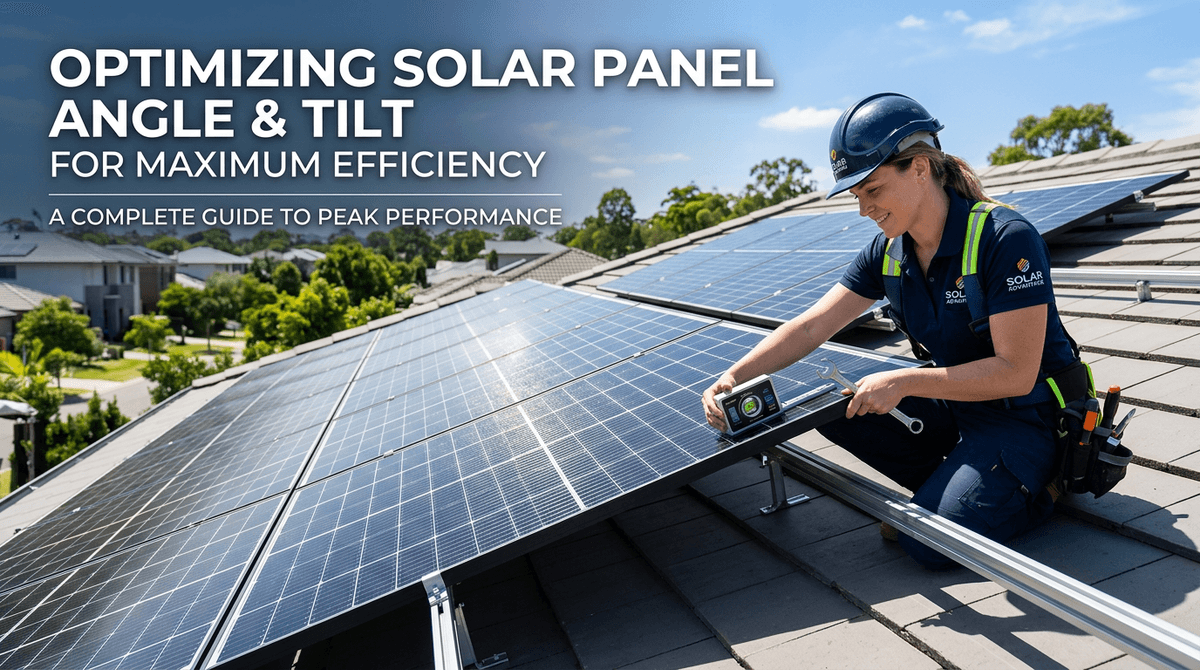
When designing an off-grid solar system, buying high-efficiency panels is only half the battle. To extract every possible watt of power from the sun, your panels must be pointed directly at it.
The angle (tilt) and orientation (azimuth) of your solar array dictate how much direct sunlight hits the photovoltaic cells throughout the day and across the seasons. A poorly angled array can easily lose 20% to 30% of its potential energy production.
In this ultimate guide, the WattSizing team breaks down the math behind solar panel tilt, how to calculate the perfect angle based on your location, and whether seasonal adjustments are actually worth the effort.
Before you start climbing on your roof with a protractor, make sure your system is sized correctly. Use our Off-Grid Solar Calculator to determine your exact energy needs.
The Basics: Angle vs. Orientation
Before we dive into the calculations, let's define the two critical terms used in solar mounting:
- Orientation (Azimuth): The compass direction your panels face. In the Northern Hemisphere, the optimal orientation is True South (not magnetic south). In the Southern Hemisphere, it is True North.
- Tilt (Angle): The vertical angle of the panels relative to the ground. A panel lying flat on the ground has a tilt of 0°. A panel standing straight up against a wall has a tilt of 90°.
This guide focuses primarily on Tilt, assuming you have already oriented your panels toward the equator.
Why Does Tilt Matter?
Solar panels generate maximum power when the sun's rays hit the glass at exactly a 90-degree (perpendicular) angle.
Because the Earth is tilted on its axis, the sun's path across the sky changes throughout the year. In the summer, the sun is high overhead. In the winter, the sun stays low on the horizon.
If your panels are mounted flat (0° tilt), they will perform decently in the summer when the sun is high, but terribly in the winter when the sun's rays glance off the glass at a shallow angle.
Conversely, if your panels are mounted vertically (90° tilt), they will catch the low winter sun perfectly but miss the high summer sun entirely.
The goal of finding the "optimal tilt" is to find the sweet spot that maximizes your annual energy production, or to optimize for a specific season when you need power the most.
The Golden Rule: Tilt = Latitude
The simplest and most widely accepted rule of thumb for solar panel tilt is: Set your tilt angle equal to your geographical latitude.
- If you live in Los Angeles, CA (Latitude 34° N), your optimal year-round tilt is 34°.
- If you live in Seattle, WA (Latitude 47° N), your optimal year-round tilt is 47°.
- If you live in Miami, FL (Latitude 25° N), your optimal year-round tilt is 25°.
This "Latitude Rule" provides the best compromise for capturing both the high summer sun and the low winter sun, resulting in the highest total energy production over a 12-month period.
Seasonal Adjustments: Are They Worth It?
While the Latitude Rule is great for a fixed, "set-it-and-forget-it" roof mount, it is still a compromise.
If you have a ground mount or an adjustable RV roof rack, you can significantly boost your energy production by changing the tilt of your panels two to four times a year.
The Math for Seasonal Adjustments
To optimize for the extreme differences between summer and winter sun paths, use these calculations:
- Optimal Summer Tilt: Latitude minus 15°
- Optimal Winter Tilt: Latitude plus 15°
Example: Denver, CO (Latitude 40° N)
- Year-Round Fixed Tilt: 40°
- Summer Tilt (May - August): 25° (Flatter, to catch the high sun)
- Winter Tilt (November - February): 55° (Steeper, to catch the low sun)
- Spring/Fall Tilt (March-April, Sept-Oct): 40°
How Much Extra Power Do You Get?
Adjusting your panels twice a year (Summer/Winter) typically yields a 4% to 5% increase in total annual energy production compared to a fixed year-round tilt.
Adjusting them four times a year (adding Spring/Fall) yields about a 5% to 6% increase.
Is it worth it? For a large residential grid-tied system, a 5% increase is usually not worth the danger and hassle of climbing on the roof twice a year.
However, for an off-grid cabin or RV where winter power is scarce and every watt counts, adjusting your panels to a steep winter angle is absolutely critical. A steep winter angle not only captures more direct sunlight but also helps shed snow rapidly.
Flat Mounting vs. Tilted Mounting (RVs and Vans)
If you are outfitting a vehicle, you face a unique dilemma: Should you mount your panels flat on the roof, or install tilting brackets?
The Case for Flat Mounting (0° Tilt)
Most RVers and van lifers choose to mount their panels flat (or use Flexible Solar Panels).
- Pros: It is aerodynamically efficient, visually stealthy, and requires no setup when you arrive at camp. You collect power while driving, regardless of which direction you are traveling.
- Cons: You lose about 10% to 15% of your potential annual power compared to an optimally tilted array. In the winter, flat panels perform abysmally, and they collect dirt and snow much faster.
The Case for Tilted Mounting
Using adjustable brackets allows you to tilt the panels toward the sun when parked.
- Pros: Massive power gains in the winter. The panels stay cleaner as rain washes dirt off the steep angle.
- Cons: You must climb on the roof every time you park to deploy them, and remember to lower them before driving. You must also park your vehicle facing the correct direction (East/West) so the panels tilt South.
The WattSizing Recommendation: If you only camp in the summer, flat mounting is fine. Just over-panel your roof by 15% to compensate for the efficiency loss. If you live in your van full-time or camp in the winter, tilting brackets are highly recommended.
Special Considerations for Off-Grid Systems
When designing an off-grid system, your goal is rarely to maximize annual production. Your goal is to survive the worst month of the year (usually December or January).
In the summer, you will likely have more solar power than you know what to do with. In the winter, you will be struggling to keep your batteries charged due to short days, low sun angles, and cloudy weather.
The Off-Grid Strategy: Instead of setting your fixed array to your Latitude (the year-round optimum), set your fixed array to your Winter Tilt (Latitude + 15°).
By optimizing for winter, you sacrifice some excess summer power (which you didn't need anyway) to gain crucial winter power when your batteries are starving.
Additionally, a steep winter tilt is highly beneficial if you are using Bifacial Solar Panels over a snowy surface, as it increases the rear-side reflection and sheds snow instantly.
Frequently Asked Questions (FAQ)
What if my roof doesn't face True South?
If your roof faces East or West, you will lose about 15% to 20% of your potential production compared to a South-facing roof. To compensate, you should install your panels at a slightly flatter angle (lower tilt) than your latitude. A flatter angle allows the panels to catch more ambient light throughout the entire day, rather than relying solely on direct hits.
Does a 5-degree difference in tilt matter?
No. The sun's angle changes constantly. Being off by 5 or even 10 degrees from the "mathematically perfect" tilt will only result in a 1% to 2% loss in annual production. Don't stress over a few degrees.
How do I find True South?
Do not use a standard compass, as it points to Magnetic South, which can be off by up to 20 degrees depending on your location (magnetic declination). Use a smartphone app that adjusts for True South, or simply look at where the sun is at exactly "solar noon" (the midpoint between sunrise and sunset).
Final Verdict
Finding the perfect solar panel angle is a balancing act between mathematical perfection and practical reality.
For most fixed installations, setting the tilt equal to your latitude is the best approach. For off-grid systems, optimizing for winter (Latitude + 15°) is the smartest strategy to ensure year-round reliability.
Ready to calculate exactly how many panels you need at your specific tilt angle? Head over to the WattSizing Calculator to finalize your off-grid design!


