
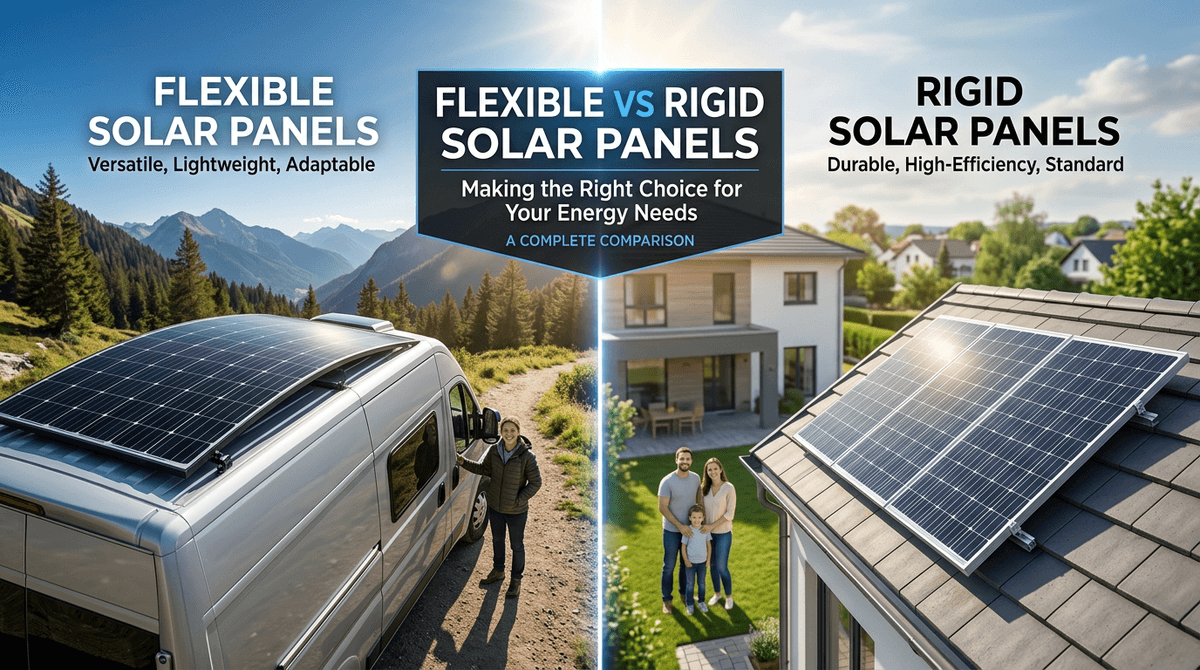
When outfitting an RV, van, boat, or tiny home with solar power, one of the first major decisions you'll face is choosing between flexible and rigid solar panels. Both types harness the sun’s energy to charge your batteries, but they are built differently, perform differently, and serve very different use cases.
At WattSizing, we’ve seen thousands of off-grid systems, and the debate between flexible and rigid panels is always a hot topic. In this comprehensive guide, we’ll break down the pros, cons, and best applications for each type so you can make an informed decision for your specific needs.
Before you buy any panels, make sure you know exactly how much solar you need. Use our free Off-Grid Solar Calculator to size your system perfectly.
What Are Rigid Solar Panels?
Rigid solar panels are the traditional, heavy-duty panels you see on residential rooftops and large solar farms. They are constructed using monocrystalline or polycrystalline silicon solar cells, protected by a sheet of tempered glass, and encased in a sturdy aluminum frame.
The Pros of Rigid Solar Panels
- Maximum Durability and Longevity: Rigid panels are built to withstand harsh weather, including heavy snow loads, high winds, and hail. The tempered glass and aluminum frame provide excellent protection. Most rigid panels come with a 25-year power output warranty.
- Higher Efficiency: Because they use high-quality silicon cells and have better heat dissipation (thanks to the air gap created by the mounting frame), rigid panels generally operate more efficiently than flexible panels, especially in hot weather.
- Lower Cost Per Watt: Rigid panels are mass-produced on a massive scale for the residential and commercial markets. This economy of scale makes them significantly cheaper per watt than flexible panels.
- Better Heat Dissipation: Solar panels lose efficiency as they get hotter. Rigid panels are mounted on brackets that leave an air gap between the panel and the roof, allowing air to circulate and cool the panel, maintaining higher output.
The Cons of Rigid Solar Panels
- Heavy and Bulky: A standard 100W rigid panel can weigh between 15 and 20 pounds. For a large array on an RV or van, this adds significant weight and top-heaviness to the vehicle.
- Difficult Installation: Installing rigid panels requires drilling holes into your roof to attach mounting brackets, which introduces the risk of water leaks if not sealed properly. They also cannot conform to curved surfaces.
- Wind Resistance (Drag): The air gap that helps with cooling also creates aerodynamic drag when driving at highway speeds, which can slightly reduce your vehicle's fuel efficiency.
What Are Flexible Solar Panels?
Flexible solar panels (also known as thin-film or semi-flexible panels) are made by depositing photovoltaic material onto a flexible substrate, such as plastic or polymer. They do not have an aluminum frame or tempered glass cover.
The Pros of Flexible Solar Panels
- Ultra-Lightweight: A 100W flexible panel typically weighs around 3 to 4 pounds—about 80% less than a comparable rigid panel. This makes them ideal for weight-sensitive applications like vans, lightweight trailers, and boats.
- Easy, Drill-Free Installation: Flexible panels can be mounted using strong adhesive tape (like VHB tape) or marine sealant. This eliminates the need to drill holes in your roof, preserving its integrity and preventing leaks.
- Conforms to Curved Surfaces: As the name implies, these panels can bend (usually up to 30 degrees) to follow the contour of an Airstream trailer, a boat deck, or a teardrop camper roof.
- Low Profile and Aerodynamic: Because they are glued directly to the roof and are only a few millimeters thick, flexible panels are virtually invisible from the ground and create zero aerodynamic drag.
The Cons of Flexible Solar Panels
- Shorter Lifespan and Lower Durability: The plastic/polymer top layer is prone to scratching, clouding from UV exposure, and damage from debris. Flexible panels typically only last 5 to 10 years, compared to the 25+ years of rigid panels.
- Overheating Issues: Because they are glued flush to the roof, there is no air gap for cooling. The panels get extremely hot in the sun, which significantly reduces their power output. Furthermore, this heat transfers directly into the vehicle's interior.
- Higher Cost Per Watt: The specialized manufacturing process makes flexible panels more expensive than rigid panels, often costing twice as much per watt.
- Lower Efficiency: While high-end flexible panels use monocrystalline cells, the heat buildup and lack of optimal angling mean they generally produce less power in real-world conditions than rigid panels of the same rating.
Head-to-Head Comparison
Let's look at how they stack up across key categories:
| Feature | Rigid Solar Panels | Flexible Solar Panels |
|---|---|---|
| Durability | Excellent (Glass/Aluminum) | Poor to Fair (Plastic/Polymer) |
| Lifespan | 25+ Years | 5 - 10 Years |
| Weight (per 100W) | ~15 - 20 lbs | ~3 - 4 lbs |
| Installation | Harder (Requires drilling/brackets) | Easier (Adhesive/Tape) |
| Cost | Lower ($0.80 - $1.20/Watt) | Higher ($1.50 - $2.50/Watt) |
| Heat Dissipation | Excellent (Air gap) | Poor (Flush mount) |
| Flexibility | None | Up to 30 degrees |
Which Should You Choose? Best Use Cases
The choice between flexible and rigid panels comes down to your specific application, budget, and how long you plan to keep your setup.
When to Choose Rigid Solar Panels
Rigid panels are the clear winner for the vast majority of off-grid applications. You should choose rigid panels if:
- You are building an off-grid cabin or home: Weight and aerodynamics don't matter. You want maximum longevity, efficiency, and the best price per watt.
- You have a large RV or Skoolie: If your roof is flat and can handle the weight, rigid panels provide the most reliable power for long-term living.
- You want a permanent, long-lasting setup: If you don't want to replace your panels in 5 years, go rigid.
- You plan to tilt your panels: Rigid panels can be mounted on tilt brackets to maximize winter sun exposure. (See our guide on Solar Panel Angle and Tilt for more info).
When to Choose Flexible Solar Panels
Flexible panels are a specialty product. You should choose flexible panels if:
- You have a curved roof: Airstreams, teardrop campers, and some fiberglass high-top vans require panels that can contour to the roofline.
- Weight is a critical concern: If you are outfitting a lightweight pop-up camper, a small van, or a sailboat where every pound matters, flexible panels are essential.
- You absolutely cannot drill holes: If you are renting a vehicle, or simply refuse to put holes in your pristine roof, adhesive-mounted flexible panels are the way to go.
- You need a portable, storable solution: While folding "suitcase" panels are usually rigid, some people prefer ultra-thin flexible panels that can be tossed on the windshield or hung from an awning when parked, and easily stored under a bed when driving.
Can You Mix Flexible and Rigid Panels?
Technically, yes, but it is generally not recommended to wire them together in the same series string. Flexible panels heat up faster and operate at different voltages and currents than rigid panels.
If you must mix them, wire the rigid panels to one charge controller and the flexible panels to a separate charge controller. For a deep dive into this topic, read our article on Mixing Different Wattage or Brand Solar Panels.
Installation Tips for Flexible Panels
If you decide flexible panels are right for you, follow these tips to maximize their lifespan:
- Use High-Quality Tape: Do not use cheap adhesive. Use 3M VHB (Very High Bond) tape or marine-grade Sikaflex.
- Create a Small Air Gap (If Possible): Instead of taping the entire perimeter, use strips of VHB tape or mount them on a thin sheet of corrugated plastic (like Coroplast) to create tiny air channels beneath the panel. This drastically reduces heat buildup.
- Seal the Edges: Once taped down, run a bead of self-leveling lap sealant or Dicor around the edges to prevent water and dirt from getting under the panel and degrading the adhesive.
Final Verdict
For 90% of off-grid users, rigid solar panels are the better investment. They are cheaper, last significantly longer, perform better in the heat, and are far more durable.
However, if you are dealing with a curved roof, strict weight limits, or a strict "no-drill" policy, flexible solar panels are a fantastic, albeit temporary, solution that allows you to harness solar energy where rigid panels simply won't work.
Ready to design your system? Head over to the WattSizing Calculator to determine your exact solar and battery requirements based on your daily energy usage!


