
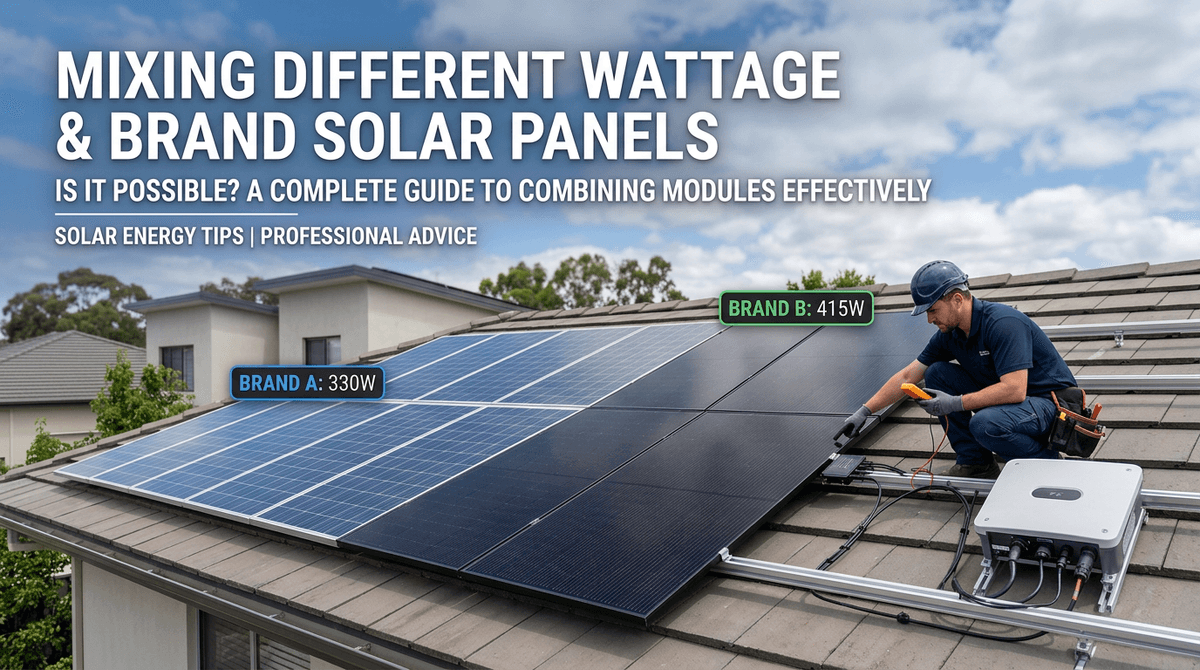
One of the most common scenarios in DIY off-grid solar is expanding an existing system. You started with two 100W Renogy panels a few years ago, and now you want to add a 200W Rich Solar panel you found on sale.
This leads to the inevitable question: Can you mix different wattage, voltage, or brand solar panels in the same system?
The short answer is yes, but you must wire them correctly. If you wire mismatched panels improperly, you will severely throttle your power output, waste money, and potentially damage your equipment.
In this comprehensive guide, the WattSizing team breaks down the golden rules of mixing solar panels. We’ll cover how to wire mismatched panels in series, in parallel, and when you absolutely need a second charge controller.
Before expanding your array, use our Off-Grid Solar Calculator to determine exactly how many total watts you need for your upgraded system.
The Golden Rules of Mixing Solar Panels
Before we dive into the math, you must understand the two fundamental rules of solar panel wiring:
- Wiring in Series adds Voltage (V) but keeps Current (Amps) the same.
- Wiring in Parallel adds Current (Amps) but keeps Voltage (V) the same.
When you mix different panels, the weakest link in the chain dictates the performance of the entire array. How that "weak link" behaves depends entirely on whether you wired them in series or parallel.
Understanding the Specs
To mix panels safely, you need to look at the sticker on the back of each panel and find three key numbers:
- Maximum Power (Pmax): The wattage rating (e.g., 100W).
- Voltage at Maximum Power (Vmp): The operating voltage (e.g., 18V).
- Current at Maximum Power (Imp): The operating amperage (e.g., 5.5A).
(Note: Do not confuse Vmp with Open Circuit Voltage (Voc), or Imp with Short Circuit Current (Isc). You need Vmp and Imp for these calculations.)
Scenario 1: Mixing Different Brands (Same Specs)
Can I mix a 100W Renogy panel with a 100W HQST panel?
Yes, absolutely. If the panels have the same (or very similar) Vmp and Imp ratings, the brand does not matter. A 100W panel from Brand A that outputs 18V and 5.5A will work perfectly with a 100W panel from Brand B that outputs 18.1V and 5.4A.
You can wire these in series or parallel just as you would two identical panels.
Scenario 2: Mixing Different Wattages in Series
Rule: When wiring in series, the panel with the LOWEST Current (Amps) drags down the entire string.
Let's say you want to wire a 100W panel and a 200W panel in series.
- Panel A (100W): 18V (Vmp) and 5.5A (Imp)
- Panel B (200W): 20V (Vmp) and 10A (Imp)
If you wire these in series, the voltages add up (18V + 20V = 38V). However, the current of the entire string is throttled by the lowest-amperage panel (Panel A at 5.5A).
- Total Output: 38V x 5.5A = 209 Watts.
The Result: You paid for 300W of solar panels (100W + 200W), but you are only getting 209W. You effectively turned your 200W panel into a 109W panel.
Verdict: Never mix panels with significantly different amperage (Imp) in series.
Scenario 3: Mixing Different Wattages in Parallel
Rule: When wiring in parallel, the panel with the LOWEST Voltage (Vmp) drags down the entire array.
Let's use the exact same panels, but wire them in parallel using Y-branch connectors.
- Panel A (100W): 18V (Vmp) and 5.5A (Imp)
- Panel B (200W): 20V (Vmp) and 10A (Imp)
If you wire these in parallel, the amperages add up (5.5A + 10A = 15.5A). However, the voltage of the entire array is pulled down to match the lowest-voltage panel (Panel A at 18V).
- Total Output: 18V x 15.5A = 279 Watts.
The Result: You paid for 300W, and you are getting 279W. You lost about 21W of potential power.
Verdict: Mixing different wattages in parallel is much better than in series, provided the voltages (Vmp) are relatively close. A 2V difference is acceptable, but a 10V difference would cause massive power loss.
Scenario 4: Mixing 12V and 24V Panels
Many people try to mix a "12V nominal" panel (usually around 18V Vmp) with a large residential "24V nominal" panel (usually around 36V Vmp).
Wiring them in Series
- Panel A (100W): 18V and 5.5A
- Panel B (300W): 36V and 8.3A
- Result: The string voltage becomes 54V, but the current is throttled to 5.5A. (54V x 5.5A = 297W). You lost over 100W of power.
Wiring them in Parallel
- Panel A (100W): 18V and 5.5A
- Panel B (300W): 36V and 8.3A
- Result: The array amperage becomes 13.8A, but the voltage is violently dragged down to 18V. (18V x 13.8A = 248W). You lost over 150W of power, and the 36V panel might actually push current backward into the 18V panel, damaging it.
Verdict: Never mix 12V and 24V panels in the same array, whether in series or parallel. The mismatch is too extreme.
The Best Way to Mix Mismatched Panels
If you have wildly different panels (e.g., a 100W flexible panel, two 100W rigid panels, and a 300W residential panel), there is only one correct way to use them all on the same battery bank: Use multiple Charge Controllers.
The Multiple Charge Controller Strategy
You can connect as many MPPT solar charge controllers to a single battery bank as you want, provided you don't exceed the battery's maximum charge current.
- Take your two identical 100W rigid panels and wire them in series to Charge Controller #1.
- Take your 300W residential panel and wire it to Charge Controller #2.
- Take your 100W flexible panel and wire it to Charge Controller #3.
- Connect all three charge controllers to the same positive and negative busbars connected to your battery bank.
Why this works: Each MPPT charge controller independently tracks the Maximum Power Point of its specific solar array. Controller #1 will optimize for the 100W rigid panels, while Controller #2 optimizes for the 300W panel. They will all dump their power into the battery simultaneously without interfering with each other.
(Note: If you are using flexible panels alongside rigid panels, you should always put them on separate controllers due to different heat degradation rates. See our guide on Flexible vs Rigid Solar Panels for more info).
Summary Cheat Sheet
Here is your quick reference guide for mixing solar panels:
- Same Brand, Same Specs: Wire them however you want (series or parallel).
- Different Brands, Same Specs: Wire them however you want (series or parallel).
- Different Wattage, Same Amperage (Imp): Wire them in Series. (Voltages add up, amperage stays the same).
- Different Wattage, Same Voltage (Vmp): Wire them in Parallel. (Amperages add up, voltage stays the same).
- Different Wattage, Different Voltage, Different Amperage: Do not wire them together. Put them on separate charge controllers.
Frequently Asked Questions (FAQ)
Do I need blocking diodes when mixing panels in parallel?
If you are mixing panels with different voltages in parallel (which we don't recommend), or if you have more than two parallel strings, you should use inline MC4 fuses or blocking diodes to prevent higher-voltage panels from back-feeding power into lower-voltage panels, which can cause overheating or fire.
Will a PWM controller handle mixed panels better than MPPT?
No. An MPPT (Maximum Power Point Tracking) controller is vastly superior for handling mixed arrays, especially in parallel, because it can sweep the voltage curve to find the best compromise. A PWM controller will simply drag the entire array down to the battery voltage, resulting in massive power loss.
Can I mix bifacial and standard panels?
You can, but treat them as mismatched panels. Bifacial panels produce varying amounts of extra current from the rear side. If you wire a bifacial panel in series with a standard panel, the standard panel will throttle the extra current generated by the bifacial panel. Wire them in parallel or use separate controllers. (Read more in our Bifacial Solar Panel Guide).
Final Verdict
Expanding your solar array with mismatched panels is a great way to save money, provided you understand the math.
Always match Amps (Imp) for Series connections, and match Volts (Vmp) for Parallel connections. When in doubt, the safest and most efficient route is to buy a second, inexpensive MPPT charge controller for the new panels.
Ready to see how many panels your expanded system needs? Head over to the WattSizing Calculator to run the numbers!


