
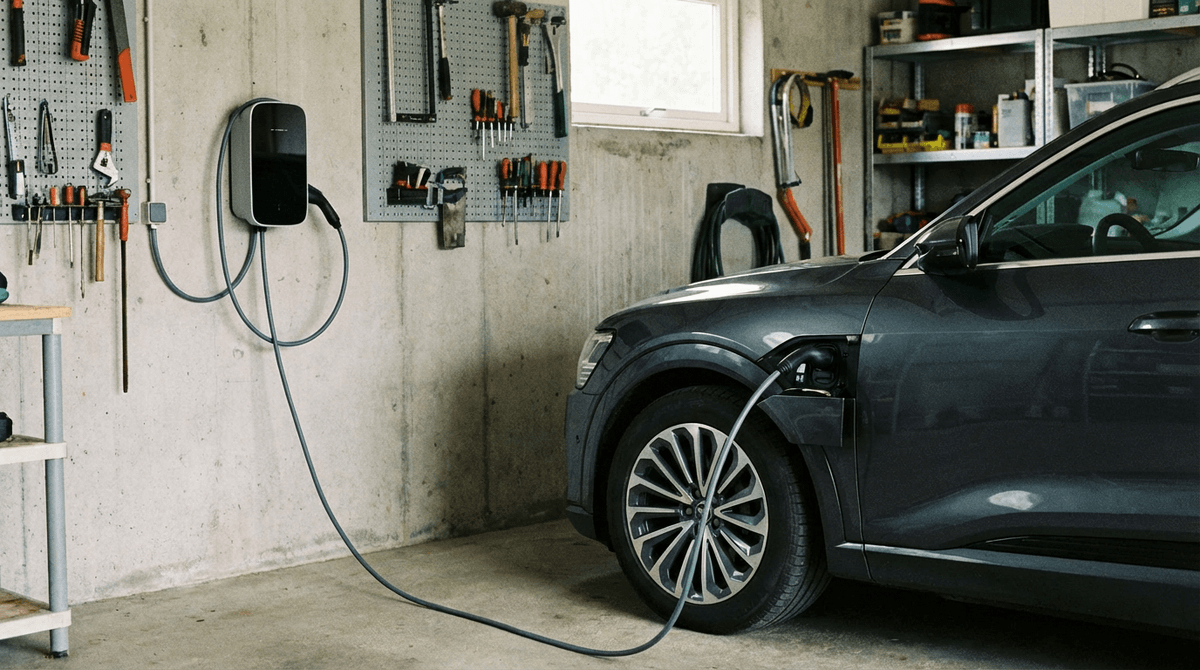
Most EV chargers use roughly 1,200 to 1,900 watts on Level 1 and about 3,300 to 11,500 watts on Level 2, depending on circuit size and vehicle limits.
For full system planning, use the WattSizing Calculator.
Quick Answer
Most EV chargers use roughly 1,200 to 1,900 watts on Level 1 and about 3,300 to 11,500 watts on Level 2, depending on circuit size and vehicle limits.
Detailed Explanation
An EV charger's actual draw is usually governed by the lowest limit between the charger, your electrical circuit, and the car's onboard charger.
Typical home ranges:
- Level 1 (120 V): often around 1.2 to 1.9 kW.
- Level 2 (240 V): often around 3.3 to 11.5 kW at home.
- Real-world tapering: charging may slow near high battery state of charge.
For home electrical planning, compare with How Many Watts Does a Water Heater Use and How Many Watts Does a Heat Pump Use, since these are also major residential loads.
Watt Table
| EV Charging Setup | Typical Running Watts | Typical Starting Watts |
|---|---|---|
| Level 1 (120 V, 12 A) | 1200 - 1500 W | 1300 - 1600 W |
| Level 1 (120 V, 16 A capable) | 1500 - 1900 W | 1600 - 2000 W |
| Level 2 (240 V, 16 A) | 3300 - 4000 W | 3500 - 4200 W |
| Level 2 (240 V, 32 A) | 6500 - 7700 W | 6800 - 8000 W |
| Level 2 (240 V, 40-48 A) | 8000 - 11500 W | 8300 - 12000 W |
Calculation Example
Example: A Level 2 charger runs at 7,200 W while active.
- kWh per charging hour = 7,200 / 1000 = 7.2 kWh
- If used for 2 hours, that session uses about 14.4 kWh
- At $0.16/kWh, session energy cost is about $2.30
For daily and monthly rollups, use the WattSizing Calculator and plug in your actual charging hours.
Tips to Reduce Power Usage
- Shift charging to off-peak utility hours if your tariff supports it.
- Use scheduled charging to avoid unnecessary top-off sessions.
- Set practical charge limits (for example 70-90%) based on your daily commute.
- Coordinate EV charging with other large loads to avoid service-panel stress.
FAQs
Does the charger always pull its maximum rated power?
No. Actual power depends on car acceptance rate, charger settings, and circuit limits.
Is Level 2 always more efficient than Level 1?
Often yes, but efficiency differences vary by vehicle and charging conditions.
Can EV charging overload a home circuit?
It can if not installed correctly. Dedicated circuits and proper breaker sizing are essential.
CTA
Planning EV charging with the rest of your household loads? Use the WattSizing Calculator to estimate realistic power and energy needs.


