
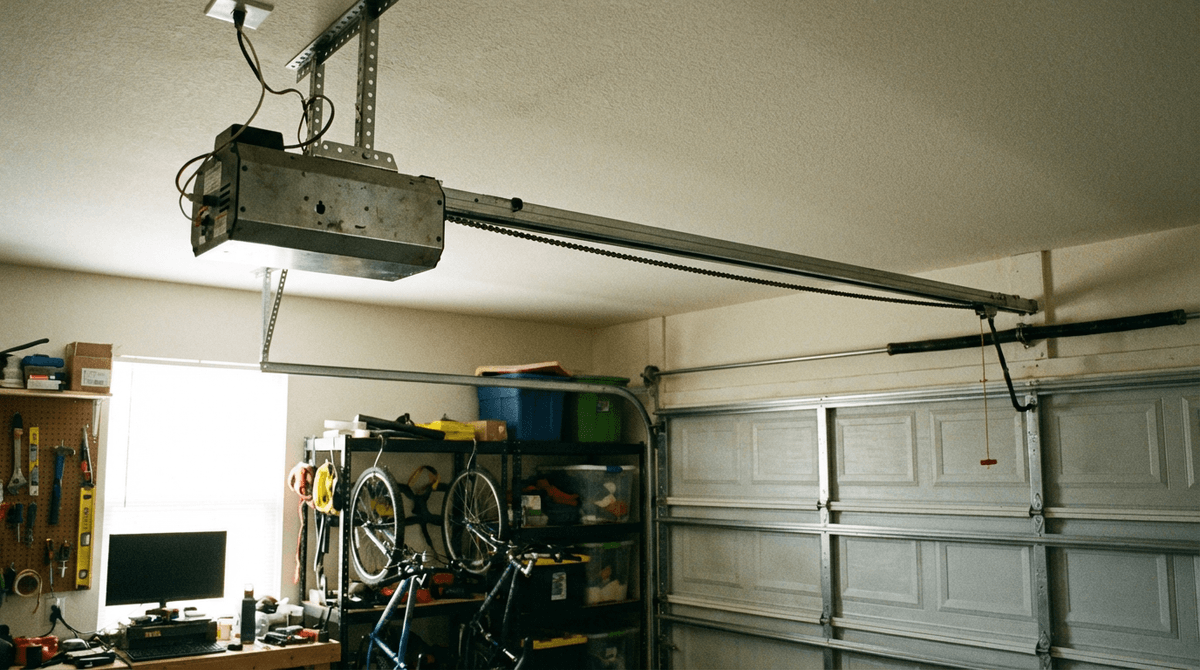
A garage door opener is an intermittent motor load: it runs for 10 to 20 seconds per cycle, then sits idle for hours. Motion watts matter for inverter surge headroom; monthly energy often comes from standby electronics—controller board, radio receiver, Wi-Fi module, and courtesy-light behavior that never fully powers down.
Practical bottom line: DC belt-drive units often draw 150 to 400 W while moving with 300 to 700 W startup peaks; AC chain-drive models commonly reach 300 to 700 W running and 500 to 1,200 W transient. Daily motion kWh is usually tiny, but 3 to 10 W standby can exceed motion energy over 24 hours. Measure yours or log the full day in the WattSizing Calculator before sizing backup power with fridge and other motor loads.
Motion watts vs standby: where the kWh actually goes
Nameplate or a plug meter beats box art. Typical 120 V opener ranges:
| Opener class | Running W (during movement) | Startup / transient W | Standby W |
|---|---|---|---|
| DC belt-drive | 150 – 400 W | 300 – 700 W | 3 – 10 W |
| AC chain-drive | 300 – 700 W | 500 – 1,200 W | 3 – 10 W |
| Older / heavy-door setups | 500 – 900 W | 800 – 1,500 W | 4 – 12 W |
The motor runs only while the door travels. Everything else—logic board, wall button receiver, smart-home radio—draws 24/7 whether you opened the door once or ten times.
Why surge headroom matters when daily kWh looks tiny
A typical open-or-close cycle lasts 10 to 20 seconds. Six trips per day is barely 90 seconds of motor runtime. Even at 500 W average while moving, motion energy stays under 0.02 kWh/day for most homes.
That low kWh does not mean an undersized inverter is fine. Motor startup and door acceleration can briefly pull 2× to 3× steady movement watts. An inverter rated for continuous output but weak on surge may trip on the first cycle—especially if a refrigerator compressor start lands in the same second.
For overlap math, see running vs starting watts and compare with other short motor rows like vacuum cleaner wattage.
What most guides skip
Standby can beat motion on the monthly bill. A 6 W always-on draw is (6 × 24) ÷ 1,000 = 0.144 kWh/day—often 10× the motion energy from a typical usage pattern. Smart Wi-Fi models sit at the high end of standby bands.
A sticky door raises watts and wear together. Poor track alignment, dry rollers, or incorrect spring balance force the motor to work harder on every cycle—higher running draw, longer runtime, and bigger transient peaks. Maintenance is an energy fix, not just a noise fix.
Courtesy lights add hidden load. Many openers keep a bulb energized for minutes after motion stops. LED retrofit helps; disabling nonessential lighting in backup mode saves watts you forget to count.
Garage circuits share the house stack. An opener alone is easy for most generators. The problem is the same minute with HVAC, dryer, or well pump starts. Model concurrent peaks, not isolated device nameplates.
DC belt-drive is quieter—not automatically lower surge. Belt systems often use softer starts, but heavy doors and cold weather still produce real transient demand. Verify with a meter on your door, not the brochure.
Worked example: motion energy plus standby in one day
Assume 500 W average while moving, 6 events/day, 15 seconds per event, and 6 W standby.
Motion runtime: 6 × 15 s = 90 s/day = 0.025 h/day
Motion kWh: (500 × 0.025) ÷ 1,000 = 0.013 kWh/day
Standby kWh: (6 × 24) ÷ 1,000 = 0.144 kWh/day
Total: ~0.157 kWh/day
At $0.16/kWh, that is roughly $0.75/month—standby dominates. For bill math, see electricity bill from kWh. EIA context: Electricity explained.
Inverter and generator sizing for garage openers
Small inverters (1,000 to 2,000 W class): Often sufficient for a single opener if surge capability clears 700 to 1,500 W transients and you manage other concurrent motor starts. Pure sine wave is gentler on opener electronics than modified sine on marginal units.
Portable generators: A 2,000 W running inverter generator usually handles one opener cycle with headroom—until you add fridge inrush, lights, and a router on the same leg. Treat the opener as one row in a full outage list.
Off-grid discipline: Disable nonessential Wi-Fi modules and courtesy-light timers when on limited backup. Standby watts you leave enabled run all night on battery amp-hours. Read inverter low-voltage cutoff when the same DC bus feeds mixed loads.
Follow U.S. DOE portable generator safety—outdoors, listed transfer, no backfeed.
Maintenance levers that cut draw and stress
- Keep tracks, rollers, and hinges clean and lubricated per manufacturer guidance.
- Verify spring balance—a door that feels heavy by hand will cost motor watts every cycle.
- Shorten courtesy-light duration where the controller allows it.
- Disable smart-home radios in constrained backup systems if manual wall buttons suffice.
- Test auto-reverse safety; a binding door increases both draw and hazard.
Checklist: measure your opener before backup planning
- Read the nameplate on the motor unit for input watts or amps at 120 V.
- Plug-meter one full open cycle and one close cycle—log peak and duration.
- Measure standby draw overnight with the door idle (Wi-Fi on vs off if applicable).
- Inspect door balance and track condition—mechanical drag shows up as higher peaks.
- List concurrent outage loads (fridge, lights, router) for the same minute as a cycle.
- Add rows in the WattSizing Calculator with honest surge and standby numbers.
FAQs
How many watts does a garage door opener use while moving?
Most residential units draw 150 to 700 W during travel depending on drive type (DC belt vs AC chain) and door weight. Startup transients often reach 300 to 1,500 W for a few seconds.
Does a garage door opener use a lot of electricity?
Usually no for motion energy—runtime is seconds per day. Standby electronics can be the larger share of total monthly kWh, especially on smart Wi-Fi models.
Is startup surge important if monthly kWh is low?
Yes. Surge headroom matters for inverter and generator reliability even when energy totals are small. A trip on cycle one is still a failed backup plan.
Do smart Wi-Fi openers use more power?
Slightly. Connectivity modules and always-on controllers raise standby consumption compared with basic radio-frequency models—often 1 to 4 W more idle.
Why does my opener watt draw seem high for a few seconds?
Motor startup, gear acceleration, and moving a heavy door from rest briefly raise draw above steady movement watts—that is normal transient behavior.
Can I run a garage opener on a small inverter?
Often yes, if surge capability is adequate and other concurrent motor loads are managed. Verify with a meter on your door, not a generic table row.
Should opener standby be included in off-grid planning?
Yes. 24/7 standby can exceed motion energy over a full day. Log idle draw separately from cycle peaks.
Does a heavier or sticky door change power use?
Yes. Mechanical resistance and poor balance raise both running draw and transient stress—and shorten motor life.
Next step: Log cycle peaks and standby watts in the WattSizing Calculator before you size backup for the garage door with fridge, HVAC, and other motor loads.


