
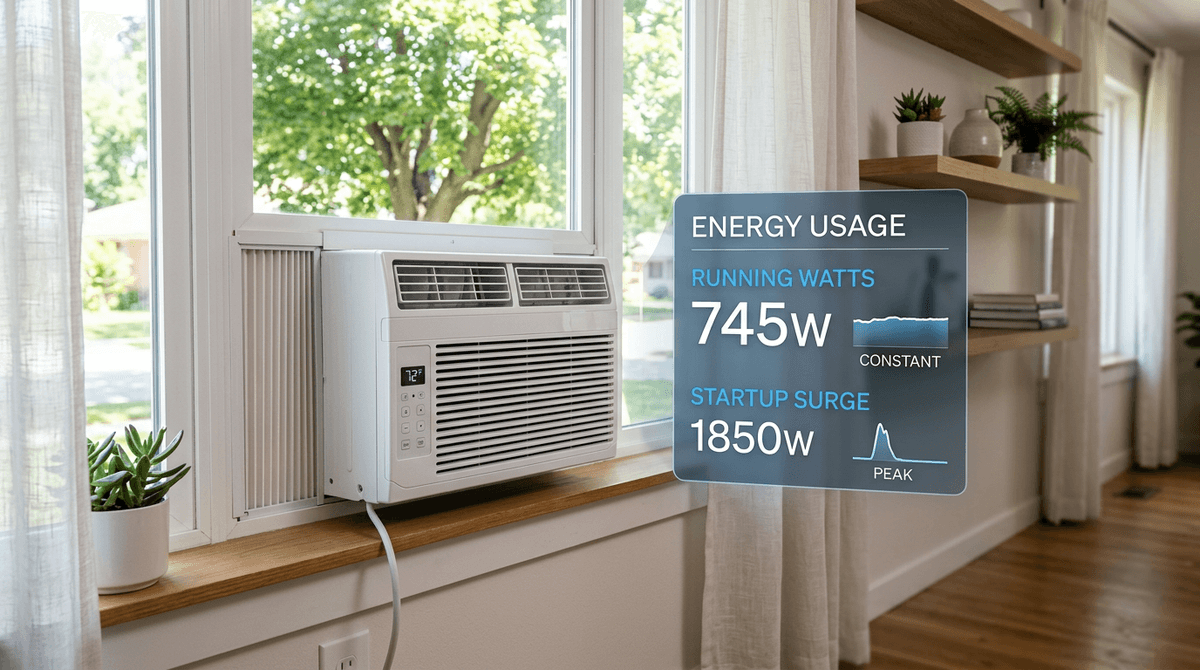
Rainy-season operation often means shorter cooling bursts but frequent compressor cycles to remove humidity.
For full system planning, use the WattSizing Calculator.
Quick Answer
Most window AC units still run around 600 to 1,500 W, with rainy-season daily usage often around 3 to 9 kWh/day based on humidity load.
Detailed Explanation
During rainy months, latent load (moisture removal) can keep compressors active even when air temperature is moderate. That makes watt spikes less intense than peak summer but can still produce steady kWh use.
To understand compressor behavior, see How Many Watts Does a Window Air Conditioner Use and compare AC options in Portable AC vs Window AC Energy Use.
Watt Table
| Window AC Size | Typical Running Watts | Rainy-Season Use (kWh/day) |
|---|---|---|
| 5,000 BTU | 500 - 700 W | 3 - 5 |
| 8,000 BTU | 700 - 950 W | 4 - 6.5 |
| 10,000 BTU | 900 - 1,200 W | 5 - 7.5 |
| 12,000 BTU | 1,050 - 1,400 W | 6 - 8.5 |
| 15,000 BTU | 1,250 - 1,550 W | 7 - 9 |
Calculation Example
At 950 W average for 6 hours/day:
kWh/day = (950 x 6) / 1000 = 5.7 kWh/day
Tips
- Use dry/dehumidify mode when available.
- Keep doors and windows closed to limit moisture ingress.
- Clean drain path so condensate removal stays efficient.
- Pair with ceiling fan to reduce compressor run time.
FAQs
Does humidity increase power use even when it is not very hot?
Yes. Moisture removal still requires compressor work.
Is rainy-season use closer to summer or winter?
Usually in between, but humid regions can be closer to summer.
Can dehumidifier plus fan beat AC for energy savings?
Sometimes. Compare loads with your comfort target.
CTA
Estimate humidity-season costs accurately with the WattSizing Calculator and tune your runtime strategy.


