
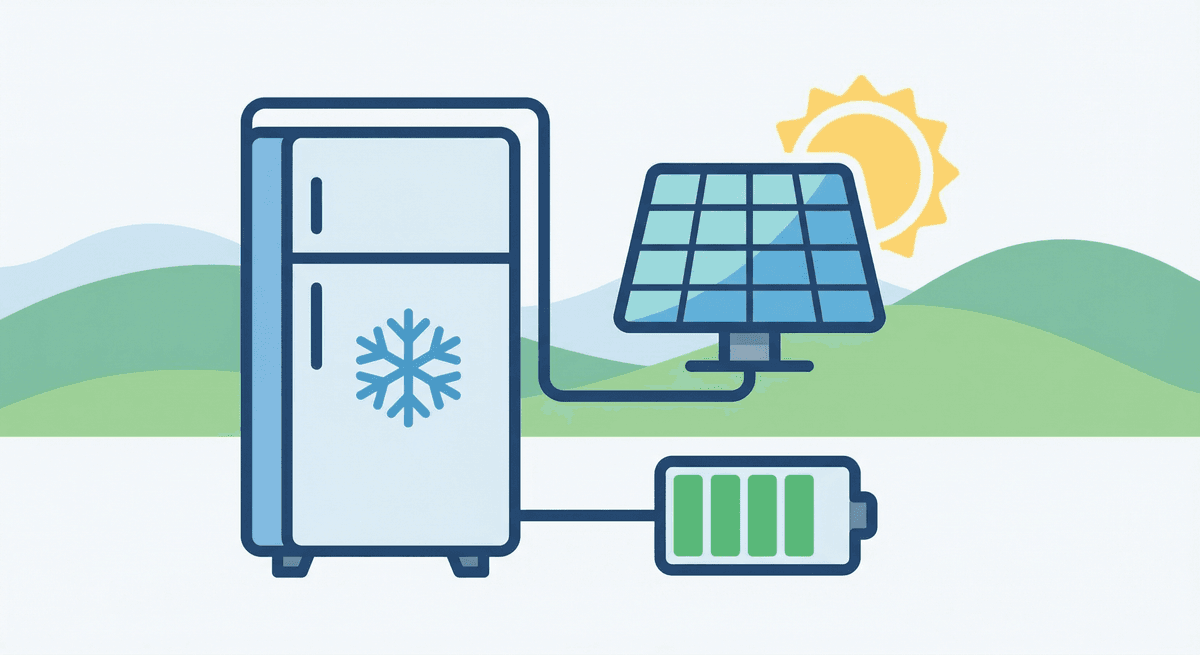
Running a fridge off-grid is one of the most common goals. The answer depends on the fridge’s power draw, how many hours it runs per day, and how many days you want backup. This guide walks through the numbers.
Fridge Power and Daily Use
- Running watts: Check the label or manual (often 30–100 W for small fridges, 50–150 W for larger). Use a plug-in meter for accuracy.
- Run time: Compressor doesn’t run 24/7. Roughly 4–8 hours per day is common for a typical fridge; efficient models less.
- Daily energy: Watts × Hours = Wh/day. Example: 50 W × 6 h = 300 Wh/day for the fridge alone.
Add your other loads (lights, charging, etc.) to get total daily use; then size solar and battery for that total. See daily energy use.
Surge: Inverter and Battery
Fridge compressors have a startup surge (often 2–5× running watts). Your inverter must handle that surge. Size the inverter’s surge rating for the fridge’s peak, and continuous for fridge plus any other loads that run at the same time.
Solar and Battery for Fridge-Only (Example)
If the fridge is 300 Wh/day and you want 1 day backup at 80% DoD:
- Battery: 300 ÷ 0.8 = 375 Wh minimum (e.g. 12V 35 Ah or similar).
- Solar: 300 Wh ÷ 4 sun hours ÷ 0.75 ≈ 100 W panel minimum; 150–200 W gives margin.
Scale up for more loads or more days of autonomy. Use the WattSizing calculator and add the fridge (and other loads) to get full system recommendations.


