
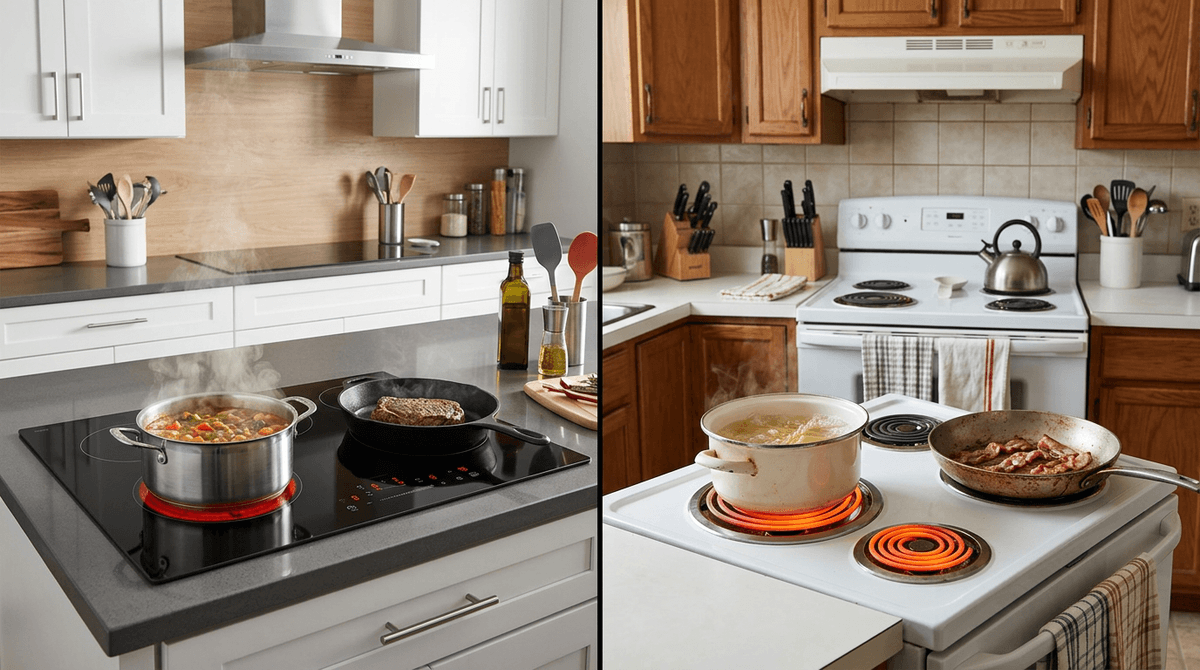
Induction and electric resistance stoves are both electric cooking options, but they deliver heat differently. Induction transfers energy directly to compatible cookware, while resistance elements first heat the burner surface.
That difference can reduce wasted heat in many real kitchens, even when both appliances have similar peak watt ratings. For full-home load planning, use the WattSizing Calculator.
Quick Comparison
| Topic | Induction Cooktop | Electric Resistance Stove |
|---|---|---|
| Typical burner power | 1,200 - 3,700 W (zone dependent) | 1,000 - 3,000+ W (element dependent) |
| Heat transfer | Direct to pan (magnetic cookware required) | Indirect via heated element/glass/coil |
| Preheat speed | Typically faster | Typically slower |
| Typical real-world efficiency | Often higher | Often lower due to surface and ambient losses |
| Control response | Fast | Slower thermal lag |
Power Use Fundamentals
Both technologies cycle power as they regulate temperature. The number on the label (for example 1,800 W) is usually maximum draw for that element/zone, not constant all-day draw.
What changes real kWh:
- Cookware compatibility and flatness (especially for induction).
- Lid use and pan size matching burner size.
- Cooking duration at high heat vs simmer.
- Preheat behavior and batch-cooking habits.
Baseline posts:
Comparison Table: Example Meal Loads
Assume electricity rate of $0.16/kWh.
| Cooking Task | Induction Example | Electric Stove Example | Notes |
|---|---|---|---|
| Boil 2L water + simmer pasta | 2.0 kW for 12 min + 0.9 kW for 8 min = 0.52 kWh | 2.0 kW for 15 min + 1.1 kW for 10 min = 0.68 kWh | Induction often reaches boil faster |
| Pan-fry dinner (25 min mixed heat) | Average 1.1 kW -> 0.46 kWh | Average 1.4 kW -> 0.58 kWh | Depends on pan and technique |
| 45-min stew/simmer | Average 0.7 kW -> 0.53 kWh | Average 0.9 kW -> 0.68 kWh | Long simmers magnify losses |
Approximate cost per task:
- 0.52 kWh -> $0.08
- 0.68 kWh -> $0.11
Small per-meal differences can add up across months of daily cooking.
Worked Scenarios
1) Weeknight Household (5 cooked dinners/week)
Assume average dinner energy:
- Induction: 0.55 kWh per meal
- Electric stove: 0.72 kWh per meal
Weekly difference:
- (0.72 - 0.55) x 5 = 0.85 kWh/week
- Monthly (~4.3 weeks): 3.66 kWh/month
- Cost difference at $0.16/kWh: about $0.59/month
This is modest for one meal style. Homes with heavier stove usage may see larger differences.
2) High-Use Kitchen (2 hot meals/day)
Assume:
- Induction total: 1.3 kWh/day
- Electric resistance total: 1.8 kWh/day
Daily difference: 0.5 kWh Annual difference: 0.5 x 365 = 182.5 kWh Annual cost difference: 182.5 x $0.16 = $29.20/year
At higher utility rates, savings increase proportionally.
Practical Takeaways
- Induction often uses less energy for the same cooking output, especially for boiling and frequent short tasks.
- Electric stoves remain workable and predictable, but can lose more heat to the surface and room.
- The biggest savings often come from habits: right-size cookware, use lids, avoid long idle preheat.
- For backup/off-grid design, size to peak simultaneous loads regardless of technology.
Related:
FAQs
Does induction always use fewer watts than electric stoves?
Peak watts can be similar. The common advantage is lower total energy for the same cooking job because heat transfer is usually more direct.
Why can my induction cooktop still look power-hungry?
High-power boost modes can draw a lot briefly. Total kWh still depends on how long and how often high power is used.
Is cookware the main reason induction efficiency varies?
It is a major factor. Flat, compatible magnetic cookware generally improves coupling and performance.
Should I switch only for energy savings?
Energy is one factor. Speed, control feel, cookware compatibility, and upfront appliance cost matter too.
CTA
Want an appliance-by-appliance estimate for your own kitchen and utility rate? Use the WattSizing Calculator to model realistic runtime and total household load.


