
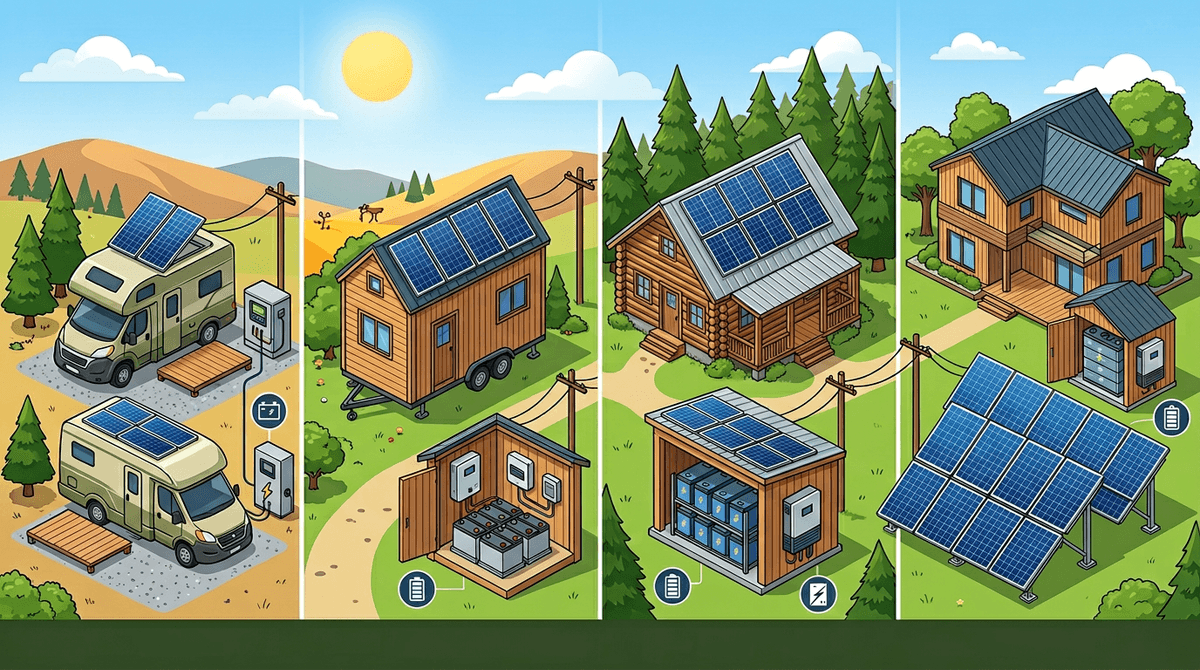
Off-grid solar cost in 2026 depends less on "solar" and more on how big your life is—RV weekenders, cabin dwellers, tiny-house families, and full-size homes each land in a different price band. This guide breaks down real costs by system size so you can budget by use case, not guesswork.
If you haven’t yet, estimate your daily energy use so the numbers below map to your actual needs.
Why System Size Drives Cost
Cost scales with daily energy use and peak power. A system that runs a 12V fridge and LED lights is orders of magnitude cheaper than one that runs central A/C and an electric stove. In 2026, panels and lithium batteries are relatively cheap; inverters, wiring, and labor (or your time) dominate at larger sizes.
RV and Small Cabin (400–800 W, ~1 kWh/day)
Use case: Weekend van or cabin—lights, phone/laptop charging, 12V fridge, small pump. No A/C, no microwave.
Typical 2026 cost (parts): ~$1,200–$1,800
| Component | Spec | Approx. cost |
|---|---|---|
| Solar panels | 400 W (2 × 200 W or 1 × 400 W) | $280–$400 |
| Charge controller | 30 A MPPT | $100–$150 |
| Battery | 12 V 100–200 Ah LiFePO4 (~1–2.5 kWh) | $350–$550 |
| Inverter | 600–1000 W pure sine | $150–$250 |
| Wiring, fuses, mounts | — | $150–$250 |
Total: $1,200–$1,800. Add a small backup generator ($400–$600) for stretches with no sun.
For sizing details, see how to calculate daily energy use for off-grid.
Medium Cabin / Tiny House (1.5–2.5 kW, ~4–6 kWh/day)
Use case: Full-time tiny house or cabin—everything in the RV tier plus microwave, TV, Starlink, coffee maker, and maybe a small A/C or mini-split for part of the day.
Typical 2026 cost (parts): ~$3,500–$5,500
| Component | Spec | Approx. cost |
|---|---|---|
| Solar panels | 1.6–2.4 kW (4–6 × 400 W) | $700–$1,200 |
| Charge controller / all-in-one | 60 A MPPT or 3 kW hybrid | $350–$600 |
| Battery | 48 V 100 Ah (5 kWh) server rack or DIY | $1,000–$1,500 |
| Inverter | 3 kW hybrid (inverter + MPPT + charger) | $600–$900 |
| Racking, wiring, breakers | — | $400–$700 |
Total: ~$3,500–$5,500. Used panels can cut panel cost by ~40–50%; see cost of off-grid solar 2026 for more budgeting tips.
Large Cabin / Small Full Home (5–8 kW, ~15–25 kWh/day)
Use case: Larger cabin or small full-time home—major appliances, mini-splits or small central A/C, well pump, washer, optional EV trickle charging.
Typical 2026 cost (parts): ~$12,000–$20,000
| Component | Spec | Approx. cost |
|---|---|---|
| Solar panels | 6–8 kW (15–20 × 400 W) | $2,500–$4,000 |
| Inverters | 2 × 5–6 kW split-phase or all-in-one | $2,000–$3,500 |
| Batteries | 20–30 kWh (server rack or DIY) | $4,000–$7,000 |
| Racking (roof or ground) | — | $1,500–$3,000 |
| Wiring, conduit, permits | — | $1,500–$2,500 |
Total: ~$12,000–$20,000. Ground mounts and permits add cost; peak sun hours affect how much panel you need for your location.
Full Family Home (10 kW+, ~25–40+ kWh/day)
Use case: No compromises—central A/C, electric water heater (heat pump), electric stove, washer/dryer, EV charging, office and entertainment.
Typical 2026 cost (parts): ~$25,000–$45,000+
| Component | Spec | Approx. cost |
|---|---|---|
| Solar panels | 10–15 kW+ | $4,000–$7,000 |
| Inverters | 10–15 kW+ split-phase, possibly multiple units | $3,500–$6,000 |
| Batteries | 30–50+ kWh | $7,000–$12,000+ |
| Racking (often ground mount) | — | $2,500–$5,000 |
| Wiring, conduit, permits, subpanel | — | $2,500–$5,000 |
Total: ~$25,000–$45,000+. Labor or your own time can add 20–40% if outsourced.
Hidden Costs by System Size
- Shipping: Panels often ship freight; budget $300–$600 for pallet delivery. Larger systems may need multiple shipments.
- Copper: Big inverters need thick cable (4/0, 2/0). Keep batteries and inverters close to limit cable cost.
- Backup generator: Essential for multi-day clouds. $500–$1,500 for small systems; $2,000–$4,000 for whole-house backup.
- Tools and safety: Multimeter, crimpers, breakers, fuses. Budget $200–$500 for DIY.
- Permits and inspection: More likely and costlier for larger, grid-interactive or permanent systems.
How to Choose Your Size
- Run your numbers: Use our calculator to get daily kWh and peak watts.
- Match a tier: Compare your result to the tiers above (RV/cabin, tiny house, large cabin, full home).
- Plan for 1–2 cloudy days: Size battery for at least one full day of use without sun; two is safer.
- Don’t undersize the inverter: Peak draw (e.g. well pump + A/C startup) must stay under inverter capacity. See how many solar panels to run your appliances for appliance-level thinking.
Summary by System Size
| System size | Use case | Typical 2026 cost (parts) |
|---|---|---|
| 400–800 W | RV, small cabin | ~$1,200–$1,800 |
| 1.5–2.5 kW | Tiny house, medium cabin | ~$3,500–$5,500 |
| 5–8 kW | Large cabin, small full home | ~$12,000–$20,000 |
| 10 kW+ | Full family home | ~$25,000–$45,000+ |
Prices are for DIY (parts). Labor, permits, and site work add 20–50% depending on size and location.
Frequently Asked Questions
How much does a small off-grid solar system cost in 2026?
A small system for an RV or cabin (about 400–800 W, ~1 kWh/day) typically costs $1,200–$1,800 in parts in 2026—panels, MPPT controller, small LiFePO4 battery, and a 600–1000 W inverter. Add wiring, mounts, and a small backup generator for cloudy stretches.
What’s the cost difference between a tiny house and a full home off-grid system in 2026?
Tiny house systems (1.5–2.5 kW, ~4–6 kWh/day) often land at $3,500–$5,500 in parts. Full family home systems (10 kW+, 25–40+ kWh/day) typically run $25,000–$45,000+ in parts, with more battery, larger inverters, and heavier wiring and racking.
Does off-grid solar cost more in 2026 than in previous years?
Panel and lithium battery prices in 2026 are competitive or lower than a few years ago. Copper, shipping, and labor have increased. Overall, small systems are similar or slightly cheaper; large systems are similar or slightly more expensive depending on local labor and permits.
Should I size my off-grid system for worst-case or average sun?
Size for average sun to meet daily use, and size battery for 1–2 days of autonomy so you can ride out cloudy periods. Sizing only for worst-case sun usually means an oversized, expensive array. Use peak sun hours for your location to get realistic production.
Can I start small and expand my off-grid system later?
Yes. Start with one or two panels and one battery, then add panels and batteries in matching voltage (e.g. 48 V). Use an all-in-one inverter/charger/MPPT that can handle more panels and battery capacity than you install at first, so expansion doesn’t require replacing the inverter.
Ready to size your system? Use the WattSizing calculator to get your daily energy and peak power, then match your result to the tier that fits your budget and lifestyle.


