
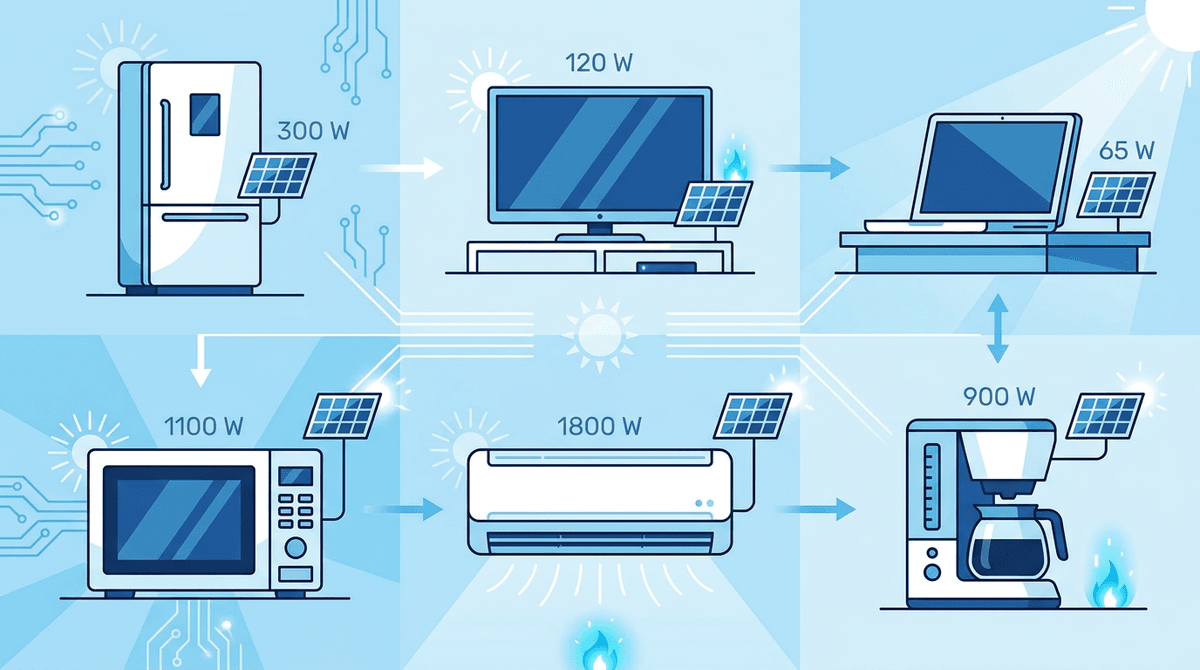
"How many solar panels do I need to run my fridge / AC / TV?" is one of the most common questions. The answer depends on how much energy each appliance uses per day and how much sun you get. This guide gives you ballpark wattages, daily energy, and the panel count (and system size) that typically fits—so you can plan off-grid or battery-backup systems around the appliances you care about.
For a custom number, use our calculator and a daily energy (load) list; the examples below map those concepts to real devices.
How Panel Count Relates to Appliances
Solar panels don’t “run” one appliance in isolation. They feed total daily production into your system; your load list (all appliances, watts × hours) gives daily energy use. You size the array so that, in your location, daily production ≥ daily use (with some margin). So “panels to run a fridge” really means: how much extra panel (and often battery) do you need when you add a fridge to your load?
- Daily energy (Wh) = watts × hours per day per appliance; sum everything. See how to calculate daily energy use.
- Peak sun hours = location-dependent; used to turn “Wh per day needed” into “W of panels.” See peak sun hours explained.
- Rough formula: Panel watts ≈ (Daily Wh ÷ peak sun hours) ÷ 0.75 (e.g. losses). So 2,000 Wh/day in 4 sun hours → about 2,000 ÷ 4 ÷ 0.75 ≈ 670 W of panels (e.g. 2 × 400 W or 2 × 350 W).
Below we apply this idea to common appliances.
Fridge and Freezer
Typical running: 50–150 W (small 12V fridge ~50 W; full-size AC fridge 100–150 W). Surge: Compressor startup can be 2–3× for a few seconds.
Daily energy: ~800–1,500 Wh for a 24/7 fridge (50 W × 24 h = 1,200 Wh; 100 W × 24 ≈ 2,400 Wh for a large one).
Ballpark panels (4 sun hours): 1,200 Wh ÷ 4 ÷ 0.75 ≈ 400 W → one 400 W panel or two 200 W panels for a small fridge. Large fridge: 2,400 ÷ 4 ÷ 0.75 ≈ 800 W → two 400 W panels. You also need battery for night and cloudy hours; see how many batteries for off-grid and days of autonomy.
TV, Laptop, and Small Electronics
TV: 30–100 W (LED 30–50 W; larger 50–100 W). Laptop: 30–65 W. Router/Starlink: 10–30 W.
Daily energy (example): TV 50 W × 4 h = 200 Wh; laptop 45 W × 3 h = 135 Wh; router 15 W × 24 h = 360 Wh → ~700 Wh/day total.
Ballpark panels (4 sun hours): 700 ÷ 4 ÷ 0.75 ≈ 235 W → one 250–300 W panel is often enough for light use. Heavier use (big TV + desktop + router all day) can push 1,000+ Wh → ~350–400 W (one 400 W or two 200 W).
Microwave and Coffee Maker
Microwave: 600–1,200 W (running); used 5–15 min/day → ~100–300 Wh/day. Coffee maker: 800–1,500 W; ~10 min → ~150–250 Wh/day.
Daily energy: ~250–550 Wh combined.
Ballpark panels: 550 ÷ 4 ÷ 0.75 ≈ 185 W → a single 200–400 W panel can cover these if the rest of your load is small. The constraint is inverter size: you need an inverter that can handle 1,000+ W surge. See inverter sizing.
Air Conditioning (Window, Portable, Mini-Split)
Window/portable AC: 500–1,500 W running; 3–8 h/day → 1,500–12,000 Wh/day. Mini-split: 300–1,200 W running; similar hours → 1,000–8,000+ Wh/day.
Example: 800 W mini-split, 6 h/day = 4,800 Wh/day. Panels: 4,800 ÷ 4 ÷ 0.75 = 1,600 W → about four 400 W panels for the AC alone. You also need a large battery and inverter. See running AC off-grid solar.
Well Pump and Sump Pump
Submersible well pump: 500–2,000 W; run time varies (e.g. 30 min/day) → 250–1,000 Wh/day. Sump: 300–800 W; intermittent.
Daily energy: Often 300–1,000 Wh. Panels: 1,000 ÷ 4 ÷ 0.75 ≈ 335 W → one 350–400 W panel can cover many pumps; the bigger issue is surge (pump startup can be 2–3× running watts). Size inverter and wire for surge.
EV Charging (Level 1 and 2)
Level 1 (120 V): ~1,400 W; 4–8 h to add ~20–40 miles → 5,600–11,200 Wh per session. Level 2 (240 V): 3,000–11,000 W; 1–4 h for similar miles.
Example: Level 1, 4 h/day = 5,600 Wh. Panels: 5,600 ÷ 4 ÷ 0.75 = 1,867 W → about five 400 W panels for that one charge session, plus battery if you want to charge from stored solar. Full EV charging often pushes you into a large system; see solar for EV charging and off-grid cost by system size.
Putting It Together: Example Load
| Appliance | Watts | H/day | Wh/day |
|---|---|---|---|
| Fridge | 80 | 24 | 1,920 |
| Lights | 30 | 4 | 120 |
| Laptop + phone | 50 | 4 | 200 |
| TV | 50 | 3 | 150 |
| Microwave | 1,000 | 0.25 | 250 |
| Total | 2,640 |
With 10% inverter loss: 2,640 × 1.1 ≈ 2,904 Wh/day. In 4 peak sun hours: 2,904 ÷ 4 ÷ 0.75 ≈ 970 W → about 3 × 400 W panels (1,200 W). Add 1–2 days of battery (2,900–5,800 Wh usable) for autonomy. That aligns with a tiny house / medium cabin tier.
Quick Reference: Panels per Appliance (4 Sun Hours)
| Load type | Approx. daily Wh | Panel watts (4 h sun) | Typical panel count (400 W) |
|---|---|---|---|
| Small fridge | 800–1,200 | 270–400 | 1 |
| Large fridge | 2,000–2,500 | 670–830 | 2 |
| TV + laptop + router | 500–1,000 | 170–330 | 1 |
| Microwave + coffee | 250–550 | 85–185 | 1 (shared with others) |
| Mini-split AC 6 h | 1,800–4,800 | 600–1,600 | 2–4 |
| Well pump | 300–1,000 | 100–330 | 1 |
| EV Level 1, 4 h | 5,600 | ~1,870 | 5 |
Peak sun hours vary by location; use your location’s value and the formula above to adjust. For a full system cost by size, see off-grid solar cost 2026 by system size.
Frequently Asked Questions
How many solar panels do I need to run a refrigerator?
For a typical fridge (about 50–100 W running, 24/7), daily use is roughly 1,200–2,400 Wh. In a location with 4 peak sun hours, that’s about 400–800 W of solar (one or two 400 W panels). You also need a battery to run the fridge at night and through short cloudy periods.
Can I run air conditioning on solar only?
Yes, but AC uses a lot of energy. A small mini-split (e.g. 800 W, 6 h/day) needs about 1,600 W of panels (e.g. four 400 W) and a sizable battery and inverter. Whole-house central AC usually requires a large off-grid or hybrid system. See running AC off-grid.
How do I figure out how many panels I need for all my appliances?
Add up daily energy: for each appliance use (watts × hours per day), then sum. Divide by your peak sun hours and by ~0.75 for losses: Panel W ≈ (Daily Wh ÷ sun hours) ÷ 0.75. Use the WattSizing calculator or a load list to get your total Wh/day, then plug into this formula. See also how many solar panels for off-grid.
Do I need a battery if I only want to run a few appliances during the day?
If you only run appliances when the sun is shining and don’t need power at night, you can get by with a smaller or no battery. Many people still add a small battery for stability and to cover passing clouds. For night use (e.g. fridge, lights), you need a battery sized to your nightly load and desired days of autonomy.
What size inverter do I need for my appliances?
The inverter must handle the highest combined surge (startup) of the loads you run at once—e.g. fridge compressor + microwave. Add running watts of everything that could be on together, then ensure inverter surge rating exceeds the largest single surge. See inverter sizing for off-grid solar.
Size your full system with the WattSizing calculator, and read off-grid solar cost by system size to see how your panel and battery needs map to real 2026 budgets.


