
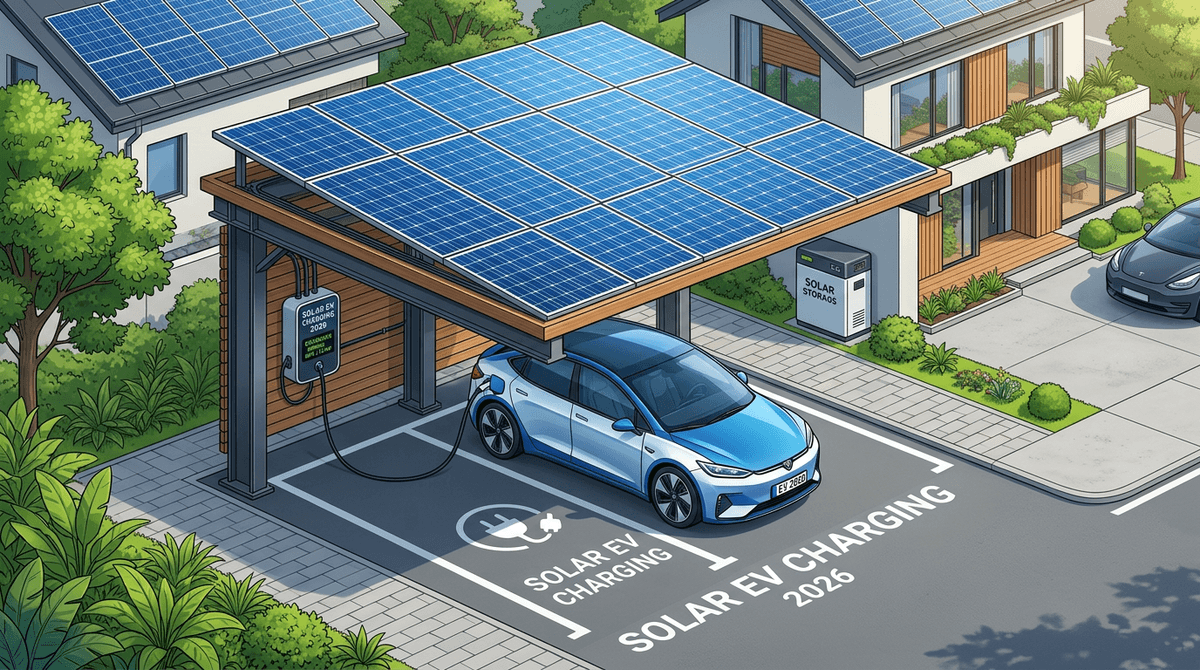
Charging an EV from solar is possible with a carport, ground mount, or rooftop array. In 2026, the main choices are how much capacity you need (Level 1 vs Level 2), whether to include battery storage, and how to handle shared or multi-tenant parking. This guide covers sizing, layout, and practical options.
To size production and storage, use daily energy use (including the EV), peak sun hours, and our calculator. For appliance-level wattages, see how many panels to run appliances.
Why Solar + EV Charging Fits Carports and Ground Mount
- Space: Carports and ground mounts give you dedicated area for panels without using roof. Useful when the roof is shaded, small, or already full.
- Proximity: Putting panels near the parking space can shorten wire runs to the EV charger and, if you add battery, to the inverter.
- Shared parking: Ground mount or carport can serve multiple spaces with one array and one or more chargers (with fair billing or allocation).
Rooftop solar works the same electrically; carport and ground mount are mainly siting and structure choices. See off-grid solar cost by system size for how EV charging fits into total system size.
How Much Energy Does EV Charging Need?
Level 1 (120 V): ~1.2–1.5 kW. Adding ~30–50 miles overnight (8–12 h) ≈ 10–18 kWh per full “overnight” charge.
Level 2 (240 V): ~3–11 kW (common 7–11 kW). Adding ~30–50 miles in 1–3 hours ≈ 7–15 kWh per session.
Daily use example: 40 miles/day at ~0.3 kWh/mile ≈ 12 kWh/day for the EV. That’s a large load compared to a typical home; solar-only for full EV use often means a large array (e.g. 3–5 kW or more) and usually battery or grid to shift charging to sunny hours or night. See how many panels to run appliances for the panel math.
Sizing Solar for EV Charging
Formula (same as other loads): Panel W ≈ (Daily Wh ÷ peak sun hours) ÷ 0.75.
Example: 12 kWh/day (12,000 Wh), 4 peak sun hours → 12,000 ÷ 4 ÷ 0.75 = 4,000 W of panels (e.g. 10 × 400 W) for the EV alone. Add house loads if you’re sizing a full system. Use peak sun hours for your location; use our calculator with EV energy included in daily use.
Battery: If you want to charge the EV at night or when the sun isn’t shining, you need a battery (or grid). Size battery for the portion of EV energy you want to store (e.g. one full charge = 10–15 kWh usable). See how many batteries and days of autonomy. For grid-tied systems, solar can offset EV use on the bill without a battery; the charger can still run from the grid when solar is low.
Carport Solar
What it is: A structure over parking (one or more spaces) with solar panels on top. Power goes to an EV charger (and optionally battery or grid). Shade for cars and rain protection; panels get good sun if orientation is correct.
Sizing: One space might fit 2–4 kW of panels (e.g. 6–10 panels); two spaces 4–8 kW. Enough for a good share of daily EV use in sunnier regions. See off-grid cost by system size for ballpark costs at these sizes.
Considerations: Structure must meet local wind/snow codes. Wiring from array to inverter/charger and from inverter to EVSE (charger) must be sized for voltage and current. If grid-tied, permits and utility interconnection apply. If off-grid or backup, you need inverter and usually battery. See grid-tied vs hybrid vs off-grid.
Ground-Mount Solar for EV
What it is: Panels on a ground-mounted rack (fixed or tracked) near the parking area or house. Same electrical logic as carport or roof; difference is foundation and layout.
Pros: No roof; can optimize tilt and orientation; easier to clean and maintain. Cons: Uses yard space; may need fencing or setbacks; permits and zoning apply.
Sizing: Same formula; fit as many panels as space and budget allow. A 5–10 kW ground mount can cover a large portion of EV + house use. Use peak sun hours and our calculator.
Shared Parking and Multi-Tenant
- Single array, multiple chargers: One solar (and optional battery) system can feed several EVSEs. Use a load management or allocation system so total draw doesn’t exceed inverter or service capacity. Billing can be by usage (metered) or flat share.
- Fair use: Define how solar energy is allocated (e.g. first-come-first-served, reserved windows, or split by tenant). Battery helps buffer so not everyone has to charge at peak sun.
- Grid backup: For shared setups, grid is usually the backup when solar and battery aren’t enough; full off-grid for multiple EVs is large and expensive. See off-grid cost by system size.
Grid-Tied vs Off-Grid for EV
- Grid-tied: Solar offsets grid use; EV can charge from grid when solar is low. No battery required for charging, but you may add battery for backup or time-of-use. Simplest and most common.
- Off-grid: EV charging must come from solar + battery (and often a generator). Requires a large array and large battery for daily EV use. See off-grid cost by system size and how many panels to run appliances.
Summary
- Carport and ground mount give dedicated space for solar near parking; sizing uses the same daily energy and peak sun hours as roof systems.
- EV daily use (e.g. 10–15 kWh) often needs 3–5 kW+ of panels and, for off-grid or night charging, battery.
- Shared parking can use one array and multiple chargers with load management and clear allocation. Use our calculator with EV load included to get panel and battery targets.
Frequently Asked Questions
How many solar panels do I need to charge an EV?
It depends on how much you drive and peak sun hours. Roughly: Panel W ≈ (Daily kWh × 1,000 ÷ peak sun hours) ÷ 0.75. Example: 12 kWh/day, 4 sun hours → about 4,000 W (e.g. 10 × 400 W panels). For a single charge session (e.g. 10 kWh), same formula with 10,000 Wh. Use the WattSizing calculator with your EV energy in daily use and peak sun hours for your location. See how many panels to run appliances.
Is a solar carport worth it for EV charging?
Worth it if you want dedicated solar near the car, shade for the vehicle, and a clear place to mount panels without using roof. Electrically it’s the same as roof or ground mount; the benefit is siting and structure. Size the array for your EV (and optionally house) use with peak sun hours and our calculator. Cost depends on structure and local labor; see off-grid cost by system size for panel/battery ranges.
Can I charge my EV at night with solar?
Only if you have battery storage. Solar doesn’t produce at night; to charge the EV at night from “solar,” you charge the battery by day from solar and discharge to the EV at night. Size the battery for the portion of EV energy you want to deliver at night (e.g. 10–15 kWh usable per full charge). See how many batteries and battery backup only. With grid-tied solar, you can still charge at night from the grid; solar offsets your bill overall.
What’s the cost of solar for EV charging in 2026?
Panel cost is similar per watt to other systems (~$0.25–$0.50/W for hardware). For EV only (e.g. 4 kW array + optional 10 kWh battery), ballpark $2,000–$5,000 (panels + inverter) without battery; $6,000–$12,000 with a small battery. Carport adds structure cost ($3,000–$15,000+ depending on size and design). See off-grid cost by system size and solar generator vs DIY for context.
Can multiple EVs share one solar carport?
Yes. One array (and optional battery) can feed multiple EV chargers with a load management system so total power doesn’t exceed your inverter or service. You’ll need more panel and battery capacity than for one EV; size for combined daily use and desired autonomy. Allocation can be by meter, time window, or agreement among users. See how many panels to run appliances and our calculator with total EV load.
Size your EV + home load with the WattSizing calculator, peak sun hours, and off-grid cost by system size to plan carport or ground-mount solar for EV charging in 2026.


