
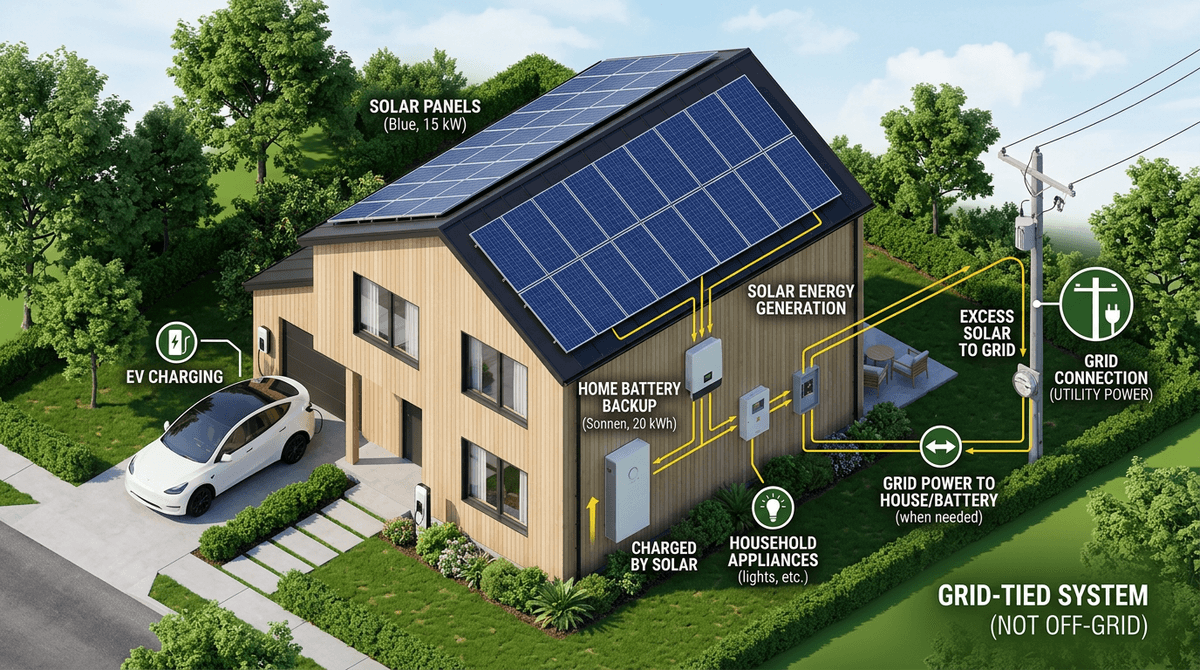
A battery backup keeps selected circuits on when the grid fails—without going fully off-grid. The battery can be charged by the grid, by solar, or both. You stay grid-connected for normal use and get backup only for outages. This guide explains how it works and how to size it in 2026.
For full grid independence, see off-grid solar cost by system size and grid-tied vs hybrid vs off-grid. For a system that also reduces daily bills with solar, see hybrid solar.
What “Battery Backup Only” Means
- Goal: Power a critical loads panel (fridge, lights, modem, medical device, etc.) during grid outages.
- No goal to run the whole house off-grid or to eliminate the electric bill. When the grid is up, you use the grid as usual; the battery may be kept full or used for time-of-use arbitrage depending on the system.
- Charging: Battery is charged from grid and/or solar. Solar can extend runtime during long outages and reduce grid charging. You are not sizing for “full off-grid” daily use.
So: backup-only = outage resilience for a subset of loads, not full independence.
How It Works (Typical Setup)
- Inverter/charger or hybrid inverter with battery and grid inputs. When grid is present, it can charge the battery (from grid and/or solar). When grid fails, it islands and powers the backup panel from the battery.
- Critical loads panel: A subpanel fed by the inverter in backup mode. Only circuits you assign (e.g. fridge, lights, outlets for modem/CPAP) are backed up. HVAC or large loads are often left off the backup panel to keep runtime reasonable.
- Solar (optional but useful): Panels can charge the battery when the grid is down, extending runtime. They can also charge from grid when the sun shines if you want to use solar to “fill” the backup without going off-grid.
This is the same hardware idea as a hybrid system; the difference is how you use it: you’re optimizing for backup, not for maximizing self-consumption or going off-grid. See hybrid solar systems.
Sizing the Backup (Not Full Off-Grid)
Step 1 – Critical loads only: List only what you want during an outage (e.g. fridge, lights, modem, CPAP). Add watts × hours per day for each. That’s your backup daily energy (Wh). See how many solar panels to run appliances for typical wattages.
Step 2 – Runtime: Decide how many days (or hours) you want those loads to run without grid. One night? One full day? Two days? Usable capacity needed = backup daily Wh × number of days. See days of autonomy.
Step 3 – Battery size: Battery capacity (Wh) = Usable capacity ÷ depth of discharge. For LiFePO4, use ~80–90% DoD. Example: 3,000 Wh usable, 80% DoD → 3,000 ÷ 0.8 = 3,750 Wh (about 3.75 kWh) of battery. See how many batteries and best battery chemistry 2026.
Step 4 – Inverter: Inverter continuous rating must exceed the total wattage of loads you might run at once on the backup panel (e.g. fridge + lights + modem). Surge for motor loads (fridge compressor) must be within inverter surge rating. See inverter sizing.
Step 5 – Solar (optional): If you add solar to charge the battery during outages, size it so that on a typical cloudy day you can at least replace one day’s backup use. That keeps the battery from depleting in multi-day outages. Use peak sun hours and the usual formula: Panel W ≈ (Backup daily Wh ÷ sun hours) ÷ 0.75. You don’t need to size solar for full off-grid; you only need enough to extend backup. Use our calculator with “backup” loads and desired autonomy to get ballpark battery and optional solar.
Cost (2026 Ballpark)
- Battery: ~$400–$700 per kWh (LiFePO4 server rack or similar). For 5 kWh usable (~6 kWh nameplate): ~$2,500–$4,000.
- Inverter/charger or hybrid: $1,000–$3,000 depending on power and features.
- Critical loads panel + wiring: $500–$1,500.
- Solar (optional): $800–$2,000 for 1–2 kW if you want solar-charged backup.
Total (no solar): roughly $4,000–$8,000 for a 3–6 kWh usable backup. With solar: add $1,000–$2,500 for a small array that extends runtime. See solar generator vs DIY if you prefer a portable all-in-one for small backup.
Summary
- Battery backup only = backup for selected circuits during outages; you stay on the grid for normal use.
- Charged by grid and/or solar; solar is optional but helps in long outages.
- Size by backup loads and desired runtime, not by full-house off-grid use. Use calculator and days of autonomy.
- Not off-grid: No need to size for full daily consumption or worst-case sun; focus on critical loads and a few days of autonomy.
Frequently Asked Questions
What’s the difference between battery backup only and off-grid?
Battery backup only: You’re on the grid for normal use; the battery (and optional solar) only back up selected circuits when the grid fails. Off-grid: No grid; you run everything from solar and battery (and usually a generator) every day. Backup-only is smaller and cheaper because you’re not sizing for full daily use. See off-grid cost by system size and grid-tied vs hybrid vs off-grid.
Can I charge my backup battery with solar only?
Yes. You can have a system that charges the backup battery only from solar (no grid charging). That’s still “backup only” if you’re not trying to run the whole house off solar every day—you’re just using solar to keep the backup battery full and to extend runtime during outages. Sizing solar for “one day of backup use” is often enough; use peak sun hours and the usual panel formula.
How long will a battery backup last in an outage?
It depends on battery capacity and how much load is on the backup panel. Runtime (hours) ≈ Usable battery Wh ÷ total backup load (W). Example: 5 kWh usable, 500 W average load → about 10 hours. If you add solar, daytime production can recharge the battery and extend runtime over multiple days. Size using daily energy of backup loads and days of autonomy.
Do I need solar for a battery backup?
No. You can have a grid-only backup: battery charges from the grid and powers the critical loads panel when the grid is down. Solar is optional and useful to (1) extend runtime during long outages and (2) reduce grid charging. For backup-only, many people start with grid-charged battery and add solar later if they want.
What should I put on the backup panel?
Put only critical loads: fridge, lights, modem/router, medical devices, a few outlets. Avoid large HVAC, water heater, or EV charger unless you have a large battery and inverter. Lower load = longer runtime. See how many solar panels to run appliances for typical wattages and inverter sizing for surge requirements.
Size your backup with the WattSizing calculator (use only backup loads and desired autonomy), and read hybrid solar and days of autonomy to align battery and optional solar with your goals.


