
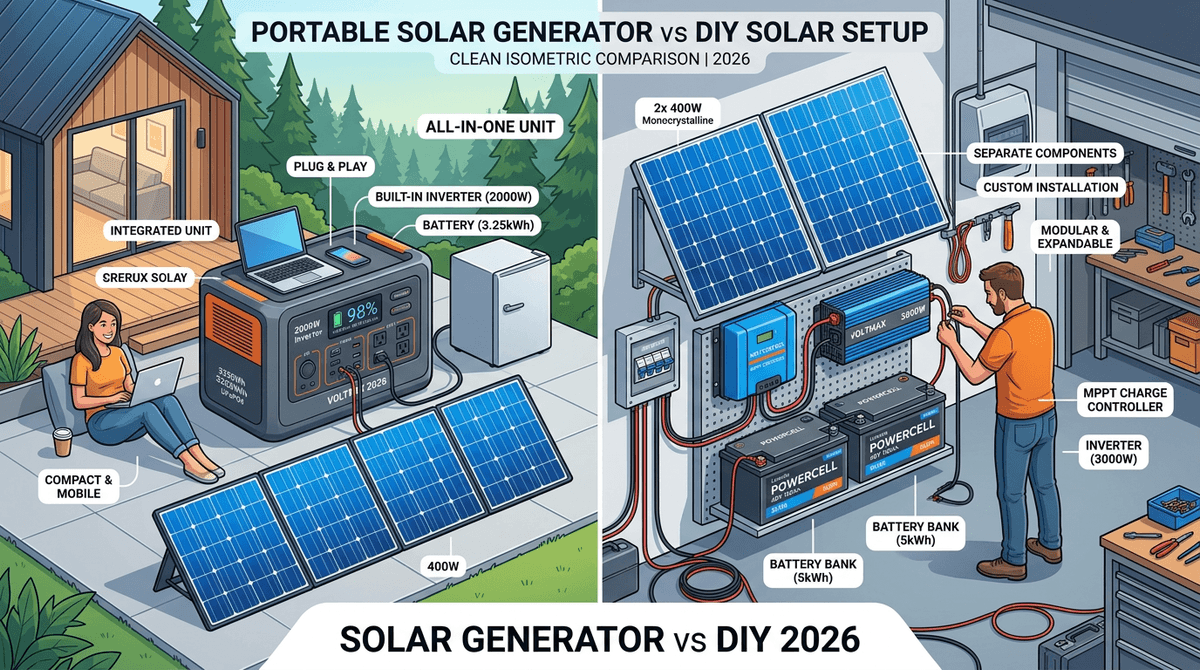
In 2026 you can power your cabin, van, or backup loads in two main ways: buy a solar generator (all-in-one portable power station + panels) or build a DIY solar system (panels, battery, inverter, charge controller separate). Each has different upfront cost, flexibility, and long-term value. This guide compares them so you can choose.
To size either approach, start with daily energy use and peak sun hours; our calculator works for both.
What Counts as a “Solar Generator” vs “DIY Solar”?
Solar generator: A packaged system—internal battery, inverter, charge controller, and often MPPT—in one box, plus optional solar panels. You plug in panels and loads; no wiring of separate components. Examples: Jackery, EcoFlow, Bluetti, Anker, and similar all-in-ones.
DIY solar: You buy panels, battery (or battery bank), charge controller (or all-in-one inverter/charger/MPPT), inverter if needed, and wiring/breakers/mounts. You size and connect everything yourself (or with an installer). See off-grid solar cost by system size for tiered DIY costs.
Upfront Cost: Solar Generator vs DIY (2026)
Small systems (~1 kWh usable, ~300–500 W solar):
- Solar generator: $400–$900 for the unit; add $200–$500 for panels. Total ~$600–$1,400.
- DIY: Panels $250–$400, small LiFePO4 $300–$500, MPPT $100–$150, inverter $150–$250, wiring/mounts $100–$200. Total ~$900–$1,500.
At this size, solar generators are often similar or slightly cheaper upfront and much simpler. DIY can undercut if you use used panels or minimal accessories.
Medium systems (~3–5 kWh usable, ~1–2 kW solar):
- Solar generator: $1,500–$3,500 for the unit; panels $400–$1,000. Total ~$2,000–$4,500.
- DIY: Panels $700–$1,200, 5 kWh server-rack or DIY LiFePO4 $1,000–$1,500, 3 kW hybrid or MPPT + inverter $600–$1,000, racking/wiring $400–$700. Total ~$2,700–$4,400. See cost of off-grid solar 2026.
At this size, DIY is often similar or cheaper per kWh and easier to expand. Solar generators are simpler and portable.
Large systems (10+ kWh, 3+ kW solar):
- Solar generator: Few all-in-ones go this big; stacking units gets expensive. $5,000–$12,000+ for equivalent capacity.
- DIY: 10 kW solar + 15–20 kWh battery + inverters + racking typically $12,000–$25,000 in parts. See off-grid cost by system size.
DIY wins clearly on cost and scalability at large sizes. Solar generators excel for portability and plug-and-play up to the medium range.
Pros and Cons at a Glance
| Factor | Solar generator | DIY solar |
|---|---|---|
| Setup | Plug-and-play | You (or installer) wire and size |
| Portability | High (all-in-one) | Low (fixed or semi-fixed) |
| Upfront (small) | Often similar or lower | Similar or slightly higher |
| Upfront (large) | Limited options; expensive to scale | Lower per kWh; scalable |
| Expansion | Limited; buy another unit | Add panels/batteries as needed |
| Repairs | Replace or warranty | Replace individual parts |
| Learning | Minimal | Sizing and wiring required |
When a Solar Generator Makes Sense
- You want minimal setup: camping, RV trips, tailgating, short-term backup.
- Your needs are small to medium (e.g. under ~5 kWh usable, ~2 kW solar).
- Portability matters: one box to move, no permanent install.
- You prefer a single warranty and no electrical work.
For portable use and small fixed setups, see also portable solar panels for camping.
When DIY Solar Makes Sense
- You need more capacity (e.g. 10+ kWh, 3+ kW solar) or plan to grow over time.
- You want lowest cost per kWh and can do (or outsource) wiring and sizing.
- Fixed install: cabin, tiny house, shed, or home backup. See off-grid solar shed, workshop, tiny home.
- You want to choose each component (e.g. battery chemistry, inverter brand, panel type).
Long-Term Value and Replacement
- Solar generators: When the internal battery degrades, you often replace the whole unit. Cycle life depends on chemistry (many use LiFePO4 now); see solar battery lifespan.
- DIY: You can replace only the battery (or add more) and keep panels and inverter. Over 10+ years, DIY usually offers better total cost of ownership for medium and large systems.
Summary
- Small, simple, portable: A solar generator is often the best value and least hassle in 2026.
- Larger, fixed, or expandable: DIY solar usually wins on cost per kWh and flexibility; use our calculator and cost-by-size guide to plan.
Both approaches rely on the same fundamentals: daily energy use, peak sun hours, and days of autonomy for battery size.
Frequently Asked Questions
Is a solar generator cheaper than DIY solar in 2026?
For small systems (around 1 kWh usable, ~300–500 W solar), solar generators are often similar or slightly cheaper upfront and much easier. For medium and large systems (several kWh and up), DIY is usually cheaper per kWh and easier to expand.
Can I expand a solar generator later?
Most solar generators have a fixed internal battery and inverter. You can add more panels (within the unit’s input limits) and sometimes expand with extra battery units on specific brands. For big expansion, a DIY system is more flexible: add panels, batteries, or a second inverter.
What’s the main downside of DIY solar?
You (or an installer) must size the system (daily use, peak sun hours, battery autonomy) and wire panels, battery, and inverter correctly. Wrong sizing or wiring can be unsafe or underperform. The WattSizing calculator and our sizing articles reduce the sizing risk.
Are solar generators good for off-grid living?
They work well for light off-grid use (small cabin, van, weekend): lights, fridge, charging, small appliances. For full-time off-grid with larger loads (AC, well pump, full kitchen), a DIY system is usually more cost-effective and scalable. See off-grid cost by system size.
Do solar generators use LiFePO4?
Many 2026 models use LiFePO4 for better cycle life and safety. Check the product specs; LiFePO4 is preferable for daily cycling and long-term value. See best battery chemistry for solar 2026.
Size your loads with the WattSizing calculator, then compare your target capacity to solar generator specs and DIY cost by system size to decide which path fits your budget and use case.


