
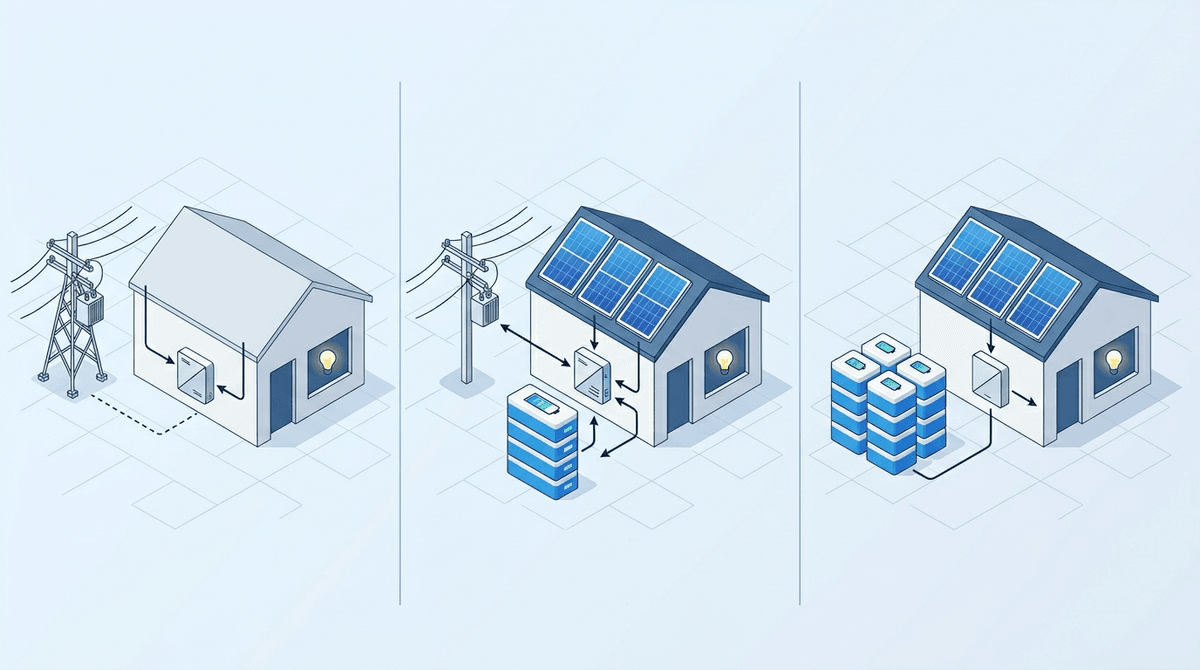
In 2026, the three main solar system types are grid-tied, hybrid (grid + battery), and off-grid. The biggest practical difference is what happens when the grid goes down. This guide compares them so you can choose the right type for backup, bill savings, or full independence.
To size an off-grid or battery-backed system, use our calculator, daily energy use, and peak sun hours.
Grid-Tied (No Battery)
What it is: Solar panels feed power into your home and/or the grid through an inverter. No battery. When the sun shines, you use solar first and often export the rest (net metering or similar). When the sun doesn’t shine, you use grid power.
Blackout behavior: No backup. Grid-tied inverters are required to shut off when the grid fails (to protect utility workers). Your house goes dark with the rest of the neighborhood even if the sun is out.
Best for: Maximizing bill savings and simplicity where blackouts are rare and backup isn’t a priority. Lowest upfront cost.
Summary: Cheapest way to reduce bills; no power during an outage.
Hybrid (Grid + Battery)
What it is: Solar plus a battery and a hybrid inverter (or inverter + battery system) that can disconnect from the grid and power selected circuits when the grid is down. Normal operation: solar and grid can charge the battery; solar and battery can power the house and reduce grid draw. During a blackout, the system goes into island mode and feeds a critical loads panel from battery and solar. See hybrid solar systems explained.
Blackout behavior: Backup for selected circuits. Inverter switches to island mode (often in ~10–20 ms), disconnects from the grid, and powers only the circuits you’ve wired to the backup panel. Runtime depends on battery size and load. Solar can recharge the battery during the day and extend backup.
Best for: Bill savings plus backup during outages without going fully off-grid. Common in 2026 for homes that want both.
Summary: Grid + solar + battery; backup when the grid fails, limited to the critical loads panel and battery capacity.
Off-Grid (No Grid Connection)
What it is: No utility connection. Solar (and often a generator) charge a battery bank; an inverter powers the loads. Sizing is based on daily energy use, peak sun hours, and days of autonomy. See off-grid solar cost by system size.
Blackout behavior: N/A. You’re never on the grid, so “grid blackout” doesn’t apply. You can have your own outages if the battery is empty and there’s no sun or generator—so autonomy and generator backup matter.
Best for: Cabins, RVs, remote homes, or anyone who wants full energy independence. Highest upfront cost and the most sizing and maintenance responsibility.
Summary: No grid; always on your own generation and storage. You must size for worst-case sun and have a backup plan (e.g. generator).
Side-by-Side
| Factor | Grid-tied | Hybrid | Off-grid |
|---|---|---|---|
| Grid connection | Yes | Yes | No |
| Battery | No | Yes | Yes (required) |
| Power during grid blackout | No | Yes (backup panel) | N/A (no grid) |
| Bill reduction | Yes (export/savings) | Yes | N/A (no bill) |
| Upfront cost | Lowest | Medium–high | High |
| Sizing complexity | Moderate | Moderate–high | High |
Choosing for 2026
- Only care about lower bills and don’t need backup: Grid-tied is the simplest and cheapest.
- Want lower bills and backup when the grid fails: Hybrid (grid + solar + battery). Decide how much battery you need for critical loads and days of autonomy.
- No grid or you want full independence: Off-grid. Size with our calculator and plan for battery autonomy and a backup generator. See off-grid cost by system size.
For battery-only backup (no solar, or solar only to charge the battery), see battery backup only, solar-charged. For how hybrid inverters manage power flow, see hybrid solar systems and AC vs DC coupling.
Frequently Asked Questions
Do I have power during a blackout with grid-tied solar?
No. Grid-tied systems shut down when the grid goes out (for safety). You get no backup unless you add a battery and a system that can island (i.e. a hybrid or backup system). See hybrid solar.
What’s the difference between hybrid and off-grid solar in 2026?
Hybrid stays connected to the grid: you use grid + solar + battery for bill savings and have backup for selected circuits during an outage. Off-grid has no grid connection: you run entirely on solar (and usually a generator) and batteries. Hybrid = grid + backup; off-grid = no grid, full self-supply. See off-grid cost by system size.
Can I add a battery to my existing grid-tied system for backup?
Yes. You can add a battery and an inverter that can island (or replace the existing inverter with a hybrid). That often involves AC coupling (battery system on the AC side) or a hybrid inverter that handles solar and battery. See AC coupling vs DC coupling and hybrid systems.
How long can a hybrid system run during a blackout?
It depends on battery size and how much load is on the backup panel. Size the battery using daily energy of the loads you want to back up and your target days of autonomy. Solar can recharge the battery during the day and extend runtime. See how many batteries.
Is off-grid solar more expensive than hybrid?
Usually yes. Off-grid needs enough solar and battery to cover all your loads every day and through cloudy periods, with no grid to fall back on. Hybrid only needs enough battery (and optional solar) for backup of selected circuits. See off-grid solar cost by system size for typical 2026 costs.
Use the WattSizing calculator to size off-grid or battery-backed systems, and read hybrid solar systems and off-grid cost by size to match system type to your budget and goals.


