
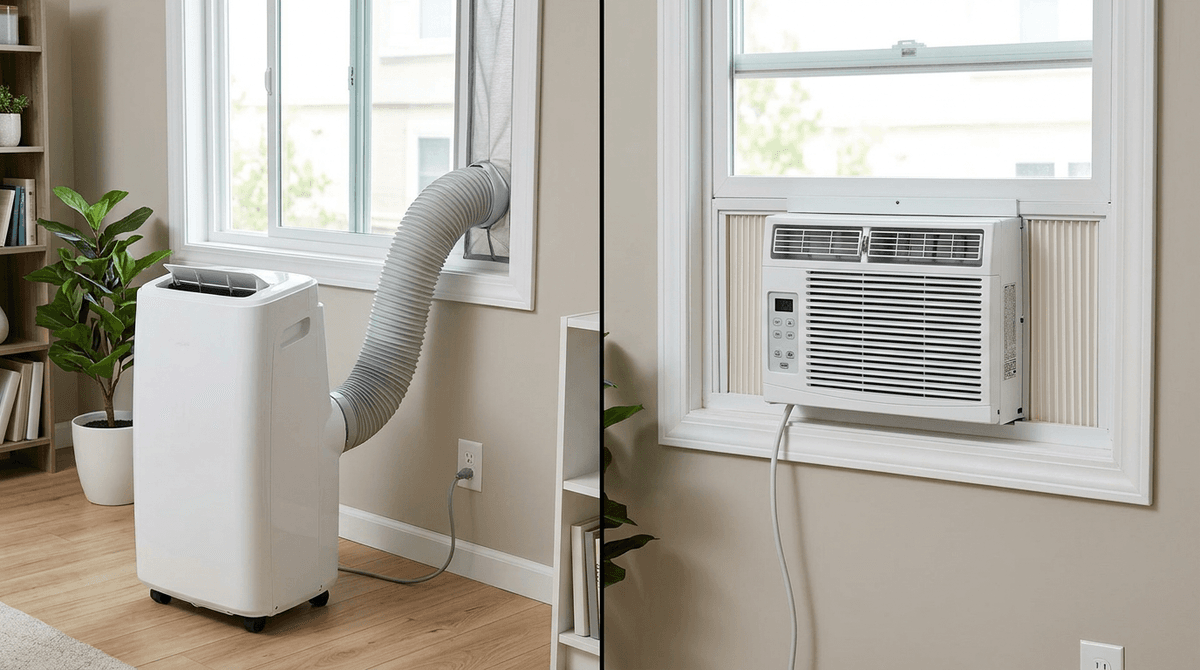
Window AC units often use less electricity than portable AC units for the same cooling output, especially when single-hose portable models pull conditioned air out of the room.
For exact runtime and local rates, use the WattSizing Calculator.
Quick Comparison
| Topic | Portable AC | Window AC |
|---|---|---|
| Typical running watts | 900 - 1,700 W | 500 - 1,500 W |
| Cooling efficiency tendency | Lower to moderate | Moderate to higher |
| Installation | Flexible, no permanent mount | Window installation required |
| Best fit | Rooms where window install is not feasible | Most single-room fixed cooling setups |
| Common energy outcome | Higher kWh for same comfort | Lower kWh in many cases |
Comparison Table: Example Daily Cooling
Assume electricity rate of $0.16/kWh.
| Use Case | Portable AC Example | Window AC Example | Cost Comparison |
|---|---|---|---|
| Bedroom evening (6 h) | Avg 1.10 kW -> 6.6 kWh | Avg 0.80 kW -> 4.8 kWh | $1.06 vs $0.77 |
| Home office day (8 h) | Avg 1.00 kW -> 8.0 kWh | Avg 0.70 kW -> 5.6 kWh | $1.28 vs $0.90 |
| Hot-day extended (12 h) | Avg 1.20 kW -> 14.4 kWh | Avg 0.95 kW -> 11.4 kWh | $2.30 vs $1.82 |
Worked Scenarios
1) Daily Summer Bedroom Cooling
Assume 30 days of the 6-hour case:
- Portable AC: 6.6 kWh/day -> 198 kWh/month
- Window AC: 4.8 kWh/day -> 144 kWh/month
Monthly cost at $0.16/kWh:
- Portable AC: $31.68
- Window AC: $23.04
Difference: $8.64/month.
2) Small Apartment Daytime Cooling
Assume:
- Portable AC: 10 kWh/day
- Window AC: 7.2 kWh/day
Monthly cost:
- Portable AC:
300 x 0.16 = $48.00 - Window AC:
216 x 0.16 = $34.56
Difference: $13.44/month.
Practical Decision Guidance
- If both are feasible, window AC usually delivers better kWh per cooling delivered.
- Dual-hose portable models can perform better than single-hose units.
- Seal leaks around window kits and doors; infiltration can dominate cooling losses.
- Right-sizing the unit matters as much as the product category.
Related reading:
FAQs
Why can portable AC units use more electricity?
Single-hose models can create negative pressure, drawing warm outside air back into the space.
Are portable AC units always inefficient?
Not always. Installation quality, hose length, and room conditions influence outcomes.
Is inverter technology available in both types?
Yes in some models, and variable-speed operation can improve efficiency.
Can insulation upgrades reduce both costs?
Absolutely. Better sealing and shading reduce runtime for both unit types.
CTA
Want to model your room size, climate, and runtime by AC type? Use the WattSizing Calculator to compare monthly cooling cost before you buy.


