
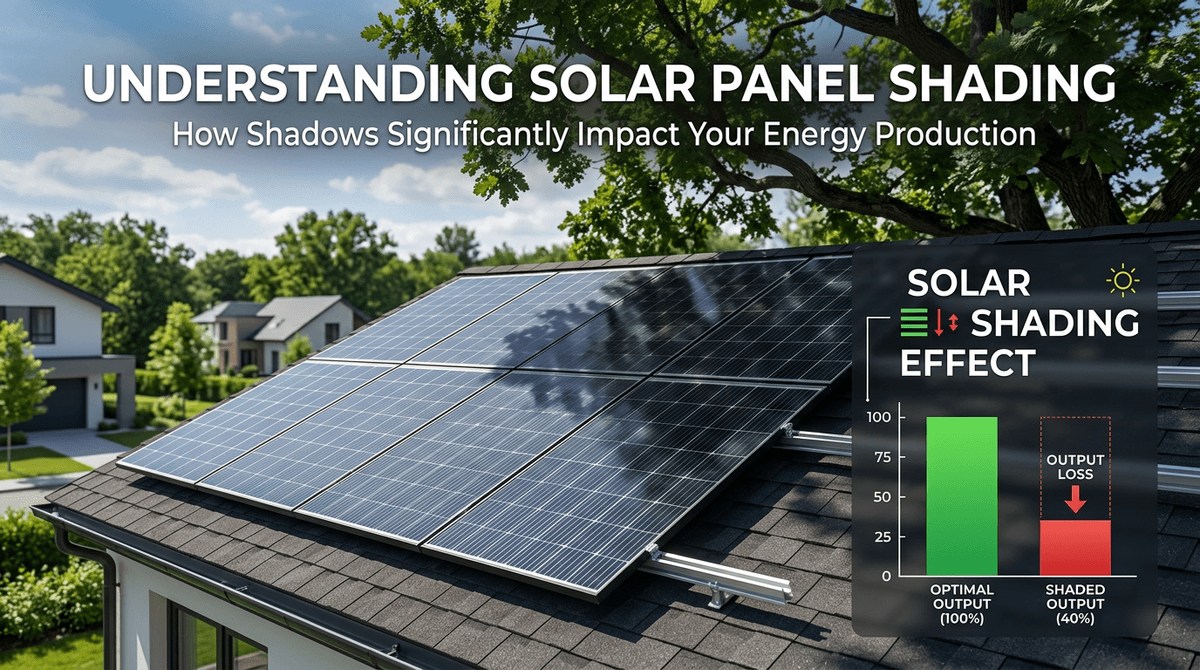
One of the most frustrating myths in the solar industry is that a single leaf falling on a solar panel will drop its power output to zero. While shading is undoubtedly the enemy of solar energy, the reality of how modern solar panels handle partial shade is much more nuanced.
At WattSizing, we constantly help users design off-grid systems for less-than-ideal locations—like forested cabins, RVs parked under trees, or roofs with chimneys and vent pipes.
In this comprehensive guide, we’ll explain exactly how partial shading affects solar panel output, how modern technology mitigates the damage, and how you can wire your array to survive the shade.
If you are dealing with a shaded property, you'll likely need more panels to compensate. Use our Off-Grid Solar Calculator to accurately size your system for your specific environment.
The Anatomy of a Solar Panel
To understand shading, you first need to understand how a solar panel is built.
A standard 100W rigid solar panel is not one giant solar cell; it is typically made up of 32 to 36 individual solar cells wired together in series.
Think of these cells like a chain of water pipes. The sunlight provides the water pressure. If you block one pipe (shade one cell), the flow of water (electrical current) through the entire chain is severely restricted.
The Problem with Series Wiring Inside the Panel
Because the cells inside a panel are wired in series, shading just one cell can have a disproportionate impact on the entire panel's output.
If 10% of a panel is shaded by a thick branch, you might assume you lose 10% of the power. In reality, without mitigation technology, shading 10% of the cells could drop the panel's total output by 50% to 80%. The shaded cell acts as a bottleneck, restricting the current of all the unshaded cells in that series string.
Furthermore, the shaded cell can actually become a consumer of electricity rather than a producer. The unshaded cells force current through the shaded cell, causing it to heat up rapidly—a phenomenon known as a "hot spot," which can permanently damage the panel.
The Hero of the Story: Bypass Diodes
To prevent hot spots and mitigate the massive power loss from partial shading, manufacturers install bypass diodes inside the junction box on the back of the panel.
A bypass diode acts like a detour on a highway. If there is an accident (shade) on one section of the road, the diode allows the traffic (current) to bypass that section entirely.
Most modern solar panels are divided into two or three "zones," with a bypass diode protecting each zone.
How Bypass Diodes Handle Shade
Let's look at a typical 100W panel with two bypass diodes (dividing the panel into a left half and a right half).
- No Shade: Both halves produce 50W. Total output = 100W.
- Shade on the Left Half: The cells on the left half are blocked. The bypass diode activates, routing current around the left half. The right half continues to produce 50W. Total output = 50W.
- Shade Across the Bottom (Both Halves): If a shadow falls across the bottom row of cells, affecting both the left and right zones, both bypass diodes activate. The entire panel is bypassed. Total output = 0W.
This is why the shape and orientation of the shadow matter just as much as the size of the shadow.
Hard Shade vs. Soft Shade
Not all shade is created equal. The density of the shadow drastically changes the impact on your solar array.
Hard Shade
Hard shade is cast by solid objects close to the panels, such as chimneys, vent pipes, satellite dishes, or thick branches resting directly on the glass. Hard shade completely blocks direct sunlight and triggers the bypass diodes immediately.
Soft Shade
Soft shade is cast by distant objects, such as a thin, leafless tree branch high above the roof, or light cloud cover. Soft shade reduces the intensity of the light but doesn't completely block it. In soft shade, the bypass diodes may not activate, and the panel will simply produce proportionally less power (e.g., a 20% drop in light intensity results in a 20% drop in power).
How to Wire Your Array for Shade Tolerance
If you know your installation site will experience partial shading throughout the day, the way you wire your solar panels together is the most critical decision you will make.
Wiring in Series (The Worst for Shade)
When you wire multiple panels in series, you are creating one massive chain. If Panel A is shaded and its output drops by 50%, it will drag down the output of Panel B and Panel C by 50% as well, even if they are in full sun.
(Note: Modern MPPT charge controllers can sometimes force the bypass diodes in Panel A to activate, saving Panel B and C, but you still lose the entire output of Panel A).
Verdict: Avoid series wiring if you have significant, unpredictable shading.
Wiring in Parallel (The Best for Shade)
When you wire panels in parallel, each panel operates independently.
If Panel A is shaded and drops to 10W, Panel B and Panel C will continue pumping out their full 100W each. The total output will be 210W.
Verdict: Parallel wiring is highly recommended for RVs, boats, and shaded cabins. It ensures that a shadow on one panel doesn't ruin the output of the entire array.
For a deeper dive into wiring, check out our guide on Mixing Different Wattage or Brand Solar Panels.
Advanced Solutions for Shaded Systems
If parallel wiring isn't enough, there are advanced technologies designed specifically to combat shade.
1. Microinverters
Instead of sending DC power from all the panels to a single central charge controller or inverter, microinverters are attached to the back of each individual panel. They convert DC to AC right at the panel level. Because each panel operates 100% independently, shade on one panel has absolutely zero effect on the rest of the array. This is the gold standard for shaded residential grid-tied systems.
2. DC Optimizers
Similar to microinverters, DC optimizers are attached to each panel. However, instead of converting DC to AC, they optimize the DC voltage and current of each panel independently before sending it to a central inverter or charge controller. This provides the shade tolerance of microinverters but keeps the system DC-coupled, which is often preferred for off-grid battery setups.
3. Half-Cut Cell Technology
Many newer panels, especially high-wattage residential panels and Bifacial Solar Panels, use "half-cut" cells. Instead of 60 large cells, they use 120 half-sized cells, wired in a complex twin-array design.
If the bottom half of a half-cut panel is shaded, the top half continues to produce 50% power. This makes them significantly more shade-tolerant than traditional full-cell panels, especially when dealing with shadows cast by roof parapets or adjacent rows of panels.
Frequently Asked Questions (FAQ)
Does a dirty solar panel act like shade?
Yes. A thick layer of dust, pollen, or bird droppings acts like soft shade, reducing the intensity of light reaching the cells. A localized bird dropping can even act like hard shade, triggering a bypass diode and causing a significant power drop. Regular cleaning is essential.
Will a shadow from a power line affect my panels?
Usually, no. Power lines are thin and far away, casting a very diffuse, soft shadow. The panels will likely not even register the drop in light intensity.
How do I know if my bypass diodes are broken?
If a panel's output drops to near zero when only a tiny corner is shaded, or if you notice a permanent dark spot or burn mark (hot spot) on the backsheet, a bypass diode has likely failed.
Final Verdict
Partial shading is a serious issue, but it doesn't have to ruin your off-grid system. By understanding how bypass diodes work, choosing half-cut cell panels, and wiring your array in parallel, you can build a highly resilient solar setup that thrives even in challenging environments.
Ready to design your shade-tolerant system? Head over to the WattSizing Calculator to run the numbers and ensure you have enough panels to compensate for those pesky shadows!


