
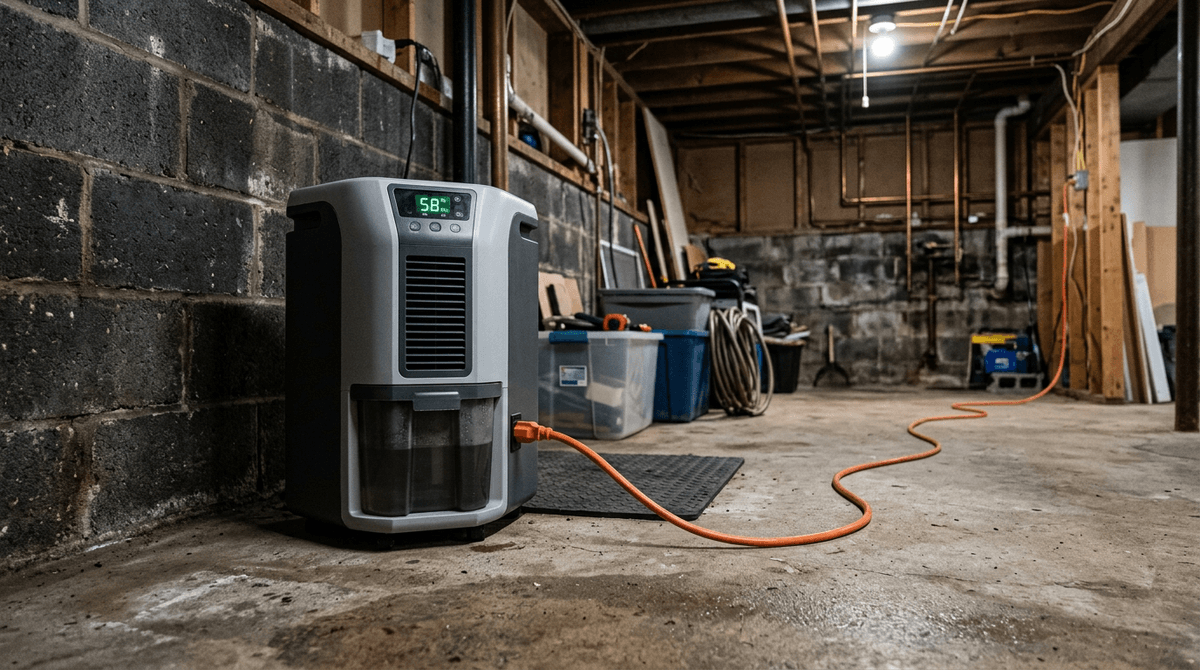
Dehumidifiers are moderate loads with compressor startup surge, so generator sizing should focus on both running watts and startup headroom.
Build your complete outage plan with the WattSizing Calculator.
Quick Answer
Most residential dehumidifiers pair best with a 2,000 to 3,500 watt generator. Larger units or shared critical loads may require 3,500 to 5,000 watts.
Dehumidifier Generator Sizing Method
- Check dehumidifier running watts from label or manual.
- Estimate compressor startup watts (often 1.5x to 2.5x running watts).
- Add concurrent loads (sump pump, lights, internet, fridge).
- Add 20% to 25% safety margin.
In humid climates, dehumidifiers may cycle frequently during outages, so restart reliability matters.
Related guides:
- How Many Watts Does a Dehumidifier Use
- How Many Watts Does a Dehumidifier Use Per Day
- What Size Generator for a Sump Pump
Dehumidifier Generator Sizing Table
| Dehumidifier Capacity | Typical Running Watts | Typical Starting Watts | Recommended Generator Size |
|---|---|---|---|
| 20 to 35 pint/day | 300 - 500 W | 600 - 1,100 W | 1,500 - 2,500 W |
| 40 to 50 pint/day | 450 - 700 W | 900 - 1,500 W | 2,000 - 3,000 W |
| 50 to 70 pint/day | 600 - 1,000 W | 1,200 - 2,200 W | 2,800 - 4,000 W |
| Commercial/large basement unit | 900 - 1,500 W | 1,800 - 3,200 W | 3,500 - 5,500 W |
Worked Sizing Example
Basement backup loads:
- 50-pint dehumidifier: 650 W run / 1,400 W start
- 1/3 HP sump pump standby run: 500 W (not always on)
- Router + modem: 35 W
- Basement lights: 80 W
Worst-case event when dehumidifier starts while other loads run:
- Peak estimate:
1,400 + 500 + 35 + 80 = 2,015 W - Add 25% margin:
2,015 x 1.25 = 2,519 W
Practical pick: a 3,000 W to 3,500 W generator.
This gives breathing room for compressor restarts and wet-weather variability.
Practical Moisture-Control Tips
- Keep doors and windows closed in the target zone to reduce runtime.
- Use short, heavy-gauge extension cords to limit voltage drop.
- Clean filter and coil area regularly for better compressor efficiency.
- If running both sump pump and dehumidifier, avoid simultaneous high-load starts when possible.
FAQs
Will a 2,000W generator run a dehumidifier?
Often yes for small to mid-size units, but large units with other active loads may need more capacity.
Why does my generator bog down when the dehumidifier starts?
Compressor startup surge is the usual cause. Increase generator headroom or reduce simultaneous loads.
Is inverter or conventional generator better?
Either can work. Inverter models are quieter and smoother for mixed household loads.
Can I run a dehumidifier and sump pump together?
Yes, but size for overlapping startup/running events or manage sequencing during storms.
CTA
Need a moisture-safe backup plan? Use the WattSizing Calculator to size your generator around compressor surge, pump loads, and real outage usage.


