
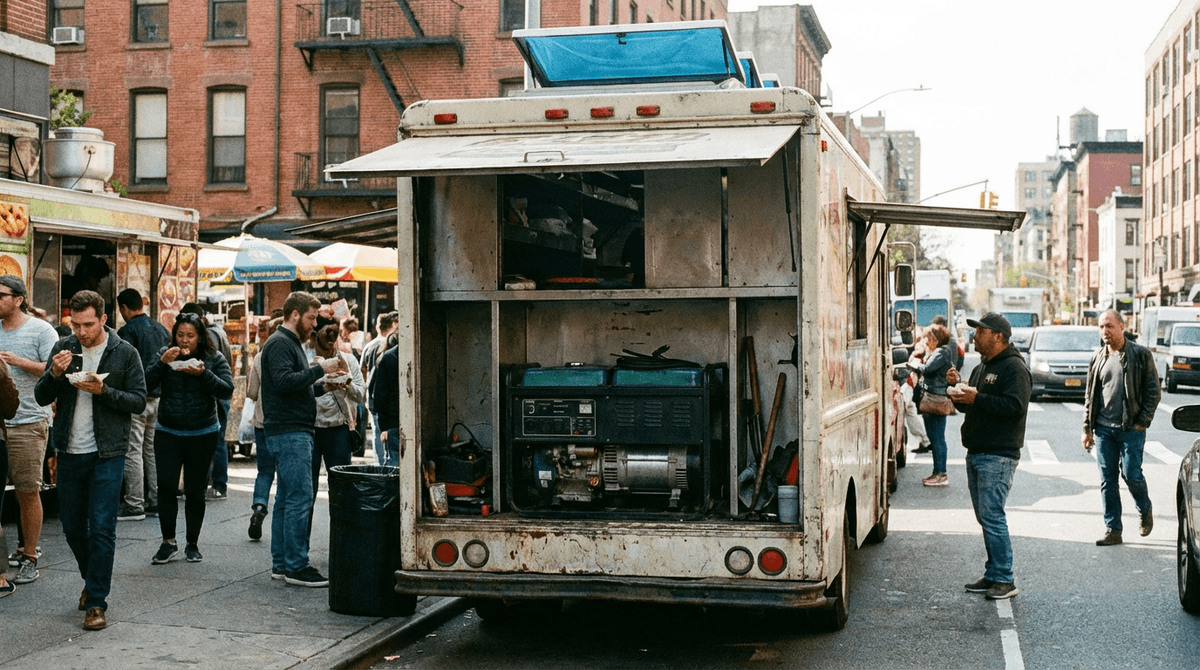
A food truck generator has to survive service spikes: compressors cycling, a griddle holding temperature, and a hood fan pulling steady watts—often while POS gear and lights stay on. Align nameplate data from cooking and refrigeration equipment with How Many Watts Does a Refrigerator Use and How Many Watts Does an Electric Griddle Use.
Lay out menu-time stacks in the WattSizing Calculator.
Quick Answer
Most revenue-stage trucks land around 7,500–15,000 W generator class, driven mainly by electric cooking count and how many refrigerated boxes run at once. Propane-fired cooking reduces electrical headroom needs but does not remove cold-chain and ventilation load.
Safety first: exhaust, CO, and cord discipline
- Generator exhaust must clear people, windows, and intake paths; carbon monoxide risk is acute in tight lots. Review EPA indoor air and CO guidance alongside your local fire code.
- Cords and inlet equipment should be rated for continuous load; underrated cords cause voltage drop that trips refrigeration controls or browns out POS gear.
- Keep a fire extinguisher and maintenance routine matched to grease and high-heat appliances.
Food truck generator sizing table
Illustrative—verify each appliance label and your 120V vs 120/240V distribution.
| Truck profile | Typical steady band | Typical rush / overlap band | Practical generator class |
|---|---|---|---|
| Cold chain + prep + POS; little electric cooking | 2,000–4,000 W | 4,000–6,500 W | 5,000–8,000 W |
| One serious electric cook surface + refrigeration | 4,000–7,000 W | 7,000–10,500 W | 8,000–12,000 W |
| Multiple electric cooks + multi-door refrigeration | 7,000–11,000 W | 11,000–16,000 W | 12,000–18,000 W |
| Large trailer kitchen, heavy electric menu | 10,000–16,000 W | 16,000–24,000 W | 18,000–28,000 W |
Worked example (illustrative)
Lunch rush snapshot:
- Fridge + freezer steady: 1,100 W; allow ~2,000 W moment if both compressors are demanding at once.
- Prep cooler: 450 W run; ~800 W start contribution (simplified).
- Electric griddle: 2,200 W while hot.
- Hood + makeup air fans: 700 W.
- Warmers, POS, LED: 900 W.
You might schedule starts, but planning should not assume perfection:
- Rough peak planning stack: ~6,700 W (rounded illustrative).
- Add 20% service margin:
6,700 × 1.2 ≈ 8,040 W.
Direction: about 9–10 kW minimum class for this profile—higher if second electric cook comes online during the same window.
What to verify beyond watts
- Phase and voltage: many rigs need 120/240V split-phase for larger equipment; confirm panel and cord plans.
- Inverter vs conventional: inverters can be quieter and smoother for electronics; large menus may prioritize raw kW and tank runtime.
- Fuel tracking: log L/hr or gal/hr at real loads so service hours don’t surprise you mid-season.
See also What Size Generator for a Microwave for overlap math when break-time appliances run against kitchen peaks.
FAQs
Can a 5,000 W generator run a food truck?
Only for lighter electric-cooking profiles with strict load management; many full menus outgrow that quickly.
Should I size for the average day or the busiest festival?
Size for credible worst-case service you still intend to operate—plus margin—or accept that you’ll throttle menu when overloaded.
Do compressor starts really matter?
Yes. Overlapping refrigeration starts with electric cooking is a common reason generators trip at the worst moment.
Is quieter always better?
Often yes for customers and neighbors, but noise cannot come at the expense of adequate kW—dropping voltage hurts food safety equipment.
When does propane cooking change the electrical size?
It can shrink electric heat demand, but you still power fans, controls, cold chain, and often water pumps—so electrical sizing stays material.
Sources
- U.S. Department of Energy: Portable Generators
- U.S. Energy Information Administration: Electricity Explained
- Generac: Generator Sizing Guide
CTA
Stress-test your rush-hour stack before you spec hardware: WattSizing Calculator.


