
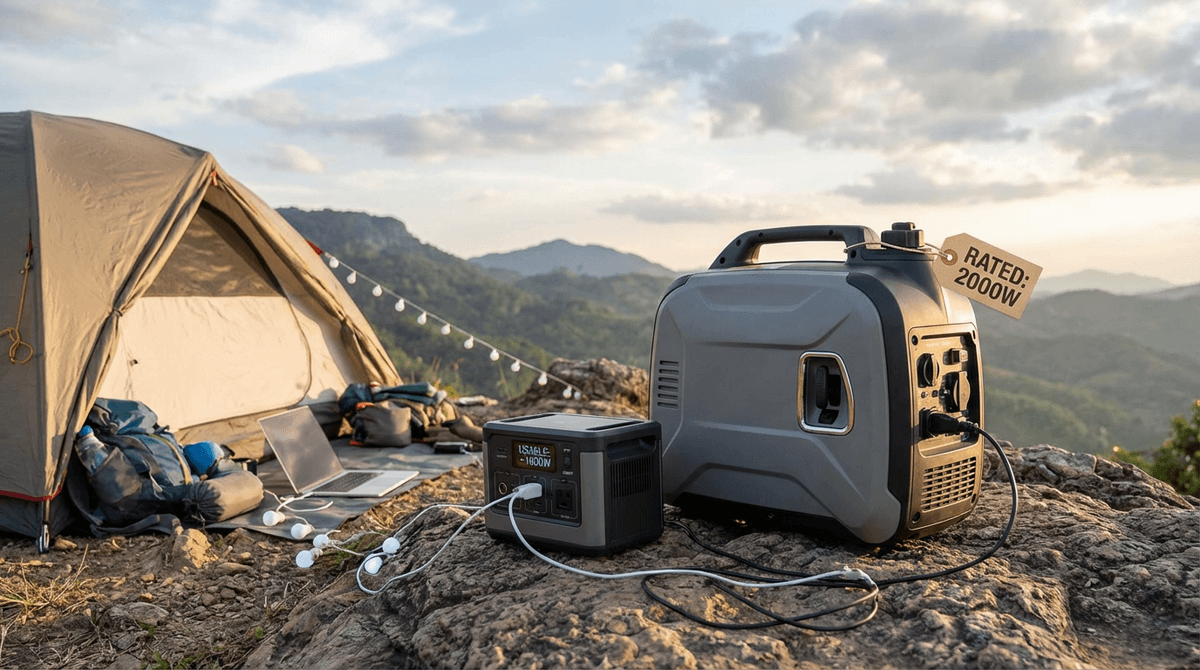
Generator labels often show optimistic headline numbers. What matters in real outages is the usable output you can rely on continuously, with surge events and safety margin included.
Build a practical backup plan with the WattSizing Calculator.
Choose the right article
- Need help reading the manufacturer sheet? How to Read Generator Specs: Running vs Peak explains what “running” and “peak” refer to on the label.
- Need the motor-start story (LRA-style surge vs steady watts)? Generator Running Watts vs Starting Watts Explained walks through why appliances spike.
- You landed here for the gap between marketing and margin: turning headline capacity into watts you can schedule an outage around.
Usable watts: what the brochure omits
- Generator capacity is the advertised rating (often running and surge specs).
- Usable output is what you can depend on after applying real-world limits such as continuous loading targets, altitude/temperature derating, and concurrent startup events.
A common rule of thumb is to plan around 70% to 85% of nameplate running watts for dependable operation.
Why Nameplate Watts and Real Watts Differ
Several factors reduce practical output:
- Continuous-load margin: Running near 100% for long periods increases heat and wear.
- Altitude derating: Engine power drops at higher elevations.
- Ambient temperature: Hot weather lowers performance.
- Fuel quality and maintenance: Dirty filters, old fuel, or tune issues reduce output.
- Startup overlap: Motors and compressors can briefly exceed running demand.
This is why two households with the same generator model can see different real performance.
When the question is which circuits to protect—not only total watts—What Size Generator for House Essential Circuits shows how panel reality lines up with these usable-output targets.
Calculation Framework
Start with:
Usable Output (W) = Running Capacity x Derating Factor x Planning Margin
Where:
- Derating factor might be 0.90 to 0.98 depending on conditions.
- Planning margin might be 0.80 to 0.90 for reliability.
Worked Examples
Example 1: 5000W Rated Generator
- Rated running capacity: 5000W
- Mild derating factor: 0.95
- Reliability margin: 0.85
5000 x 0.95 x 0.85 = 4037W
Practical usable output is about 4.0kW.
Example 2: Hot Day + Higher Altitude
- Rated running capacity: 7000W
- Combined derating: 0.90
- Planning margin: 0.80
7000 x 0.90 x 0.80 = 5040W
Even with a 7kW label, dependable planning may be near 5.0kW.
Example 3: Startup Event Check
Loads:
- Fridge: 180W run / 1200W start
- Sump pump: 900W run / 2200W start
- Lights + network: 220W
Worst overlap during pump start:
2200 + 180 + 220 = 2600W
A generator with 4kW usable output handles this easily, while a "3kW class" unit could struggle depending on surge rating.
Related Guides
- How Many Watts Does a Sump Pump Use (includes generator and backup sizing)
- What Size Generator Do You Need for a Home Office
- How Many Watts Does a Refrigerator Use
FAQs
Is surge watt rating the same as usable output?
No. Surge watts are short-duration peaks, while usable output is sustainable planning capacity.
Should I size a generator exactly to my running load?
No. Add room for startup surges, load changes, and environmental derating.
How much buffer should I keep?
Many homeowners target at least 15% to 30% headroom beyond expected continuous running load.
Do inverter generators have better usable output?
They often provide cleaner and more stable power for electronics, but usable output still depends on load profile and operating conditions.
Sources
- U.S. Energy Information Administration (EIA) - Electricity explained
- U.S. Department of Energy - Energy Saver
- ENERGY STAR - Save Energy at Home
CTA
Need to convert nameplate ratings into realistic backup capacity? Use the WattSizing Calculator to account for surge, runtime priorities, and dependable usable output.


