
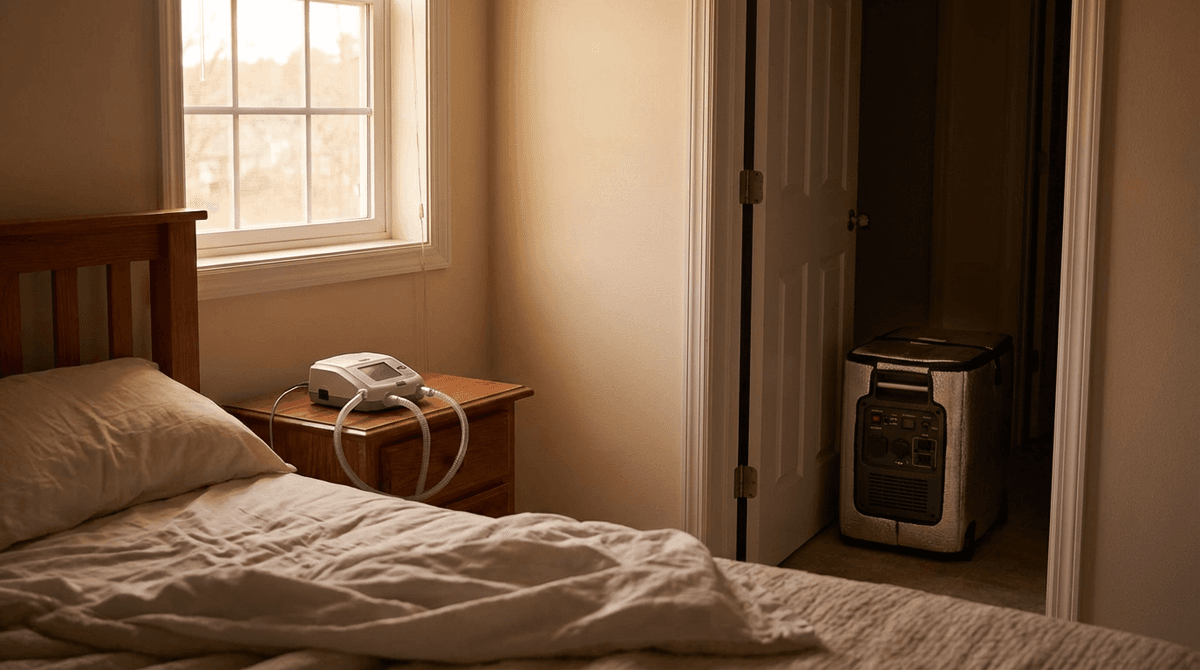
When care equipment is involved, generator sizing is not a generic appliance exercise. You need written requirements from your clinician or equipment supplier, clear rules for oxygen or ventilation, stable power for communication, and—often—temperature control. This article gives electrical planning context only; it does not replace professional medical advice.
For cold-chain context, start with How Many Watts Does a Refrigerator Use. For climate loads on backup, see How Many Watts Does a Mini Split Use.
Layer devices and support loads in the WattSizing Calculator.
Straight answer (non-prescriptive bands)
Many home care scenarios land in 3,500–8,500 W portable-class planning once you include medical devices, medication refrigeration, communications, and sometimes HVAC—but your plan may be smaller or much larger depending on device power, simultaneous starts, and required circuits.
If you only need low-watt electronics + fridge + router, you may be far below that range—if you must keep whole-room cooling or large concentrators online, you may exceed it.
Tier loads the way hospitals tier triage
- Must-run continuously (per care team guidance): primary therapeutic devices.
- Cold chain: medication refrigerator if required—use refrigerator watt bands from How Many Watts Does a Refrigerator Use.
- Connectivity: modem/router baseline from How Many Watts Does a Router Use.
- Environment: fans, portable conditioning, or a mini split segment—compare starting watts in How Many Watts Does a Mini Split Use.
- Only if margin allows: convenience outlets and non-critical loads.
Illustrative sizing scenario (hypothetical—verify with your team)
Assumed planning numbers for math only:
-
Continuous medical electronics: 300 W
-
Oxygen concentrator (illustrative): 450 W run / 900 W brief peak (confirm on label)
-
Medication refrigerator: 180 W run / 600 W start (How Many Watts Does a Refrigerator Use context)
-
Router/phone/lighting: 220 W
-
Bedroom mini split segment: 900 W run / 1,800 W ramp window (see mini split guide)
-
Continuous stack:
300 + 450 + 180 + 220 + 900 = 2,050 W -
Stress-case planning moment (illustrative overlap): about 3,370 W before margin
-
With 25% margin:
3,370 × 1.25 ≈ 4,213 W
Illustrative pick: ~5,000 W inverter-class portable if your verified peaks fit—otherwise move up.
Also plan short UPS bridging for devices that cannot tolerate generator start or refueling gaps—your equipment manuals define tolerance.
Preparedness beyond watts
- Written runbook for who connects what, in what order.
- Fuel rotation and maintenance logs for the generator.
- Emergency contacts for equipment vendors and clinical on-call lines.
Safe power for medical contexts
- Never operate portable generators indoors or near open windows; carbon monoxide is lethal. CDC power outage guidance explains ventilation rules.
- The FDA discusses home medical devices in consumer terms—use manufacturer instructions for power quality (grounding, acceptable waveform, UPS needs).
- Have a licensed electrician review transfer switches, bonding, and neutral requirements—NFPA generator safety covers baseline generator hazards.
FAQs
Is an inverter generator usually preferred for sensitive medical electronics?
Often, because frequency and voltage stability matter for some power supplies—but confirm against your device documentation—marketing labels are not clinical approval.
Do I size to “worst day in August” or “typical outage”?
Size to the care plan your team agrees on—some patients need climate stability; others need minimal continuous watts only.
Should automatic transfer switch gear be on the table?
If manual steps are unsafe for your situation, automatic paths can reduce risk—this is an electrical + care logistics decision, not a wattage footnote.
How do I avoid double-counting refrigerator surge?
Model worst simultaneous starts you cannot sequence—if you can stagger intentionally, your peak drops—but do not rely on hope.
What about battery-only backup instead of a generator?
Batteries can cover short gaps; multi-day events often still point to fuel-based generation—many real plans use both.
Where does essential-circuit planning overlap?
Read What Size Generator for House Essential Circuits for motor-heavy homes—pumps can dominate even when medical loads are modest.
Sources
- FDA: Home medical devices — using devices safely at home
- CDC: Power outages — CO and preparedness
- NFPA: Generators — safe operation
CTA
Translate care priorities into watts and surge watts with professional sign-off on the medical side. Use the WattSizing Calculator for the electrical stack.


