
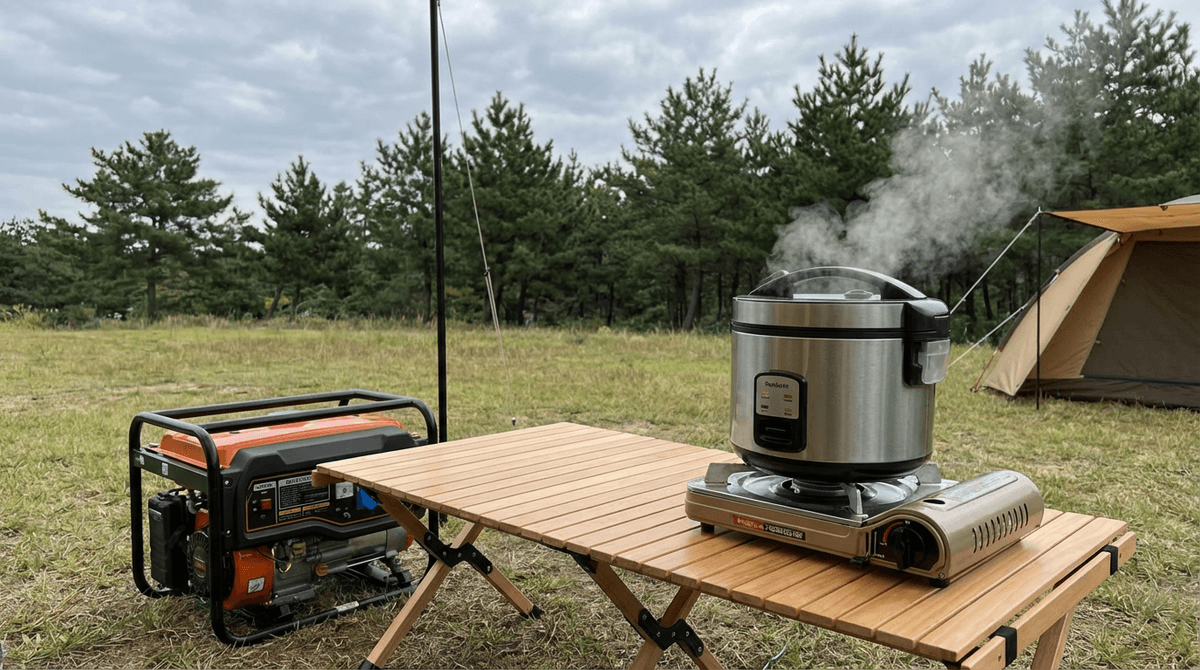
Rice cookers are usually straightforward backup loads, but generator sizing still matters when other kitchen appliances run in parallel. A setup that looks fine on nameplate wattage can struggle once breakfast or dinner loads overlap.
Plan your complete cooking loads with the WattSizing Calculator.
Quick Answer
Most homes can run a rice cooker reliably with a 1,200 to 2,000 watt generator. If you expect concurrent kitchen usage (kettle, microwave, toaster, or fridge cycling), a 2,000 to 3,000 watt range is usually safer.
Rice Cooker Loads to Count
For practical sizing, include:
- Rice cooker cooking watts
- Keep-warm mode if used for long periods
- Concurrent kitchen loads
- A sizing margin of 15% to 25%
If you need baseline appliance numbers first, start with How Many Watts Does a Rice Cooker Use and How Many Watts Does an Electric Kettle Use.
Rice Cooker Generator Sizing Table
| Rice Cooker Type | Typical Cooking Watts | Typical Keep-Warm Watts | Recommended Generator Size |
|---|---|---|---|
| Small basic (3-cup) | 250 - 450 W | 20 - 50 W | 900 - 1,400 W |
| Medium basic (5-6 cup) | 300 - 600 W | 25 - 60 W | 1,200 - 1,800 W |
| Large basic (8-10 cup) | 450 - 800 W | 30 - 80 W | 1,500 - 2,200 W |
| Induction / smart cooker | 600 - 1,200 W | 30 - 90 W | 2,000 - 3,000 W |
Worked Sizing Example
Your outage meal setup includes:
- Rice cooker cooking draw: 700 W
- Refrigerator cycling average: 180 W
- Kitchen lighting and charging: 120 W
Calculation:
- Continuous load:
700 + 180 + 120 = 1,000 W - Add 20% operating margin:
1,000 x 1.2 = 1,200 W
Practical pick: 1,500 W inverter generator.
If you also run a microwave at the same time, step up toward 2,500 to 3,000 W.
Practical Operation Tips
- Let the generator stabilize for a minute before starting heating appliances.
- Avoid simultaneous use of rice cooker and kettle on small units.
- Use keep-warm mode strategically to reduce total fuel use.
- Test your exact setup under load once per month.
FAQs
Can a small portable generator run a rice cooker?
Yes, many can, especially for smaller models. The key is reserving headroom for overlap loads.
Does a rice cooker need surge capacity like a compressor?
Not usually. It is mostly a resistive heating load, but a margin still helps with real-world voltage stability.
Should I size for cooking mode or keep-warm mode?
Size for cooking mode, since that is the higher draw period.
Is 2000W enough for rice cooker plus other kitchen items?
Often yes for light overlap, but it can be tight with high-watt appliances running together.
CTA
Want accurate generator sizing for your meal routine? Use the WattSizing Calculator to map rice cooker use with simultaneous kitchen loads and runtime goals.


