
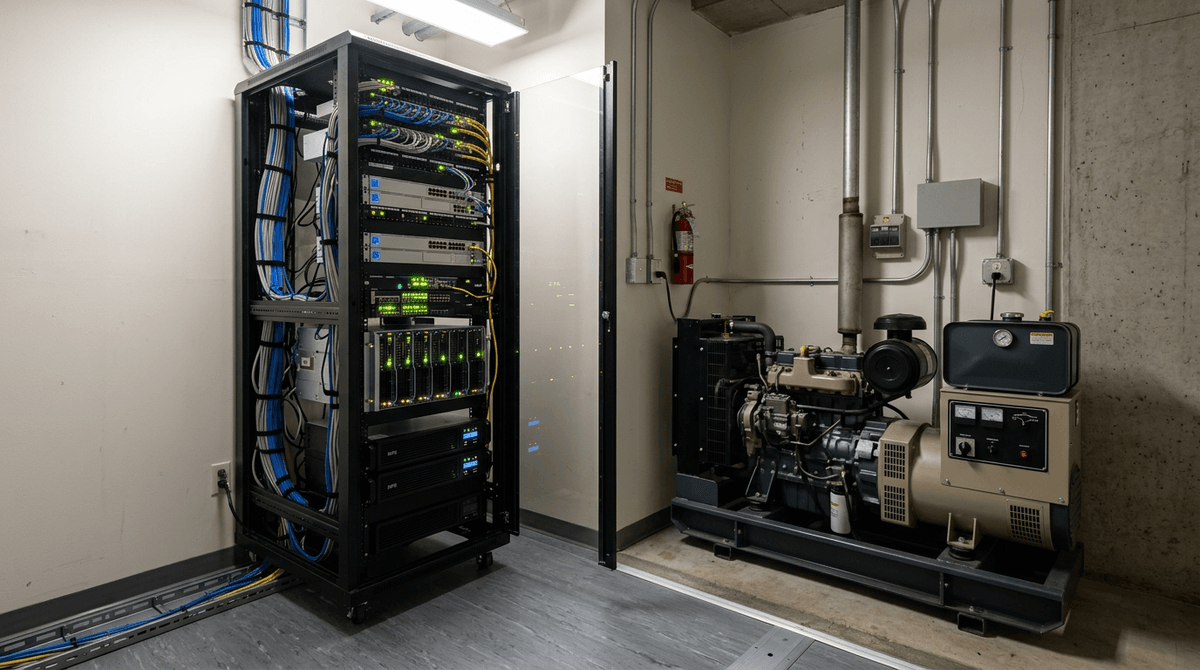
For rack power, the goal is stable uptime under real conditions, not a best-case watt number. Your generator has to handle IT load, cooling, and battery charger draw at the same time without brownouts.
Model your exact backup scenario with the WattSizing Calculator.
Quick Answer
For a small business or homelab rack, a 5,000 to 9,000 watt inverter generator is a common practical range once you include cooling and UPS charging overhead.
How to Size Rack and Network Loads
Use this order when building your load list:
- Critical IT loads (servers, storage, firewall, core switch)
- Supporting network gear (access switches, AP PoE budget, modem/ONT)
- Rack cooling and room ventilation
- UPS charging draw after an outage event
- 20% to 30% headroom for sustained reliability
If you need baseline watt references, review How Many Watts Does a Desktop Computer Use and How Many Watts Does a Router Use.
Server Rack Generator Sizing Table
| Rack Profile | Typical Running Watts | Typical Peak Watts | Recommended Generator Size |
|---|---|---|---|
| Network-only mini rack (router, switch, modem, NVR) | 250 - 700 W | 600 - 1,500 W | 1,800 - 3,000 W |
| Homelab rack (1-2 servers + network + UPS charge) | 900 - 2,000 W | 2,000 - 3,800 W | 3,500 - 6,000 W |
| Small business rack + cooling | 2,000 - 4,000 W | 4,000 - 7,000 W | 6,000 - 10,000 W |
| Dense rack with PoE + stronger cooling | 3,500 - 6,000 W | 6,500 - 10,000 W | 9,000 - 14,000 W |
Worked Sizing Example
Your outage plan includes:
- Two 1U servers: 1,000 W total
- Firewall + core switch + access switch + ONT: 320 W
- PoE AP and cameras: 260 W
- Rack/room cooling fans: 500 W
- UPS recharge allowance: 700 W
Calculation:
- Continuous load:
1,000 + 320 + 260 + 500 + 700 = 2,780 W - Peak planning with 25% margin:
2,780 x 1.25 = 3,475 W - Additional startup/transient cushion for cooling and chargers: about 1,000 W
Practical pick: 5,000 W inverter generator (or larger if growth is expected).
Practical Reliability Tips
- Keep IT load and cooling on separate branch circuits where possible.
- Configure staged UPS charging to avoid a large recharge spike.
- Test monthly using your real outage load profile, not a partial bench load.
- Track rack growth; PoE and storage expansion can quietly eat your margin.
FAQs
Is an inverter generator necessary for servers?
It is strongly preferred. Cleaner voltage and frequency control reduce risk for sensitive power supplies and network equipment.
Should I size to total PSU rating?
No. Use measured real load under peak business usage, then add a practical safety margin.
Do I include UPS charging watts?
Yes. Ignoring recharge draw is a common sizing mistake and can cause overload right after startup.
Can one portable generator run rack and office AC too?
Sometimes, but separate planning is safer. Cooling loads can create startup events that disrupt IT stability.
CTA
Need clean, resilient backup for your rack? Use the WattSizing Calculator to size your generator around IT load, cooling, and recharge behavior.


