
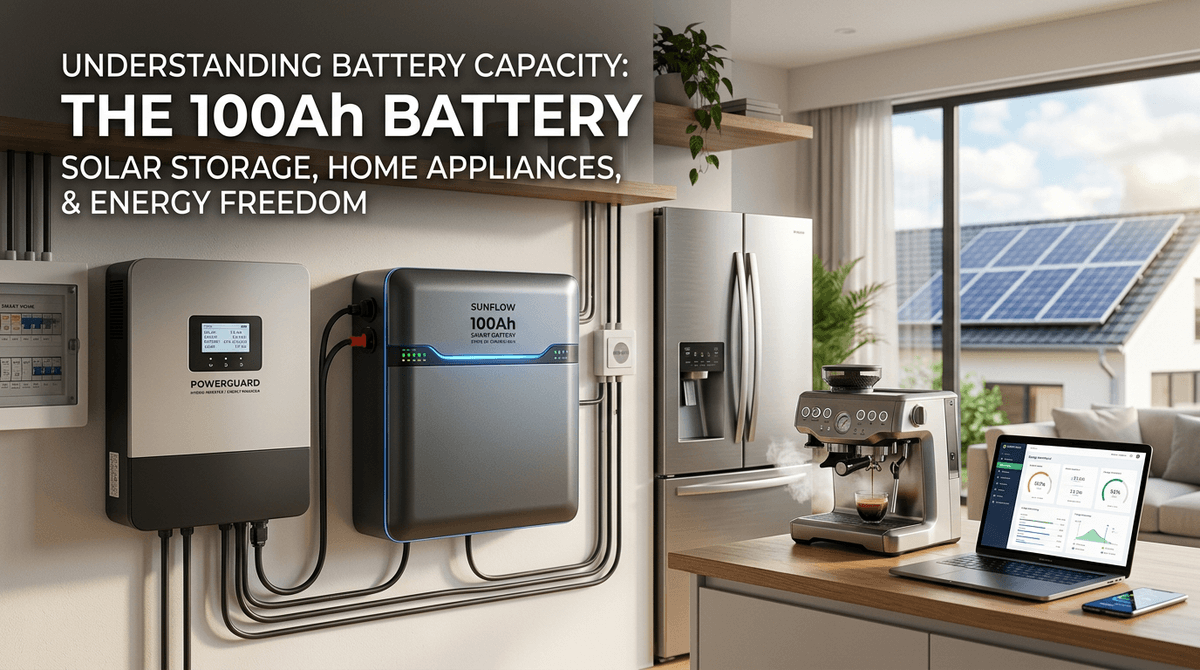
When building an off-grid solar system, the battery bank is the heart of your setup. It stores the energy your solar panels collect during the day so you can use it at night or during cloudy weather. (Curious about cloudy weather performance? Read our guide: Do Solar Panels Work in the Rain or Snow?).
The most common building block for these systems is the 12-volt, 100 Amp-hour (100Ah) battery. But what does that actually mean in the real world? "How long will a 100Ah battery run my fridge, TV, or CPAP machine?"
In this comprehensive guide, we'll demystify battery capacity, explain the crucial differences between lead-acid and lithium batteries, and provide detailed charts showing exactly how long a 100Ah battery will run common household appliances. If you want to skip the math, use our free WattSizing calculator to perfectly size your battery bank in seconds.
Understanding Battery Capacity: The Math
Before we look at the charts, you need to understand how battery capacity is measured.
What is an Amp-Hour (Ah)?
An Amp-hour (Ah) is a unit of electrical charge. It simply means the battery can deliver 1 Amp of current for 100 hours, or 10 Amps of current for 10 hours, or 100 Amps of current for 1 hour.
However, most household appliances are rated in Watts, not Amps. To figure out how long a battery will run an appliance, we need to convert Amp-hours into Watt-hours (Wh).
The Magic Formula: Volts x Amps = Watts
To find the total energy capacity of a battery in Watt-hours, you multiply its voltage by its Amp-hour rating:
12 Volts × 100 Amp-hours = 1,200 Watt-hours (Wh)
This means a 12V 100Ah battery contains a total of 1,200 Watt-hours of energy. If you have an appliance that uses 100 Watts of power per hour, the battery could theoretically run it for 12 hours (1,200 Wh ÷ 100 W = 12 hours).
But there's a catch. You can rarely use 100% of a battery's capacity.
The Big Difference: Lead-Acid vs. Lithium (LiFePO4)
The type of battery chemistry you choose drastically changes how much of that 1,200Wh you can actually use.
Lead-Acid (AGM / Gel) Batteries
Lead-acid batteries are cheap and reliable, but they have a major flaw: Depth of Discharge (DoD).
If you drain a lead-acid battery below 50% of its total capacity, you will permanently damage the internal lead plates and drastically shorten its lifespan. Therefore, a 100Ah lead-acid battery only gives you 50Ah of usable capacity.
- Total Capacity: 1,200 Wh
- Usable Capacity (50% DoD): 600 Wh
Lithium Iron Phosphate (LiFePO4) Batteries
Lithium batteries are more expensive upfront, but they are vastly superior for off-grid solar. You can safely discharge a lithium battery down to 10% or even 0% without damaging it.
- Total Capacity: 1,200 Wh
- Usable Capacity (90% DoD): 1,080 Wh
Note: For the runtime charts below, we will assume you are using a modern 12V 100Ah Lithium (LiFePO4) battery with 1,080Wh of usable capacity.
Inverter Inefficiency
If you are running AC appliances (things that plug into a standard wall outlet), you must use an inverter to convert the battery's 12V DC power into 120V AC power.
Inverters are not 100% efficient. During the conversion process, they lose about 10% to 15% of the energy as heat. Therefore, when calculating runtimes for AC appliances, we must reduce the battery's usable capacity by another 10%.
- Usable AC Capacity: 1,080 Wh × 0.90 = 972 Watt-hours
100Ah Battery Runtime Charts for Common Appliances
Now that we have our real-world usable capacity (972 Wh for AC appliances, 1,080 Wh for DC appliances), let's look at how long a single 100Ah lithium battery will run common devices.
Chart 1: Small Electronics & Lighting
These devices draw very little power and can run for days on a single 100Ah battery.
| Appliance | Average Power Draw | Estimated Runtime on 100Ah Lithium |
|---|---|---|
| Smartphone Charger | 10 Watts | 97 Hours |
| Laptop Charger | 50 Watts | 19 Hours |
| LED Light Bulb (12V DC) | 10 Watts | 108 Hours |
| String Lights (AC) | 25 Watts | 38 Hours |
| Wi-Fi Router | 15 Watts | 64 Hours |
Chart 2: Entertainment & Medical Devices
If you are camping or living in an off-grid cabin, you'll likely want some entertainment or need to run a medical device overnight.
| Appliance | Average Power Draw | Estimated Runtime on 100Ah Lithium |
|---|---|---|
| 32-inch LED TV | 40 Watts | 24 Hours |
| 55-inch OLED TV | 100 Watts | 9.5 Hours |
| Video Game Console | 150 Watts | 6.5 Hours |
| CPAP Machine (No Humidifier) | 30 Watts | 32 Hours |
| CPAP Machine (With Humidifier) | 90 Watts | 10.5 Hours |
Chart 3: Kitchen Appliances
Kitchen appliances are notorious power hogs because they use electricity to generate heat or run large compressor motors.
| Appliance | Average Power Draw | Estimated Runtime on 100Ah Lithium |
|---|---|---|
| 12V Portable Fridge (DC) | 45 Watts* | 24 Hours |
| Mini Fridge (AC) | 100 Watts* | 9.5 Hours |
| Full-Size Refrigerator | 150 Watts* | 6.5 Hours |
| Microwave | 1,000 Watts | 58 Minutes |
| Coffee Maker | 800 Watts | 1 Hour 12 Minutes |
| Blender | 400 Watts | 2.4 Hours |
*Note: Refrigerators cycle on and off. They do not draw power continuously. The runtimes above assume the compressor is running 100% of the time, which is unrealistic. In reality, a 100Ah battery can easily run a 12V portable fridge for 2 to 3 days, or a highly efficient full-size fridge for 15 to 20 hours.
Chart 4: Heating & Cooling
Heating and cooling require massive amounts of energy. A single 100Ah battery is generally insufficient for these tasks, as you can see below.
| Appliance | Average Power Draw | Estimated Runtime on 100Ah Lithium |
|---|---|---|
| Box Fan | 50 Watts | 19 Hours |
| Small Space Heater | 1,500 Watts | 38 Minutes |
| 5,000 BTU Window AC | 500 Watts | 1.9 Hours |
| 12V Diesel Heater (DC) | 15 Watts (after startup) | 72 Hours |
As you can see, trying to run a space heater or air conditioner on a single 100Ah battery will drain it in less than two hours. If you need climate control, you must build a massive battery bank and a large solar array. Ensure your panels are protected from the elements by reading our guide on solar panel hail protection.
How to Calculate Your Own Runtimes
If your specific appliance isn't listed above, you can easily calculate the runtime yourself.
- Find the Wattage: Look at the sticker on the back or bottom of the appliance. It will list the power draw in Watts (W). If it only lists Amps (A) and Volts (V), multiply them together (e.g., 120V × 2A = 240W).
- Divide the Usable Capacity: Take the usable capacity of your battery (972 Wh for a 100Ah lithium battery running AC loads) and divide it by the appliance's wattage.
- The Result: 972 Wh ÷ 240 W = 4.05 Hours.
Frequently Asked Questions (FAQ)
Can I run a refrigerator on a 100Ah battery? Yes, but the runtime depends heavily on the fridge. A highly efficient 12V DC portable fridge can run for 2-3 days on a single 100Ah lithium battery. A standard AC mini-fridge might run for 12-15 hours. A full-size residential fridge will drain the battery in less than 8 hours.
How many 100Ah batteries do I need to run a house? An average American home uses about 30,000 Watt-hours (30 kWh) of electricity per day. To run a normal house entirely off-grid for one day without solar input, you would need roughly thirty 12V 100Ah lithium batteries.
How long does it take to charge a 100Ah battery with solar panels? This depends entirely on the size of your solar array and the weather. If you have 400 Watts of solar panels, they will produce roughly 300 Watts of actual power in full sun. It would take about 4 hours of direct, perfect sunlight to fully recharge a depleted 100Ah lithium battery (1,200 Wh ÷ 300 W = 4 hours).
Conclusion
A single 12V 100Ah battery is a powerful energy storage device, perfect for weekend camping trips, van life, or running essential medical devices during a power outage. However, as the charts above demonstrate, it will quickly be overwhelmed by heat-generating appliances like microwaves, coffee makers, and space heaters.
Understanding your energy needs is the most critical step in designing an off-grid system. Don't guess—use our free WattSizing calculator to accurately determine exactly how many batteries and solar panels you need to power your specific lifestyle!


