
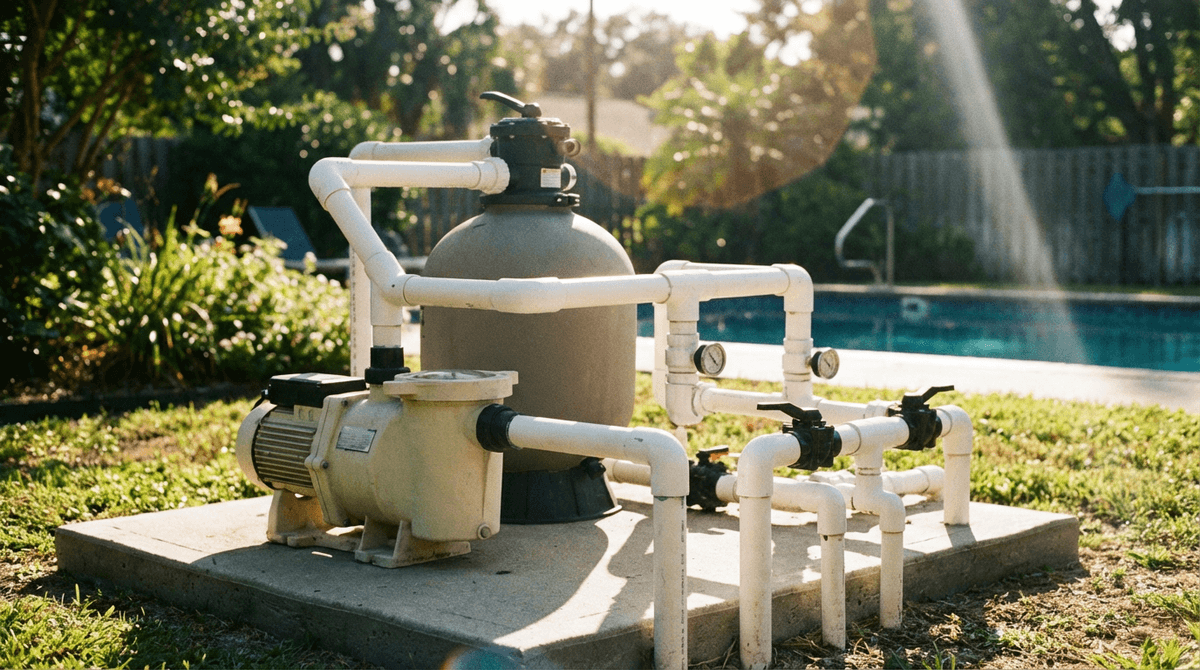
Most residential pool pumps use about 700 to 2,500 running watts, with startup surges often around 1,200 to 4,000 watts depending on motor size and pump type.
For full system planning, use the WattSizing Calculator.
1) Load shape and what changes draw
Pool pump energy use depends on three key factors: motor size (HP), pump speed, and hydraulic load from filters, plumbing, and elevation changes.
Single-speed pumps typically run near full output whenever they are on, while variable-speed models can drop wattage dramatically at lower RPM. Because pump power scales non-linearly with speed, even modest RPM reductions can cut energy use significantly.
If you are comparing household motor loads, see How Many Watts Does a Well Pump Use and How Many Watts Does a Sump Pump Use.
2) Typical watt ranges (label first)
| Pool Pump Type | Typical Running Watts | Typical Starting Watts |
|---|---|---|
| 0.75 HP single-speed | 700 - 1,100 W | 1,200 - 2,000 W |
| 1.0 HP single-speed | 1,000 - 1,600 W | 1,800 - 2,800 W |
| 1.5 HP single-speed | 1,500 - 2,300 W | 2,500 - 3,800 W |
| Variable-speed (low/medium) | 150 - 900 W | 250 - 1,200 W |
| Variable-speed (high) | 900 - 2,500 W | 1,400 - 4,000 W |
3) Session or daily kWh example
Example: A 1.5 HP single-speed pool pump running at 1,900 W for 8 hours uses:
kWh/day = (1,900 x 8) / 1000 = 15.2 kWh/day
At $0.16/kWh, that is about $2.43/day or around $73/month.
For daily-use planning, see How Many Watts Does a Pool Pump Use Per Day and compare with cooling loads in How Many Watts Does a Central Air Conditioner Use.
4) Practical ways to reduce energy impact
- Run a variable-speed pump at lower RPM for longer periods instead of short high-speed cycles.
- Clean skimmer baskets and filters regularly to lower hydraulic resistance.
- Use a timer schedule that aligns with your pool size and local turnover guidance.
- Keep plumbing restrictions low; unnecessary elbows and partially closed valves increase watt draw.
5) Backup sizing context
Use Generator running watts vs starting watts to model overlap with other home loads, not this row in isolation. For small systems, validate Inverter sizing for off-grid solar and waveform trade-offs in Pure sine vs modified sine.
FAQs
Is a variable-speed pool pump worth it for energy savings?
In many homes, yes. Lower-speed operation can reduce power draw substantially compared with single-speed pumps, often paying back the higher upfront cost.
Why is my measured pool pump wattage higher than the label suggests?
Real draw can increase with dirty filters, high backpressure, long plumbing runs, or voltage differences.
Can I run a pool pump from a home battery system?
Yes, but size the inverter and battery for both running watts and motor startup surge, especially for single-speed pumps.
Sources
- U.S. Energy Information Administration (EIA) - Electricity explained
- U.S. Department of Energy - Energy Saver
- ENERGY STAR - Save Energy at Home
CTA
Need a realistic pool equipment load estimate? Use the WattSizing Calculator to size inverter, battery, and solar requirements from your actual pump runtime.


