
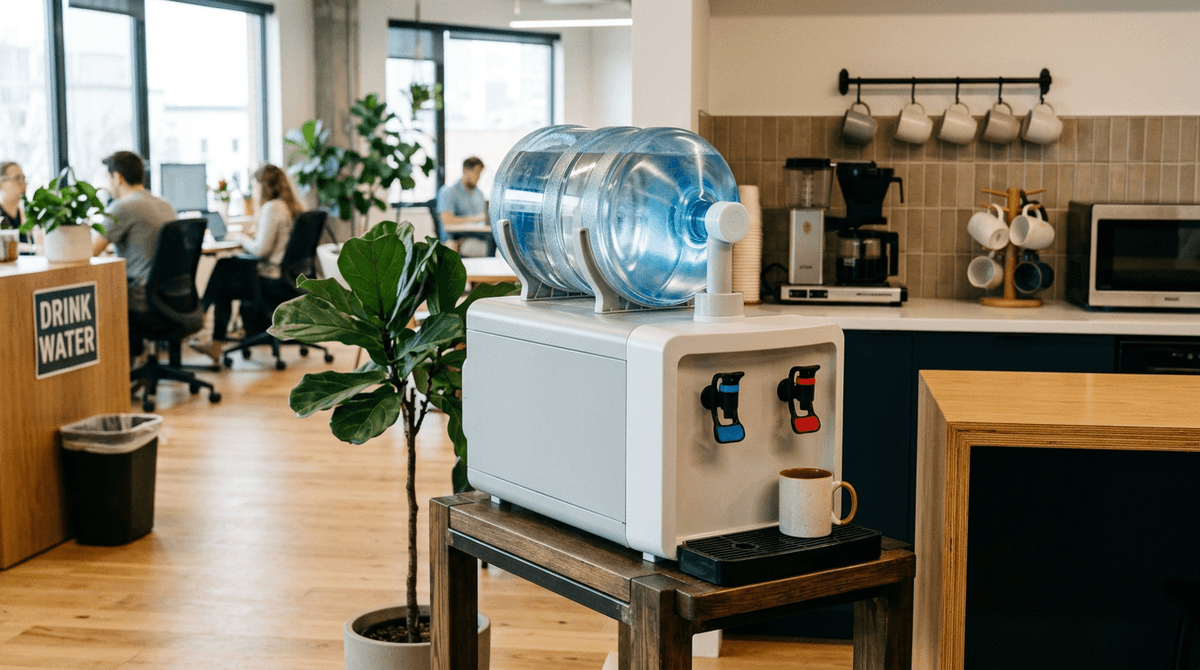
A countertop or floor water dispenser is an always-on thermal load: it heats or cools a small tank and cycles on and off to hold temperature. That is very different from a kettle that runs at full power for a few minutes and then shuts off.
Practical bottom line: how many watts is a water dispenser on the label is often 300 W to 500 W for the heating element alone, but water dispenser power consumption in real life is usually an average over the day—often about 70 W to 200 W for many hot/cold office units, and roughly 0.8 kWh to 4.5 kWh per day depending on type, room temperature, and how much hot water you draw. Compressor-cooled floor models can land higher when the room is warm.
Figures checked against typical nameplate ranges and common cycling behavior as of May 2026. Your plug-in meter beats any table if you need billing or battery math.
This page answers how many watts does a water dispenser use, converts that to water dispenser electricity consumption in kWh, and shows one clear daily cost example. For a full household or off-grid load list, use the WattSizing calculator.
Typical water dispenser power consumption (watts) and kWh per day
The table below uses realistic average watts—what matters for kWh per day—not the brief peak when the heater or compressor is actively on.
| Water dispenser type | Typical average watts (24 h mix) | Plugged in 24/7 → kWh per day (W × 24 ÷ 1000) | Peak when heating/cooling |
|---|---|---|---|
| Room-temperature only (pump/light) | ~5–30 W | ~0.1–0.7 kWh/day | Similar to average |
| Hot-only countertop | ~40–120 W* | ~1.0–2.9 kWh/day | ~300–500 W when heating |
| Thermoelectric hot + cold | ~70–200 W | ~1.7–4.8 kWh/day | ~80–240 W bursts |
| Compressor hot + cold (floor) | ~100–250 W** | ~2.4–6.0 kWh/day | ~150–500 W when cooling |
*Average depends heavily on thermostat, insulation, and how often you draw hot water.
**Warm rooms and frequent cold-water use push averages toward the top of the band.
How many watts does a water dispenser use at any single moment can be much higher than the daily average. Budget kWh with an average from a meter or the bands above; size backup power with peak watts in mind if several loads start together.
What counts as “water dispenser power consumption”
For most searches—water dispenser electricity consumption kwh, office bills, or solar planning—the useful number is energy at the wall over 24 hours, not the sticker’s maximum heating wattage.
- Included: hot tank, cold tank or thermoelectric/compressor cooling, controls, indicator lights, and small pump on bottle-fed units.
- Not the same thing: boiling a kettle once (short spike) vs keeping 10 cups hot all day (many reheat cycles).
- Compare fairly: a refrigerator also cycles; dispensers are smaller but can still be a steady standby load in break rooms and home offices.
Why your meter reads something different than the nameplate
Three effects explain most “my watts seem wrong” cases:
- Thermostat cycling: The heater or compressor is not on 24 hours at full nameplate power. Average watts drive kWh; peaks matter for circuit breakers and small inverters.
- Ambient temperature: A hot room makes cold side work harder; a cold room can increase hot tank losses.
- Usage pattern: Frequent hot-water draws trigger more reheat cycles; idle nights can sit lower in the same unit.
For repeatable water dispenser electricity consumption in kWh, log one full day (or a weekend) with a plug-in energy meter that totals kWh, then divide by days. That beats guessing from a single “600 W” line on the label.
Worked examples: from watts to kWh per day
Use kWh/day ≈ (average watts × 24) ÷ 1000:
- ~90 W average (thermoelectric hot/cold, light office use): 90 × 24 = 2,160 Wh ≈ 2.2 kWh/day
- ~140 W average (busier hot/cold unit): 140 × 24 = 3,360 Wh ≈ 3.4 kWh/day
- ~450 W for 3 h/day only (hot-only, heavy morning use, off otherwise): 450 × 3 = 1,350 Wh ≈ 1.4 kWh/day
Monthly electricity (illustrative): 3.4 kWh/day × 30 days ≈ 102 kWh/month. At $0.16/kWh, that is about $16/month—your rate and real average watts will differ.
Hot vs cold: what most guides skip
- Hot-only units can show high nameplate watts but moderate daily kWh if the tank is well insulated and the thermostat has a wide hysteresis.
- Thermoelectric cooling is usually lower peak watts than a compressor but can run longer cycles in a warm room—daily kWh is not always lower.
- Compressor floor dispensers often cool more effectively; in a hot pantry or garage, they may still win on comfort while using more kWh than a thermoelectric unit in a cool room.
- Child locks and eco modes (when present) reduce accidental hot draws; they do not replace measuring if you are sizing solar or a battery bank.
Practical ways to lower daily kWh
- Turn off hot or cold overnight if the unit has separate switches and you do not need overnight service.
- Place the dispenser out of direct sun and away from refrigerators or ovens that raise ambient air temperature.
- On compressor models, keep rear condenser areas clean per the manual.
- Lower the hot setpoint if your workplace only needs “warm enough for tea,” not near-boiling hold temperature.
Backup power and shared circuits
Water dispensers are usually 120 V and moderate continuous loads, but compressor starts can add a brief surge. If you stack a dispenser with a microwave or coffee maker on the same branch, read generator running watts vs starting watts before assuming a small portable inverter is enough.
Checklist before you trust a watt number
- Read the nameplate (peak heating/cooling watts).
- Measure kWh for at least one typical day at the wall.
- Convert to average watts if needed: average W ≈ (kWh × 1000) ÷ hours.
- Add the result as a line item in the WattSizing calculator with other always-on loads.
Frequently asked questions
How many watts does a water dispenser use?
How many watts is a water dispenser on the sticker is often 300 W to 500 W for the hot side alone, but average water dispenser power consumption over 24 hours is commonly about 70 W to 200 W for many hot/cold units because the heater or cooler cycles off. Measure or use the table above for kWh per day.
What is typical water dispenser electricity consumption in kWh per day?
Many hot/cold dispensers fall near ~1.7 kWh to 4.8 kWh per day if left plugged in 24/7 at typical office averages; hot-only or room-temperature units are often lower. Water dispenser electricity consumption in kWh should come from a meter when possible.
How many watts is a water dispenser when it is “off” but plugged in?
Usually not zero: controls, lights, and occasional thermostat cycles still draw power. Room-temperature-only units are often ~5 W to 30 W average; hot/cold models still sip power between cycles.
Does a compressor water dispenser use more power than thermoelectric?
Peak watts are often higher on compressor models, but daily kWh depends on room temperature and how hard the cold side runs. A compressor in a cool room can beat a thermoelectric unit struggling in heat.
How do I calculate water dispenser power consumption cost?
Cost ≈ kWh/day × days × $/kWh. Example: 3.4 kWh/day × 30 × $0.16 ≈ $16/month. Use your utility rate and measured kWh.
Is a water dispenser cheaper than boiling a kettle?
A kettle wins on kWh per liter if you only heat what you use once. A dispenser wins on convenience and can cost more if it keeps a tank hot 24/7 for a few cups a day.
Can I run a water dispenser on a small inverter or generator?
Often yes for running watts, but verify surge on compressor models and total load with other appliances. See running vs starting watts.
Conclusion
Water dispenser power consumption is best expressed as average watts and kWh per day, not nameplate heating watts alone. Measure one real day, apply the formula, then fold that kWh into your wider plan.
Next step: open the WattSizing calculator, enter your measured or estimated kWh/day for the dispenser alongside refrigeration and other loads, and stress-test monthly cost or battery autonomy before you buy hardware.


