
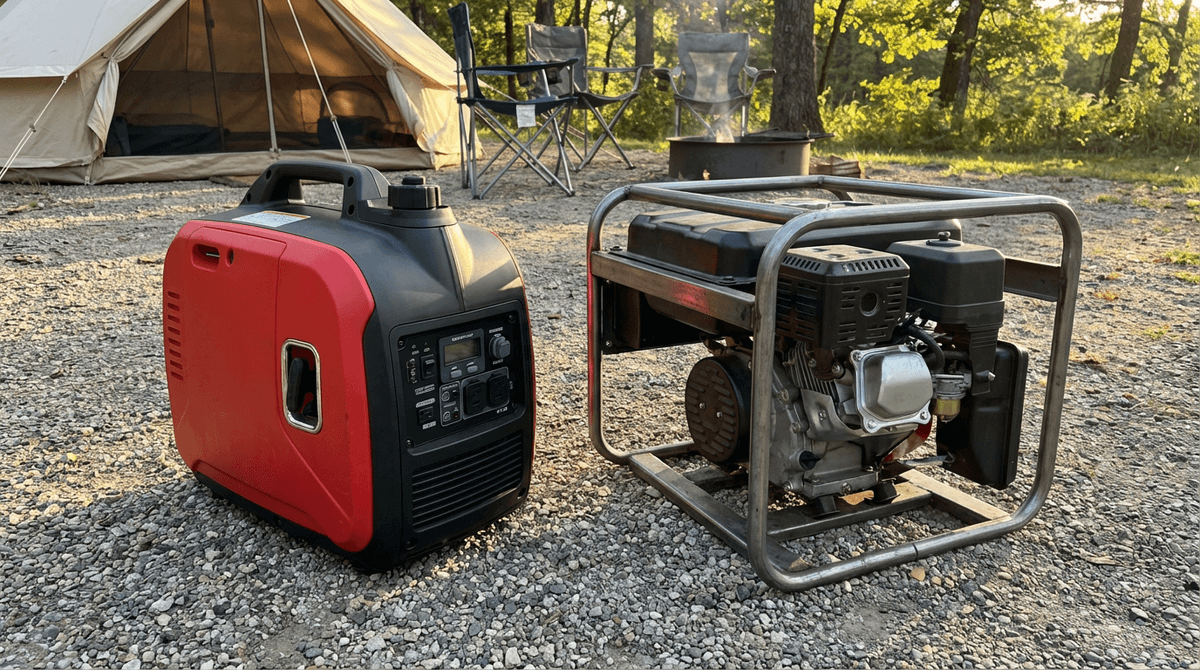
If you run a generator mostly at light or variable loads, fuel efficiency can differ a lot between inverter and conventional models. Inverter units typically throttle engine speed to match demand, while many conventional units run near fixed RPM.
This article compares fuel use in practical terms: liters (or gallons) per hour, runtime, and estimated cost per kWh delivered. For appliance-level backup sizing, use the WattSizing Calculator.
Quick Comparison
| Topic | Inverter Generator | Conventional Generator |
|---|---|---|
| Engine speed behavior | Variable with load | Often fixed speed |
| Part-load fuel efficiency | Usually better | Often lower |
| Best use pattern | Light-to-medium variable loads | Steady higher loads, heavy-duty use cases |
| Noise tendency | Often quieter | Often louder |
| Power quality | Generally cleaner sine output | Model dependent, can be rougher |
Why Fuel Use Differs
Fuel burn depends on engine efficiency, alternator design, and load fraction. Running a large generator lightly loaded is usually inefficient regardless of type, but inverter models often hold an advantage at lower loads due to variable-speed control.
Two key points:
- No generator is very efficient at extremely tiny loads.
- Matching generator size to expected demand often saves more fuel than brand/type alone.
Related:
Fuel Use Table (Illustrative Range)
Assume similar output class and gasoline fuel. Actual values vary by model and maintenance.
| Load Level | Inverter Generator Fuel Use | Conventional Generator Fuel Use | Typical Observation |
|---|---|---|---|
| 25% load | 0.25 - 0.45 gal/hr | 0.35 - 0.65 gal/hr | Inverter often meaningfully better |
| 50% load | 0.40 - 0.70 gal/hr | 0.50 - 0.85 gal/hr | Gap narrows but often remains |
| 75% load | 0.60 - 1.00 gal/hr | 0.70 - 1.10 gal/hr | Differences depend heavily on engine size |
| Near full load | 0.90 - 1.40 gal/hr | 0.95 - 1.50 gal/hr | Performance converges on some models |
Worked Scenarios
Assume fuel price = $3.80/gal.
1) Overnight Essentials (Low-to-Mid Load)
Load profile:
- Average electrical load: 1.2 kW
- Runtime: 10 hours
- Energy delivered: 12 kWh
Fuel assumptions:
- Inverter generator: 0.42 gal/hr -> 4.2 gal
- Conventional generator: 0.58 gal/hr -> 5.8 gal
Fuel cost:
- Inverter: 4.2 x $3.80 = $15.96
- Conventional: 5.8 x $3.80 = $22.04
Difference for this run: $6.08.
2) Heavier Daytime Workload
Load profile:
- Average load: 3.0 kW
- Runtime: 6 hours
- Energy delivered: 18 kWh
Fuel assumptions:
- Inverter: 0.95 gal/hr -> 5.7 gal
- Conventional: 1.05 gal/hr -> 6.3 gal
Cost:
- Inverter: $21.66
- Conventional: $23.94
Difference shrinks at higher load, but inverter may still lead.
Practical Buying and Operating Tips
- Size for your common load window, not just rare startup peaks.
- For light overnight loads, inverters often reduce fuel and noise.
- For constant high loads, compare model-specific fuel curves; generic assumptions can be wrong.
- Keep generators maintained (air filter, spark plug, oil) because poor maintenance can erase efficiency gains.
FAQs
Are inverter generators always more fuel efficient?
Not always at every operating point, but they are often more efficient at partial loads where many households spend most runtime.
Does a larger generator always use more fuel?
At the same output, oversized units often burn more fuel, especially at low load fractions. Proper sizing matters.
Is fuel-per-hour the best metric?
Fuel-per-kWh delivered is usually better for comparisons because it accounts for actual electrical output, not just engine runtime.
Should I choose only based on fuel use?
No. Consider surge handling, runtime tank size, noise, maintenance, purchase cost, and expected use pattern.
CTA
Want to estimate your own backup load and runtime before buying? Use the WattSizing Calculator to map appliances, startup needs, and daily energy demand to a practical generator plan.


