
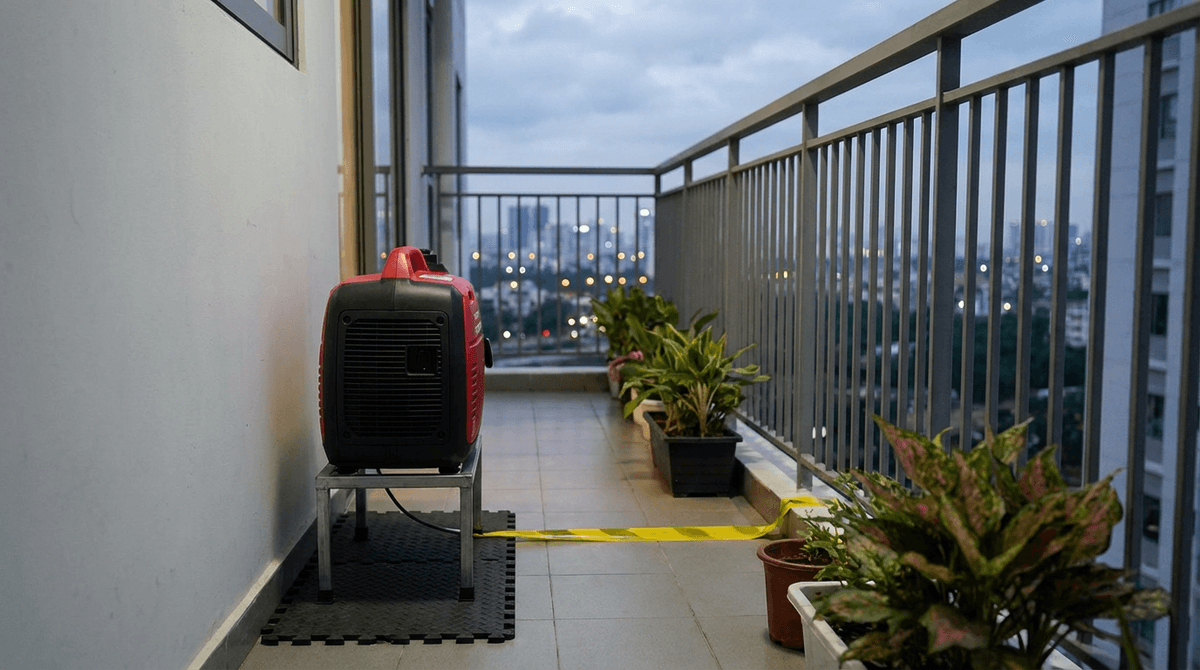
Most apartments cannot treat backup like a detached house: you may have no private yard, strict fuel rules, and noise limits—even when the math says a modest generator would cover essentials. This page sizes watts for common essential stacks and flags non-electrical constraints early.
Use the WattSizing Calculator from your real device list.
Quick Answer
- Communications + lights + charging + careful fridge support: often 2,000–2,500 W class.
- Comfortable essentials + occasional microwave or small heat load: commonly 3,000–4,000 W class.
- Multiple kitchen peaks or larger surge habits: 4,500 W+—or better load discipline.
If your lease or city rules prohibit fuel generators, apply the same watt math to a portable power station or battery + inverter plan.
Apartment constraints that change what “fits”
- Outdoor placement: generators need open-air exhaust clearance—balconies and garages are often unsafe or disallowed.
- Fuel storage: many buildings restrict gasoline/propane quantities indoors.
- Noise: quiet-hour complaints can matter as much as nameplate kW.
Essential load table (illustrative)
| Load | Typical running band | Typical surge / notes |
|---|---|---|
| Refrigerator | 120–250 W | compressor start often ~600–1,200 W |
| Router + modem | 15–40 W | treat as must-run for remote work |
| LED lighting (multi-room) | 40–150 W | low, but always on |
| Laptop + phone charging | 40–150 W | can spike briefly with fast chargers |
| Box/pedestal fan | 40–100 W | motor start modest vs fridge |
| Microwave (small–mid) | 800–1,500 W input | overlaps dominate generator trips |
Generator size bands (rule-of-thumb)
| Goal | When it tends to work |
|---|---|
| 2,000–2,500 W | Essentials + tight discipline; sequence high draws |
| 3,000–4,000 W | Fridge + more comfortable overlap for short microwave use |
| 4,500 W+ | Multiple conveniences or less willingness to stagger loads |
Worked examples (illustrative)
Example A: work-from-home “keep online”
- Router/modem: 30 W
- Two fans: 120 W
- LED: 80 W
- Laptop + phones: 100 W
- Fridge average while cycling: 180 W
Running total ≈ 510 W, but fridge start and small charger spikes push practical generator class upward—2,000–2,500 W is a common minimum class for margin.
Example A + periodic microwave
Add ~1,100 W microwave window (illustrative):
- Overlap planning often lands around 3,000–3,500 W class for less stressful operation.
Safety: the apartment-specific CO problem
- Never run a fuel generator indoors, including balconies with poor dispersion. EPA CO guidance explains why outdoor-only operation matters.
- Use CO alarms in living spaces during outages.
- If you cannot operate safely and legally, pivot to battery-based backup for essentials.
Further reading on alternatives: Solar Panels for Apartments and Balconies and Solar Generator vs DIY Solar Cost.
Related generator pages: What Size Generator for a Laptop, What Size Generator for a Microwave.
FAQs
Can I run a portable generator on an apartment balcony?
Usually no—CO, fire, and lease rules commonly forbid it. Treat balcony operation as exceptional and confirm with building and local rules, not forum posts.
Is 2,000 watts enough for apartment backup?
Often yes for lean essentials if you stagger microwave and accept discipline; not if you expect multiple heat appliances at once.
Should I pick a battery power station instead?
Frequently yes where fume-free, quiet operation is required—reuse the same watt and Wh math for runtime.
How do I handle fridge surge in a small unit?
Sequence: let the fridge stabilize, then run short microwave bursts; avoid starting everything in one minute.
Can I use extension cords through a window?
Only with safe routing—damaged cords, pinch points, and rain create shock and fire risk; follow manufacturer and code guidance.
What if my building bans all generators?
Size essential watts for approved equipment—often battery, UPS, or landlord-provided backup paths.
Sources
- U.S. Department of Energy: Portable Generators
- U.S. Energy Information Administration: Electricity Explained
- Generac: Generator Sizing Guide
CTA
Turn your apartment essentials into one right-sized number: WattSizing Calculator.


