
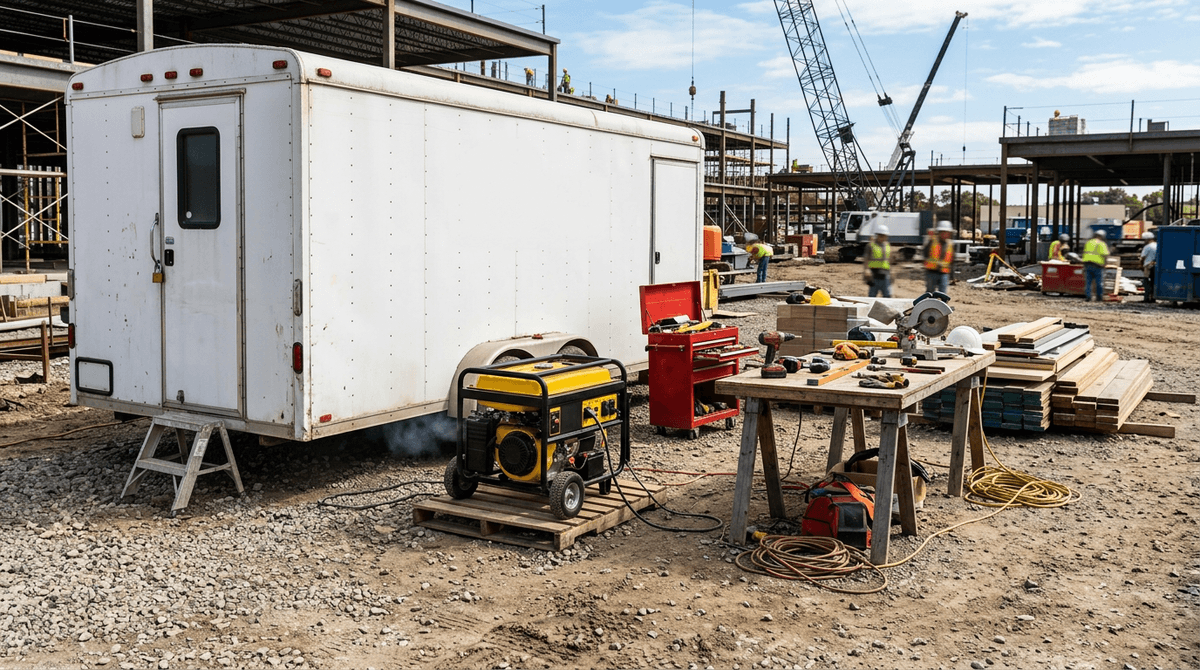
Short answer: A construction site trailer is not one steady load—it is HVAC baseload, charger banks, and break-time spikes (microwave, kettle, coffee) stacked on top of occasional corded tools. Many single-trailer setups land in ~7,000–15,000 W generator class; multi-room offices or shared tool feeds push higher.
Compare component estimates with generator sizing for home office and lay out shift-long patterns in the WattSizing Calculator.
Scope: temporary office trailer power
This page covers portable or towable site trailers fed by 120/240 V single-phase temporary power—typical for field offices, safety meetings, and plan review spaces. Hardwired three-phase construction feeds need an electrician; the stacked-load logic below still applies once you read nameplates.
Site trailer generator class table
Illustrative—confirm with equipment labels, season, and site conditions.
| Trailer scenario | Typical steady band | Typical peak / overlap band | Practical generator class |
|---|---|---|---|
| Small office, mild climate | 1,800–3,500 W | 3,500–6,000 W | 5,000–8,000 W |
| HVAC + daily device charging | 3,000–5,500 W | 5,500–9,000 W | 8,000–12,000 W |
| Multi-room + occasional corded tools | 4,500–8,000 W | 8,000–13,000 W | 10,000–16,000 W |
| Large office + heavier temporary loads | 7,000–12,000 W | 12,000–20,000 W | 15,000–25,000 W |
Season matters: electric heat or AC sets the baseline; size for the worst week, not the idle spring morning.
Corded tool surge table (illustrative)
When tools share the trailer feed—or plug into the same generator—motor inrush adds to office baseload.
| Tool (typical job-site class) | Running W | Start / surge context |
|---|---|---|
| Circular saw (7¼ in.) | 1,200–1,800 W | ~2,000–3,500 W brief |
| Miter saw | 1,400–1,800 W | ~2,500–4,000 W brief |
| Shop vac | 1,000–1,600 W | ~1,800–3,000 W brief |
| Small air compressor | 1,500–2,200 W | Large start—often dominates |
Motor surge theory: running vs starting watts. Best practice: isolate field tools on a separate circuit or second generator when possible.
Worked example: busy lunch window (illustrative)
Baseline "everything on" running load:
| Load | Running W |
|---|---|
| Office electronics + LED lighting | 1,000 |
| Comms rack / router | 120 |
| Mini-split HVAC | 1,400 |
| Device charging station (6 ports) | 1,000 |
| Microwave | 1,200 |
| Running subtotal | ~4,720 W |
Start-heavy overlap (HVAC compressor start while baseload remains):
- HVAC start (illustrative): ~2,800 W peak contribution
- Other loads still on: 1,000 + 120 + 1,000 + 1,200 = 3,320 W
- Peak stack (illustrative): ~6,120 W
Add ~20% margin for voltage drop and measurement error: 6,120 × 1.2 = **~7,344 W**.
Direction: about 8–9 kW minimum class for this profile—higher if a circular saw or compressor shares the same generator without strict staging.
NEC duty and 120/240 V feeds
When an electrician wires a temporary panel, NEC distinguishes continuous loads (HVAC, chargers—often 100–125% of nameplate) from non-continuous loads (microwave, tools—higher diversity if staggered). Largest motor rules can add headroom beyond a simple watt sum.
Most site trailers use 120/240 V single-phase: 240 V for HVAC or heat strips; 120 V for outlets, chargers, and lighting. A generator 240 V twist-lock feeds the panel; legs split inside. Verify grounding, neutral bonding, and main breaker rating before energizing (U.S. DOE – Portable Generators).
Do not treat a 7 kW running subtotal as proof a 7 kW generator suffices if HVAC start + microwave align.
What most guides skip
- Break-time overlap is real: HVAC + microwave + chargers happens daily, not as a theoretical peak.
- Long cord runs: temporary feeds over 100 ft on undersized cord cause voltage drop that trips HVAC controls or dims lights under load.
- Charger creep: six 200 W chargers is 1.2 kW continuous—easy to miss in a one-line spreadsheet.
- Tool + office on one gen: saves rental cost until one saw start drops the mini-split—separate feeds often pay for themselves in uptime.
Safety: jobsite power habits
- Keep generators outside with exhaust clear of doors, windows, and intake vents (EPA CO guidance).
- Refuel only per manufacturer cool-engine rules; control spills near dust and ignition sources.
- GFCI protection on temporary 120 V outlets where required and where cords run in wet conditions.
- Separation: where feasible, isolate field tools from office electronics to reduce nuisance trips.
Checklist before rental or purchase
- List seasonal HVAC—size for hottest and coldest expected week on site.
- Count chargers and comms gear as continuous kW, not "small stuff."
- Map break window—microwave + kettle + HVAC overlap is your sizing anchor.
- Decide tool policy—same generator or dedicated tool feed.
- Measure cord length and gauge—voltage drop affects HVAC reliability.
- Confirm 120/240 V panel rating matches generator twist-lock output.
- Dry-run lunch-window load once before critical deadlines.
FAQs
Can one generator power both the trailer and corded tools?
Sometimes, but shared feeds need higher kW and strict load management—or separate circuits/generators for clarity and fewer nuisance trips.
Should I size for the coldest and hottest weeks on site?
Yes if HVAC is electric—seasonal peaks change the real story more than mild-week idle load.
Do battery chargers matter for generator sizing?
Yes—multiple chargers add continuous kW that is easy to miss. Six fast chargers can exceed one microwave in steady draw.
Is three-phase required for a site trailer?
Many trailers use 120/240 V single-phase; verify panel and HVAC nameplates before purchase. Three-phase is common on larger construction temp power, not every office trailer.
How does NEC "continuous load" affect my generator pick?
Continuous loads (HVAC, chargers) must be fully covered in planning; non-continuous loads get diversity in permitted wiring—but overlap still drives generator surge needs.
What about noise limits near residential areas?
Noise rules can force inverter generators, distance, or enclosures—plan placement early to avoid rework or curfew shutdowns.
Sources
CTA
Stress-test your break window, seasonal HVAC, and tool overlap in the WattSizing Calculator.


