
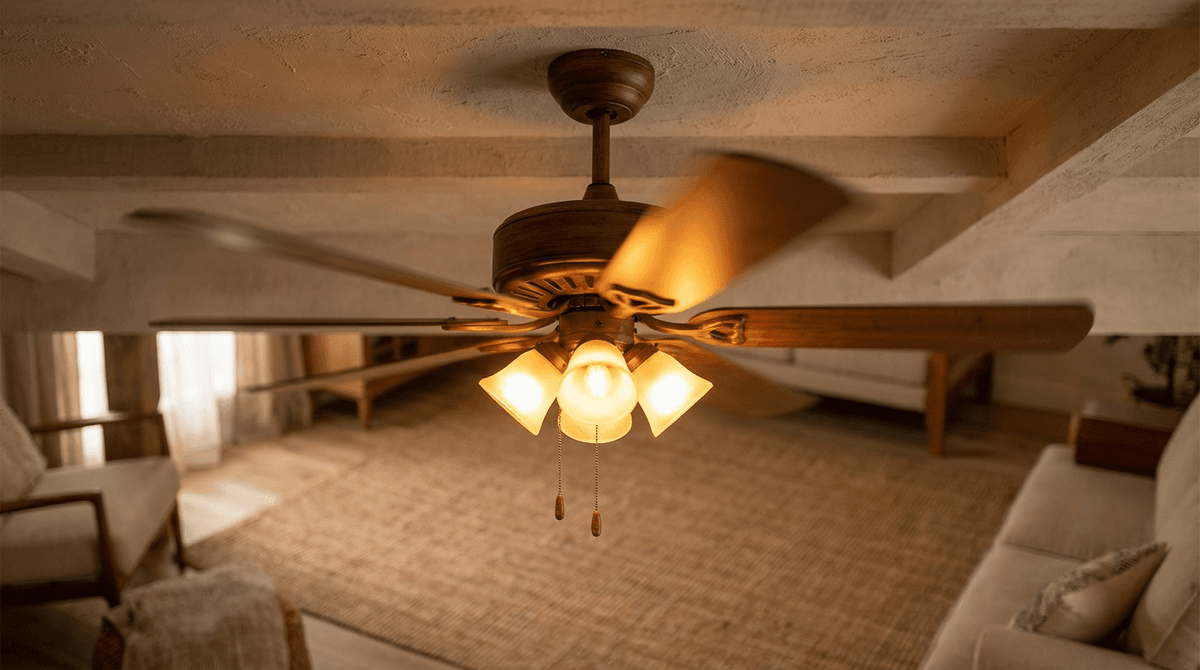
A ceiling fan draws about 2 to 95 watts at the cord for the motor alone—far less than a compressor AC—plus whatever the light kit adds. AC induction motors land higher in the band; EC ("DC") designs sold for 120 V homes often run lower with finer speed steps. Comfort comes from airflow over skin, not removing heat, so the bill depends on motor type, speed habit, and whether old incandescent lamps still glow in the fixture.
Practical bottom line: typical AC-motor fans run 15 to 95 W from low to high; DC/EC models often sit 2 to 35 W at comparable speeds. Four legacy 60 W bulbs add ~240 W on top of the motor—size backup and kWh for fixture plus fan together. Measure yours or stack room loads in the WattSizing Calculator before treating a ceiling fan as negligible on an inverter list.
AC-motor ceiling fans: speed and wattage
Nameplate and a meter beat memory. Typical 120 V AC induction ranges:
| Speed (typical AC fan) | Running W (ballpark) |
|---|---|
| Low | 15 – 30 W |
| Medium | 30 – 55 W |
| High | 50 – 95 W |
Older, larger, or out-of-balance units can land high in the band. Use a fan-rated wall control—not a random LED dimmer—for most AC-motor models.
DC and EC motor fans: lower watts, more steps
Most "DC ceiling fans" wired to North American 120 V still take AC at the canopy; the drive rectifies and controls current inside. The win is efficiency and finer speed steps, not a native 12 V battery install unless the product was designed for that.
| Speed (typical DC/EC fan) | Running W (ballpark) |
|---|---|
| Low | 2 – 8 W |
| Medium | 8 – 18 W |
| High | 15 – 35 W |
Smart or Wi-Fi models may add 1 to 3 W standby on top of motor watts—a small but real line in a tight off-grid Wh budget.
Light kits: where watts can dwarf the motor
Motor-only tables ignore lamps. Four old 60 W incandescents are ~240 W total; four 8 to 10 W LED bulbs are ~30 to 40 W. Size monthly kWh and backup for fixture plus fan together, especially if lights stay on hours longer than the motor.
What most guides skip
A 72-inch fan is not automatically higher watt than a 44-inch. Large DC/EC blades can move air slowly at very low W; a small cheap AC fan on high can still beat it in watts. Read the label on the speeds you use.
Ceiling fans do not replace AC—they change setpoint comfort. Running a fan in an empty room wastes kWh with no felt benefit, same as a box fan left on downstairs. Pair fan use with a slightly higher thermostat in summer when you actually occupy the room.
Buzz on inverter backup is often waveform, not mystery. Modified sine can make AC induction motors noisy; EC drives behave differently but mixed loads still favor pure sine. Test on grid first, then the inverter, then check blade balance if the sound is mechanical.
Wrong dimmers overheat drives. A light dimmer misapplied to a motor load is a common nuisance-trip and overheating path—not a watt-range problem but a safety one. Use controls rated for fan motors.
Winter reverse mode is a low-speed habit. Many fans offer reverse for destratification; follow the manufacturer for blade direction. Low-speed W is modest, but 24/7 "fan on" at the thermostat still adds blower load elsewhere in the HVAC story—see central AC wattage for the compressor side.
Worked example: overnight kWh with motor and lights
Use kWh = watts × hours ÷ 1,000 per session.
Example A — DC/EC motor only: 15 W on medium for 8 hours:
15 × 8 ÷ 1,000 = 0.12 kWh
Example B — AC motor plus four incandescents: 75 W motor on high plus 240 W lights for 4 hours:
(75 + 240) × 4 ÷ 1,000 = 1.26 kWh
At $0.16/kWh, Example A costs about $0.02 per night; Example B about $0.20—the lamps dominated. For dollar math, see electricity bill from kWh.
A legacy AC fan on high 12 hours daily for a month at 75 W alone reaches 27 kWh—enough to notice even without lights.
Off-grid inverters and generator overlap
A few hundred watts of continuous inverter capacity can cover one or several ceiling fans if the rest of the load list fits. Motor inrush is tiny next to a refrigerator compressor start—see running vs starting watts for what actually sizes portables.
Generator headroom is set by clothes dryer, portable AC, or whole-house cooling—not a bank of fans. Add fan plus light W honestly anyway. Operate portables outdoors with listed transfer; the U.S. DOE portable generators page covers safety basics.
Read inverter low-voltage cutoff when the same AC bus mixes fan motors with laptop chargers or a router.
Checklist: measure your ceiling fan before backup planning
- Read the nameplate on the motor housing for 120 V watts if listed.
- Meter low, medium, and high at the wall for the speeds you use in sleep hours.
- Add light kit watts separately—count bulbs, not fixture style.
- Confirm you use a fan-rated control, not a light dimmer, for AC motors.
- Add rows in the WattSizing Calculator with other bedroom and whole-house loads.
FAQs
How many watts does a ceiling fan use?
AC-motor fans typically draw 15 to 95 W from low to high. DC/EC models often sit 2 to 35 W at comparable speeds. Add light kit watts on top for honest totals.
Do 72-inch windmill fans always use more watts than a 44-inch fan?
Not necessarily. Large DC/EC blades can move air slowly at very low W; a small AC fan on high can still beat it. Use the label or a meter on the speeds you run.
Is the light kit or the motor bigger on kWh?
It depends. Four old incandescents can dwarf a 60 W motor; four efficient LED bulbs usually do not.
How many kWh is 75 W on high for 12 hours daily for a month?
75 × 12 × 30 ÷ 1,000 = 27 kWh per month. Your utility rate turns that into dollars—see electricity bill from kWh.
Why does my ceiling fan buzz on inverter backup?
Often waveform—modified sine on AC induction motors—or a failing capacitor or blade wobble. Test on grid first, then the inverter, then balance blades if mechanical.
Do smart Wi-Fi ceiling fans add meaningful watts?
A small always-on radio (1 to 3 W class) plus the motor—not a second kettle, but not zero in a tight Wh budget.
Should I size a generator around ceiling fan surge?
Almost never—fridge, pump, and AC loads eat headroom. Add running fan plus light watts to totals honestly; skip fictional surge multipliers for fans.
Next step: Enter motor watts, light kit load, and concurrent room circuits in the WattSizing Calculator when sizing backup for sleep comfort or whole-house outage plans.


