
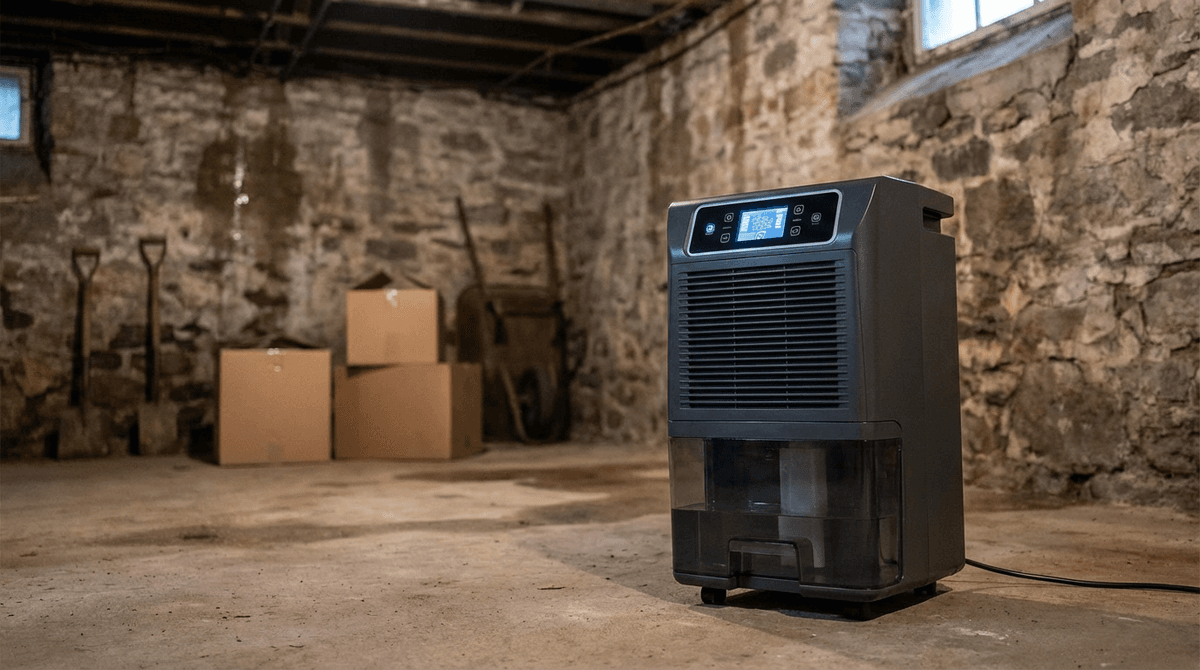
A compressor dehumidifier on 120 V draws about 250 to 750 watts while the compressor runs, with a brief 900 to 2,200+ watt start when the refrigeration loop leaves a dead stop. Pint-per-day class sets the ballpark; humidity setpoint, room temperature, and duty cycle set the season kWh bill line.
Practical bottom line: a 35–50 pint basement unit might run near 350 to 550 W yet need 1.2 to 1.7 kW of surge headroom for backup sizing. Damp-season kWh adds up when the compressor runs many hours a day—50% RH is a common comfort target; chasing 35% all summer buys extra kWh for little gain. Stack yours beside sump pump and refrigerator loads in the WattSizing Calculator if storm backup matters.
Running watts by pint class
DOE test and label rules changed around 2019—energy.gov on dehumidifiers explains the pints number. The same physical machine can read "50-pint" today where it once said "70-pint"; use the sticker W, not the year you bought it.
| Modern label class (pints/day) | Typical run W | Surge to respect (brief) |
|---|---|---|
| ~20–30 | ~250–450 | ~0.9–1.4 kW |
| ~35–40 | ~350–550 | ~1.2–1.7 kW |
| ~50+ | ~450–750 | ~1.5–2.2+ kW |
Internal pump kits, low-temperature modes, or dirty filters can move run W and cycle time. A humidifier adds moisture—it is a different electrical story entirely.
Compressor start vs steady running watts
Compressors present a start current that can exceed steady W for a short window—enough to trip a tight portable power station or a margin-starved generator. Size for concurrent peaks if a dehumidifier and clothes dryer could both demand in the same second of a storm.
Unlike a resistive space heater, the dehumidifier is a motor load with inrush. See running vs starting watts for the frame—same physics family as a small portable AC or window AC, usually at lower total W than central AC.
Duty cycle, setpoint, and seasonal kWh
Running W times hours the compressor is actually on sets the bill—not the nameplate alone.
50% relative humidity is a common target band for mold comfort. Lower setpoints lengthen run time. A gravity or pump drain so the unit does not stop on a full bucket saves humidity spikes and off-time gaps you would rather not have—it does not necessarily lower W at the cord, but it keeps the machine working.
Clean the air filter on the schedule the manual suggests—restriction raises fan W and can ice coils in borderline conditions. Give the unit clearance on all sides; a stuffy corner lengthens run time.
What most guides skip
"600 W running" is not the whole backup story. A marketing label for average W does not tell you whether a 1,000 W power station survives compressor inrush. Measure start W or read inverter surge specs with margin.
DOE pint labels changed—old shopping ads lie. A new "50-pint" cabinet may match your old "70-pint" physically; the sticker W and pints on the unit you own are what matter for kWh.
Warm exhaust is normal, not a broken AC. Heat removed at the evaporator is rejected at the condenser in the same airstream. That is how compressor dehumidifiers work.
Desiccant vs compressor is two different kWh shapes. Desiccant units use a rotor and small regeneration heat section instead of a big compressor. Surge and run W are not the same as a pint-class compressor cabinet—read the nameplate; "no surge" is a sales claim, not physics you should bank a gen size on.
Cold basements ice compressor models. Near-freezing or garage-like spaces may need a low-temp mode or a desiccant design—compressor duty cycle and kWh change sharply when coils ice.
Worked example: damp-season kWh
Use kWh = (watts × hours) ÷ 1,000 when average on-watts holds.
Example: a 40-pint compressor dehumidifier averages 550 W while the compressor is energized, and runs mixed on/off roughly 12 hours in a humid July day:
550 × 12 ÷ 1,000 = 6.6 kWh that day if the average holds
Real days cycle—measured kWh from a plug meter or utility trend beats one W and a guess at duty cycle. At $0.16/kWh, 6.6 kWh costs about $1.06/day—meaningful on a summer bill, still modest next to season totals. See electricity bill from kWh for the general formula.
For a lighter day: 450 W average with 6 hours effective on-time → 450 × 6 ÷ 1,000 = 2.7 kWh.
Basement backup stacking
Storm outages often want dehumidifier + sump pump + fridge + router on the same portable:
- Add surge W for each motor load the way running vs starting watts describes—worst-case overlap is a real design case.
- Do not share a cheap power strip with a dehumidifier and a high-W resistive neighbor like an electric kettle—stagger or use separate branches.
- U.S. DOE portable generators: outdoors, listed transfer, no backfeed.
In a long outage, food safety (chest freezer), flood risk (sump), and mold control (dehumidifier) are judgment calls—not a single W number. Size for what you will actually run concurrently.
Checklist: measure your dehumidifier before backup planning
- Read the nameplate for 120 V input watts and modern pints/day label.
- Plug-meter one humid week for total kWh—not just a one-hour sample.
- Log highest W during compressor start—that is surge planning data.
- Confirm drain path (bucket vs gravity vs pump) so duty cycle is not interrupted.
- Clean filter and coils per manual—restriction changes run time.
- List concurrent basement loads (sump, freezer, router) on the same backup source.
- Add rows in the WattSizing Calculator with honest run and start watts.
FAQs
How many watts does a dehumidifier use?
Compressor 120 V units typically draw ~250 to 750 W while running, depending on pint class. Brief start surges often reach ~0.9 to 2.2+ kW. Desiccant models follow different nameplate bands—read the sticker.
Why does my dehumidifier blow warm air out the top?
Normal for a compressor unit: heat removed at the evaporator is rejected at the condenser in the same airstream. It is not broken AC behavior.
How many kWh is 600 W for 12 hours of compressor on-time?
600 × 12 ÷ 1,000 = 7.2 kWh. Real days cycle; measured kWh or a utility trend beats one W and a guess at duty cycle.
Can a 1,000 W power station run a 600 W dehumidifier?
Only if the inverter's continuous and surge ratings—with your measured start—clear the load with margin. Battery sag under inrush on the DC side trips units that look big enough on average W alone.
Why does my new 50-pint dehumidifier look like my old 70-pint unit?
DOE test and label rules changed; the W and pints on the new sticker are what matter for kWh, not the print ad from five years ago.
Can I share a power strip with a dehumidifier and a space heater?
Stagger or use separate branches. A compressor plus high-W resistive load on a cheap strip is how nuisance trips happen.
In a long outage, do I run the dehumidifier or the chest freezer first?
Size for what you can start in the same moment—food safety, flood risk, and mold control are judgment calls. See running vs starting watts when adding motor loads sequentially.
Are whole-home dehumidifiers a different W class?
Often yes—higher continuous W, ducted or larger blowers, and system-level install. Model blower plus compressor W together like any central HVAC add-on.
Next step: Log your dehumidifier's running watts, measured surge, and typical humid-season kWh—plus any sump or fridge on the same backup path—in the WattSizing Calculator.


